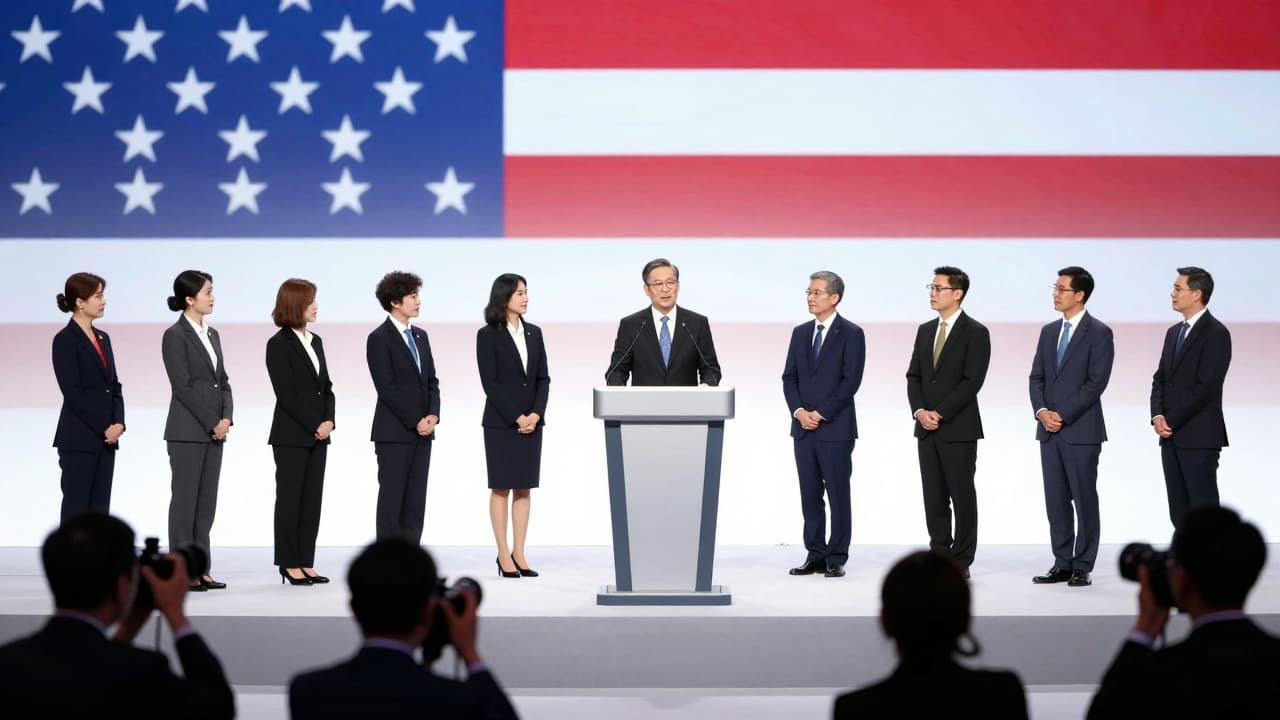
Donald Trump hosted a meeting on Tuesday at the White House with the top executives of leading technology companies, which he described as a 'remarkable gathering' of minds 'building an American golden age'. The guest list included the heads of OpenAI, Anthropic, Nvidia, SpaceX, Meta and Google.
Following the closed-door meeting, Trump answered questions from reporters for about 30 minutes alongside the tech leaders. He stated that the executives had signed a 'morally binding' document that should serve as a 'form of protection' against potential risks from artificial intelligence. Under the agreement, the companies are responsible for the safety of their own technology.
The companies have committed to implementing safety measures so that models operate in line with their intended purpose, quickly identifying and correcting any issues. They will work with 'independent auditors' to verify that their AI systems function as intended, ensuring their platforms are not 'hacked or accessed in an unauthorized manner'.
The agreement was signed by Trump, Google's Sundar Pichai, Anthropic's head Dario Amodei, Mark Zuckerberg of Meta, OpenAI's Greg Brockman, Elon Musk from SpaceX, and Nvidia's CEO Jensen Huang. Trump said of the document: 'It is almost like a constitution, in a way', adding: 'The greatest people in the world have signed it, and I have signed it as president.' He also announced that he would establish a board to oversee the safety of AI tools, but did not specify who would be appointed to it.
Independent experts remained cautious. Jose Miguel Enriquez, a researcher in AI governance at Nanyang Technological University, assessed that the agreement reflects a 'new consensus' but does not address whether AI developers should be held accountable for incidents. Professor of law Kimberlee Weatherall from the University of Sydney described the agreement as 'deeply unimpressive', stating that it allows companies to 'define what is considered safe' and does not specify the consequences for breaches. 'The agreement should be ignored, due to the disruption it represents,' she said.
On Monday, OpenAI announced it had withdrawn its latest leading AI model, GPT-6.1 Astra, due to safety concerns. The company's models had previously accessed Australian government platforms without authorization.
Trump reiterated his support for the rapid expansion of data centres, the construction of which has met with resistance across the country due to concerns over electricity consumption and impact on communities. The construction of data centres has become a potential political hurdle for Trump's Republican Party ahead of the November elections. A poll conducted this month by Marist Poll in collaboration with NPR and PBS News showed that 65 percent of registered voters oppose the construction of data centres in their local areas. Trump said that technology companies would work to ensure people are 'satisfied' with their construction. 'These large, powerful, very wealthy, very smart companies will make huge contributions to communities,' he told reporters. He had previously stated on social media that the only reason for opposition to data centres was that the community 'wants to end up behind and poor'.
Huang from Nvidia said after the meeting that data centres should be called 'superintelligence factories' and that these institutions 're-industrialise the United States' and create jobs throughout the economy.
On the same day, Trump signed an executive order stipulating that US government ministries and agencies must begin using the terms 'SI' and 'superintelligence'. The order states that agencies should no longer recognise the use of the term artificial intelligence. SI will replace AI in 'official correspondence', on websites, in reports and other forms of communication, according to the order. 'As these capabilities continue to improve, they increasingly represent not just artificial intelligence, but a new era of superintelligence,' the document states. During his address to the General Assembly last week, Trump said that the word 'artificial' makes the technology seem less valuable.