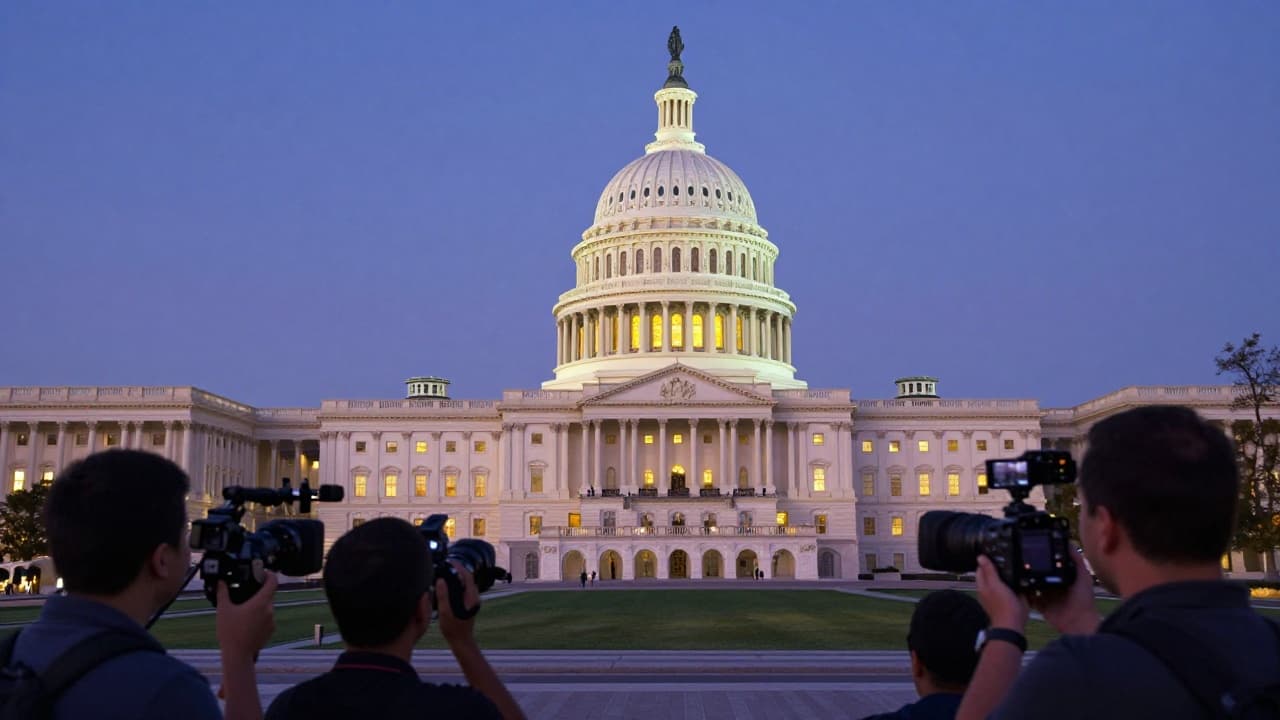
Millions of Americans went to the polls in midterms that could shift the balance of power in Washington. The outcome will determine which party – President Donald Trump’s Republicans or the opposition Democrats – controls Congress.
The US Congress consists of two chambers – the lower House of Representatives and the upper Senate. For a majority in the House of Representatives, a party must win 218 seats, while an absolute majority in the Senate requires 51 seats. If the balance of power in the upper chamber is 50 to 50, the Vice President of the United States has the deciding vote, giving their party control of the Senate. After polling stations close, it may take several hours, days or even weeks before election result projections are known.
Former Republican Senator Rick Santorum, in an interview with Hrvoje Krešić ahead of the US midterms, warned of the possibility of a heavy defeat for Republicans, which could cause serious divisions within the party. According to polls, Democrats should win 241 seats in Congress and 52 in the Senate, meaning Republicans are losing powerful tools.
Professors Đana Luša and Nikolina Borčić analysed the messages of the US midterms, the possibilities of curbing Trump’s power, and the consequences of the election for Europe and world politics in a special N1 broadcast. Borčić described the difference between Trump’s campaign and the Democrats’ messages as personal attacks and the creation of an image of a dangerous opponent versus concrete issues of the standard of living. She stated that Trump primarily offered himself, that everything revolved around him and dangerous Democrats, while the Democrats offered an affordable America as the key campaign theme. Luša warned that the consequences of foreign policy directly affect the daily lives of American voters. She stated that a war in Iran could cost the Republicans these elections because geopolitics has moved into American wallets, which is evident in the cost of living, fuel prices and the fact that the economy is the top issue. The guests also spoke about young voters’ dissatisfaction, the role of algorithms in spreading extreme messages, and how a change in the balance of power in Congress could make Trump’s governance more difficult in the remaining two years of his term.
Marijana Grbeša, a professor at the Faculty of Political Science in Zagreb, reported for N1 from London. During the presidential elections two years ago, she was in the US and spent a long time with "MAGA voters". She stated that enthusiasm has dropped compared to two years ago because their living conditions are harder and that for a large part of the electorate, expectations have not been met. She added that they will vote for Republicans in the elections, if they turn out. Grbeša stated that some who had publicly supported Donald Trump are distancing themselves from him. She described Trump as a specific person who does the opposite of what his advisers tell him, that he deals with trivial matters rather than what troubles voters, and that his finish to this campaign illustrates that he is like a projectile that cannot be steered. She stated that it is very difficult to say who is with Trump and who is not, and that many have left him. She claims that for Trump, the most important thing now is that he has lost a good part of his voters, and that only Harry Truman and George Bush in their second term had such a low rating. Grbeša stated that America has changed a lot from the nineties to today, especially in terms of social policies, and that people are more aware that their education and health systems are not the best in the world. Republicans therefore tried to shift the topic from the economy to worldview issues, but Americans always look at the economy, so they will do so now, she said. She added that socialism is no longer the bogeyman it used to be and that a whole series of research today shows that Americans have much less aversion to socialism, but a large number of them still do not know what the word means. People want affordable healthcare, education or housing, Grbeša stated, and that it is important to people now that some things become better and that they can live normally. This is new and Trump slipped on this topic, she asserted. She added that Trump’s rating would not be so low if he had not started a war in Iran, which led to economic problems.
The relationship between Donald Trump and the American media is marked by open conflicts, accusations and public attacks on journalists, whom the president has called "enemies of the people". Nina Kljenak, who reports for N1 from the United States of America, spoke with Clayton Weimers, executive director of the US branch of Reporters Without Borders. Weimers spoke about the state of media freedom in the US, the consequences of the Trump administration’s attitude towards journalists, and the resilience of American democracy.
Even hundreds of kilometres above Earth, American citizens vote in the Congressional elections. American astronauts voted in space.