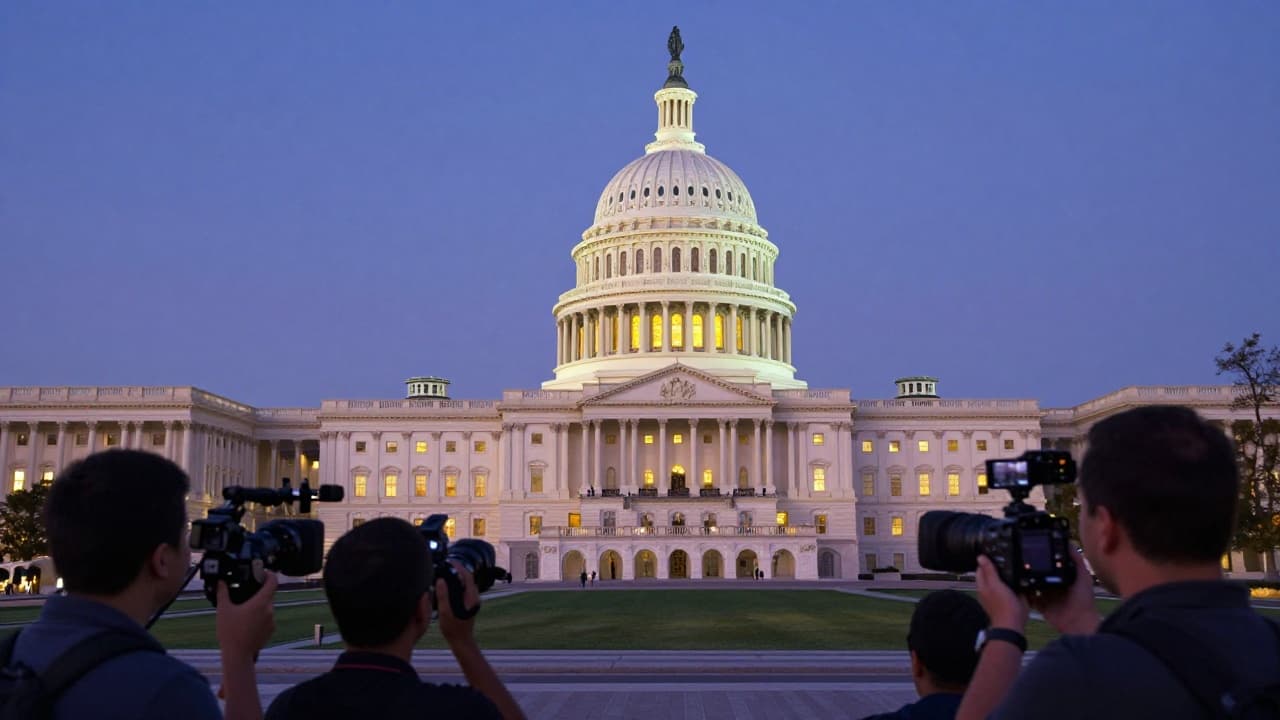

Democrats have secured a string of victories in competitive districts in the race for the United States House of Representatives and are expected to take control of the chamber. Republicans currently hold 218 seats, while Democrats have 214 seats, with one seat vacant in each camp. One Republican representative changed party affiliation and became an independent. Democrats need to win just three seats for a majority, which they are expected to achieve without major difficulty.
The expected Democratic victory comes after two turbulent years of Donald Trump's second presidential term. Republicans face significant problems this year as Trump's approval rating has fallen to record lows. The war in Iran remains deeply unpopular, and fuel prices continue to be exceptionally high. It is customary for the president's party to perform poorly in mid-term elections, which are held at the midpoint of a four-year presidential term.
A change in control of the House would give Democrats a basis for strong oversight of the administration in the final two years of the term. They would gain control of the chamber's committees and the ability to issue subpoenas for documents and witnesses as part of investigations. Democrats have announced they will investigate Trump's family business, the enforcement of immigration regulations, issues related to Jeffrey Epstein, and the handling of vaccination procedures and recommendations by Robert F. Kennedy Jr.
If Democrats take the House, Hakeem Jeffries is expected to become the speaker of the House. Jeffries is a Democrat from Brooklyn, first elected in 2012, and is 56 years old. His election would make him the first Black speaker of the House in United States history.
Democrats are expected to approach control of the chamber despite an unusual and aggressive effort by Republicans to redraw congressional districts in their favour before the election. At Trump's request, Republicans in Texas, Florida, Missouri and other Republican-led states redrew districts to add as many GOP-leaning districts as possible. After the Supreme Court issued a ruling that significantly weakened a key provision of the Voting Rights Act, legislators in Alabama, North Carolina and Tennessee redrew their maps to remove districts where Black voters could elect a candidate of their choice.
The political environment is so unfavourable for Republicans that Democrats may win in redistricted districts in Alabama and North Carolina, and some GOP-leaning districts added in Texas also appear winnable for Democrats. Overall, Republicans may only win a handful of the districts they redrew in their favour.
The first polling places closed in Indiana and Kentucky at 18:00 Eastern Time, with most other states following roughly every hour after that. Particular attention was paid to the outcome in Kentucky's 6th district, where Democrat Zach Dembo, a Navy veteran and former prosecutor, defeated Republican Dr Ralph Alvarado in a race for an open seat. Trump endorsed Alvarado, and the Cook Political Report rated the race as a toss-up despite the district's Republican lean.
In Florida, polling places closed at 19:00 Eastern Time, and the state had several competitive House races, even in districts that state Republicans had recently redrew in their favour. Democrat Kathy Castor won in the district that includes Tampa, which was redistricted to be more Republican-leaning; had that district existed in 2024, Trump would have won it by 11 points. The Cook Political Report rated the race as one of the most competitive in this cycle. Democrat Jared Moskowitz won in a highly competitive race in Florida's 25th congressional district, which Republicans had redrew in their favour, while Democrat Pia Dandiya won in the newly created 22nd congressional district, which was heavily Republican-leaning. Democrats thus won in three of the four Florida districts that Republicans redrew in their favour earlier this year, and are narrowly leading in the fourth.
Florida Governor Ron DeSantis and Republicans who control the state legislature redrew the state's congressional map earlier this year to create four new districts – the 9th, 14th, 22nd and 25th – that lean Republican. Had those districts existed in 2024, Donald Trump would have won all but one by a double-digit margin, and the last by about nine points. On Tuesday, Democrats won three of those seats: Kathy Castor, Pia Dandiya and Jared Moskowitz are expected to win in the 14th, 22nd and 25th districts, while Darren Soto leads in the 9th district.
In North Carolina, Democrat Jamie Ager won in the 11th congressional district in the western part of the state, flipping it to the Democrats. The district is currently represented by Republican Chuck Edwards, who withdrew from the race for re-election after an ethics committee report found that he had sexually harassed staff members. In New Jersey, Democrat Rebecca Bennett defeated Republican representative Tom Kean Jr. Kean disappeared from public view for three months earlier this year without any initial explanation, later saying he had suffered from depression.
Republican pressure in Florida was part of a national effort by Trump and allies to redraw districts across the country. Among those who redrew districts in their favour were Republicans in Texas, Florida, Alabama, Missouri, Tennessee and North Carolina. In addition to the Florida districts, some new congressional districts in Texas and North Carolina also appeared winnable for Democrats.
Nicholas Stephanopoulos, a professor of election law at Harvard, warned that no wrong conclusions should be drawn from Democratic victories in gerrymandered districts. He wrote on the network X that gerrymandering is not delivering the results the GOP expected, but added that in a neutral environment Republicans would win about nine seats net, and that their new maps, even in this environment, will work better than the old ones.
Trump easily won in Florida in 2024 and four years earlier, and Governor Ron DeSantis won in the state by nearly 20 points. Barack Obama won Florida twice. Incumbent Senator Ashley Moody defeated Democratic challenger Angie Nixon by a narrow margin, while Republican Byron Donalds narrowly won the gubernatorial race, which few observers initially believed would be close.
Democrats are one step away from taking control of the United States House of Representatives after two turbulent years of Donald Trump's second presidential term. They need to win just three seats for a majority, which is expected to be achieved without major difficulty. In the Senate, Republicans are defending their majority against emboldened Democrats, who believe voter dissatisfaction with Trump's presidency gives them an advantage.