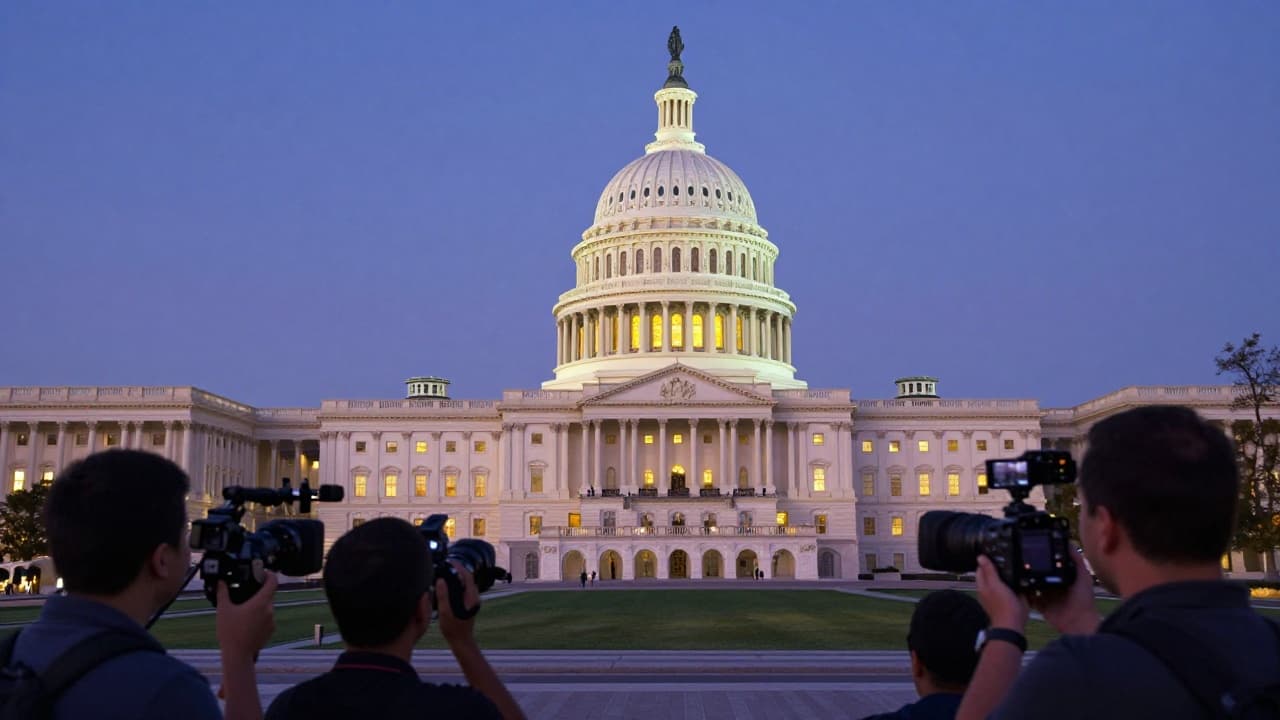
The first polling stations closed in Kentucky and Indiana, while in North Carolina, Ohio and West Virginia, polls opened at just before 6:30 am local time. Americans voted in elections that will determine control of Congress and the trajectory of the final years of Donald Trump’s second presidential term.
Voter turnout has surged, with key states such as Florida, Georgia, Michigan and North Carolina recording record numbers of voters. More than 57 million Americans had already voted by Monday, surpassing the total early vote recorded in 2022. The first results, still unofficial, came from the US territory of Guam, where Republicans took control of the governorship, while Democrats won the seat for a non-voting delegate to Congress.
The economy has consistently emerged as voters’ biggest concern. A Reuters/Ipsos poll showed that 48 per cent of voters consider the cost of living the most important issue when deciding how to vote, while 26 per cent cited democratic norms as key, and 13 per cent immigration. Nearly half of Americans stated that their household finances had worsened since Trump returned to office in January 2025. Trump’s decision to wage war on the Tehran regime further exacerbated economic worries, while Iran’s decision to close the Strait of Hormuz raised fuel prices for American drivers.
Law enforcement and border closure remain signature themes of Trump’s policy, while artificial intelligence has emerged as a key electoral issue. Surveys show that the majority of voters hold a negative view of artificial intelligence, while Trump advocates its development and attempts to rename it 'superintelligence'. These elections are widely viewed as a referendum on Trump’s second term, and voter dissatisfaction has made races competitive even in traditionally Republican states.
Democrats, according to consistently favourable polls, are optimistic about retaking control of the House of Representatives, and possibly the Senate. Senate Democratic minority leader Chuck Schumer said: 'We don't want to count chickens before they hatch. So I would describe my mood as nauseatingly optimistic.' Republicans are targeting narrow majorities in both chambers of Congress, while the president’s approval rating has fallen to record lows.
Trump held 30 campaign rallies during the past month, and on Monday, in his closing address by a pool in front of the Lincoln Memorial, he spoke mainly about algae, granite, re-sealing and grass. He stated that the US would cut $4 billion in annual aid to Israel after the end of this year, and that he would follow the results at the White House, where he is hosting a reception to watch the results on Tuesday evening. He also said: 'The Democratic Party has nominated the most extreme and most dangerous slate of candidates in American history.'
In the Senate race, 35 of 100 seats are up for election, and Democrats need a net gain of three seats in the House of Representatives and four in the Senate to take control of both chambers. The fight for the Senate is concentrated on a dozen or so competitive races, and Democrats are seeking victories in traditionally Republican states such as Texas, Kansas, Iowa and Alaska. In Texas, Democrat James Talarico is battling Republican Attorney General Ken Paxton, in a race that has attracted national attention and massive financial support, including more than $150 million in Republican backing from billionaire Elon Musk. Paxton has faced a series of scandals and attacked Talarico on cultural issues, while Talarico focused on the economic consequences of Trump’s tariffs and the war with Iran. At a packed rally in Austin on Monday evening, Talarico said that Musk and other big-money groups are desperately trying to stop him, and stated: 'They are scared. They are horrified. They see what we see: that we will win these elections tomorrow night.'
In Kansas, Democrat Adam Hamilton, a megachurch pastor, is narrowly ahead of Republican Senator Roger Marshall in polls, in a state that voted for Trump in 2024 by more than 16 percentage points and has not elected a Democratic senator in nearly a century. Michigan has also emerged as a key battleground.
The Trump administration hinted at federal intervention in Alaska after a judge rejected a lawsuit by its Department of Justice seeking to block the certification of the Senate race if Republican Dan Sullivan loses. The administration also sent election observers to all 50 states, including a final push in Los Angeles on Tuesday morning, while a legal correspondence is ongoing with the Trump administration over 20,000 disputed ballots in California.
Astronaut Anil Menon voted in the elections electronically from the International Space Station. Menon filled out his ballot on the station’s computer and sent it to election officials in Harris County, Texas, and all three American crew members also had the opportunity to vote. A voter from Saint Paul in Minnesota travelled to Minneapolis to leave their 'I Voted' sticker at the memorial site for Renée Good, who was killed earlier this year by a federal immigration official during Trump’s mass immigration enforcement operation in the region. Voters in Minneapolis today also left their stickers at the memorial site for Alex Pretti. Good and Pretti, both US citizens, were killed by immigration officials in January, and Good’s family recently filed two federal lawsuits.