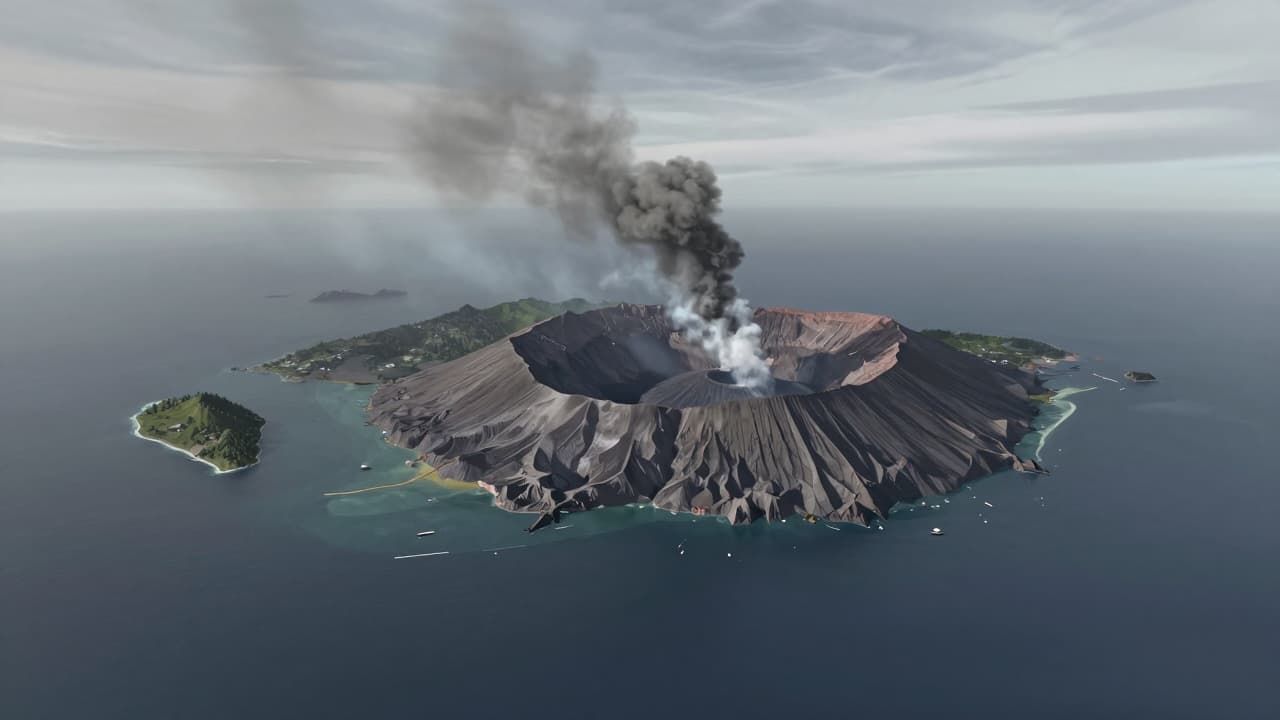
Two new island formations have appeared near the Indonesian volcano Anak Krakatau following a series of eruptions last month, the Indonesian Centre for Volcanology and Geological Hazard Mitigation (PVMBG) has stated. According to satellite images, the formations are located less than one kilometre from the volcano.
A PVMBG official, Rita Susilawati, stated that two formations resembling small islands were visible around Anak Krakatau in satellite images. She added that it was too early to describe the formations as 'offspring' of Anak Krakatau, and warned that there was not enough data on their origin and formation.
Indonesian authorities have not yet conducted field research to determine the material composition of the formations and how they formed. Susilaw said that it could not yet be confirmed whether these were indeed new eruption centres or simply accumulations of volcanic material formed during the eruption. She also warned that the two new island formations might not last long, as they could be eroded by waves and submerged again.
A similar phenomenon had been recorded in the past in the area of Anak Krakatau. Starting from 1927, land masses appeared there several times, emerging from the sea only to disappear again due to erosion. A permanent island formed in 1930, and the volcano has erupted several times since then.
The volcano erupted in early September, leading to the closure of several airports across the country, including the main airport. Hundreds of flights were cancelled, and the eruptions and volcanic ash disrupted air traffic in several parts of Indonesia.
Authorities have warned the public and visitors not to approach the volcano within three kilometres. Anak Krakatau is currently on the second level of danger on a four-point scale.
The name Anak Krakatau means 'child of Krakatoa' in Indonesian. The volcano is located in the area of the former Krakatoa volcano, in the Sunda Strait between Java and Sumatra, about 150 kilometres east of Jakarta. The area is geologically active, and volcanic and seismic activity is regularly recorded in the region.
The catastrophic eruption of 1883 was one of the most famous and devastating volcanic eruptions in history. It is estimated that around 35,000 people died in the disaster, with a high number of casualties due to the massive tsunamis that struck the shores of nearby islands following the eruption. The volcano began to emerge from the sea decades after that eruption.
Five journalists reporting on the eruption from a boat on September 1 were reported missing, and it is now assumed that they have died. Three crew members on the vessel are also presumed to have died.