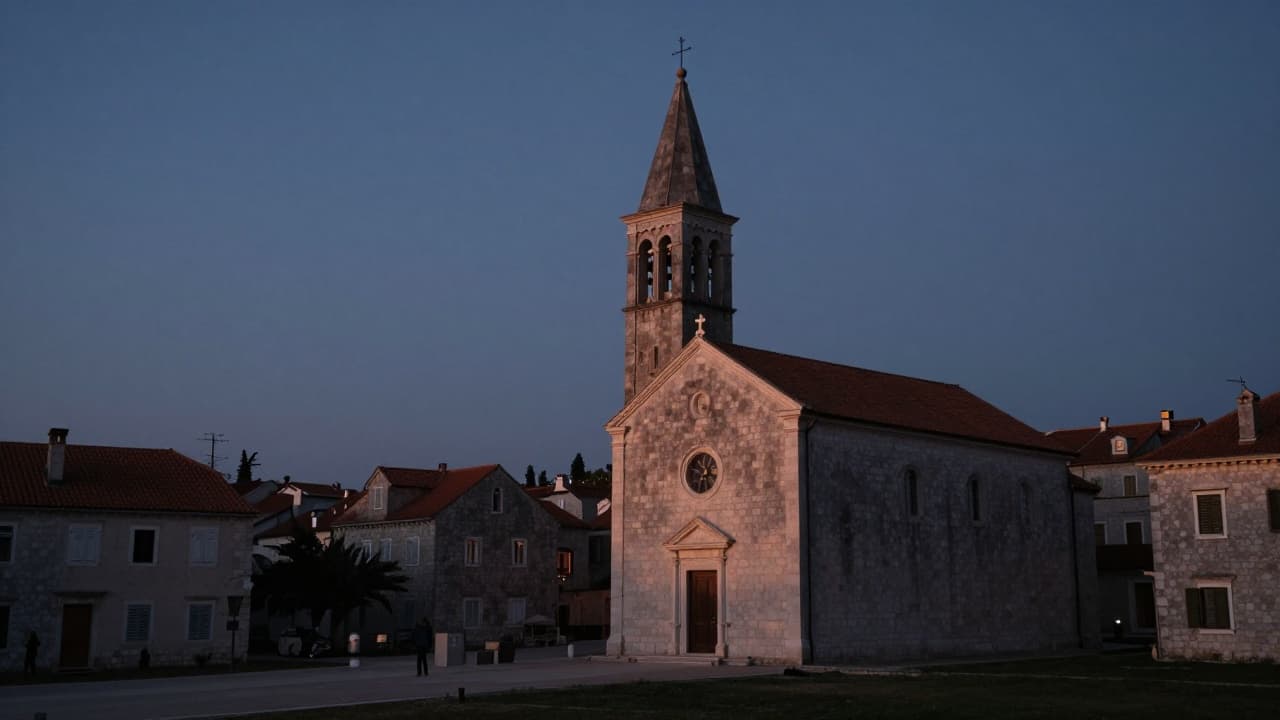
Niko Andrišević was born on 24 January 1882 in Gradac, into the family of teacher Petar Andrišević and Dora, née Šimić, the sister of the writer Nikola Šimić. He completed primary school in his home town, and classical gymnasium in the Split seminary. He studied in Vienna and Zagreb, where he took courses in history, geography, geology, Slavic studies, and law, and in 1909 he received his doctorate with the thesis 'On the vertical movement of the shoreline in historical times in the north-east of the Adriatic Sea'.
In his own biographical note, Andrišević states that in 1905 he founded a society that sang 'Lijepa naša' in church. For this, he writes, he was punished by the police, persecuted almost to the point of exile, and lost his scholarship. When, after completing his studies, he sought employment in Dalmatia, the authorities considered him politically unsuitable. In 1911 he was a judicial auditor in Banja Luka, and then moved to Sarajevo, where he built a legal career and spent the greater part of his life.
His literary work began earlier: in 1902 he published in Vijenac the sketch 'From the Oppressed Souls', and in 1907 Matica hrvatska published his first collection, Images and Stories from the Neretva Region. In Glas Matice hrvatske, Ante Radić began his review with the words: 'We have him! We have a storyteller again!' In other reviews, the comparison with Gaj was made, and even the term 'Nerva Turke' was used. Ante G. Matoš placed him among the young authors from whom much was expected.
Andrišević's friend Stjepan Perić described him in Hrvatska revija in 1908 as an original author who, even in his school days, had shown a special gift for observing and narrating. Together they later wrote the verse drama Mila Gojsalić, performed in 1909. The second collection, simply titled Stories, was published by Andrišević in 1912. Stjepan Perić, in a review of his Stories, identified in the life, people, nature, and emotions of Andrišević's region the foundation of his literary world.
He was a writer, doctor of science, lawyer, and public figure. In the war years, he defended the Primorska region in court, and invested his own money in a park, botanical garden, and swimming pool in his home town. After the Second World War, he was caught by a heavy sentence and confiscation of his property. He left literature after only two books of stories and a number of texts scattered across periodicals.