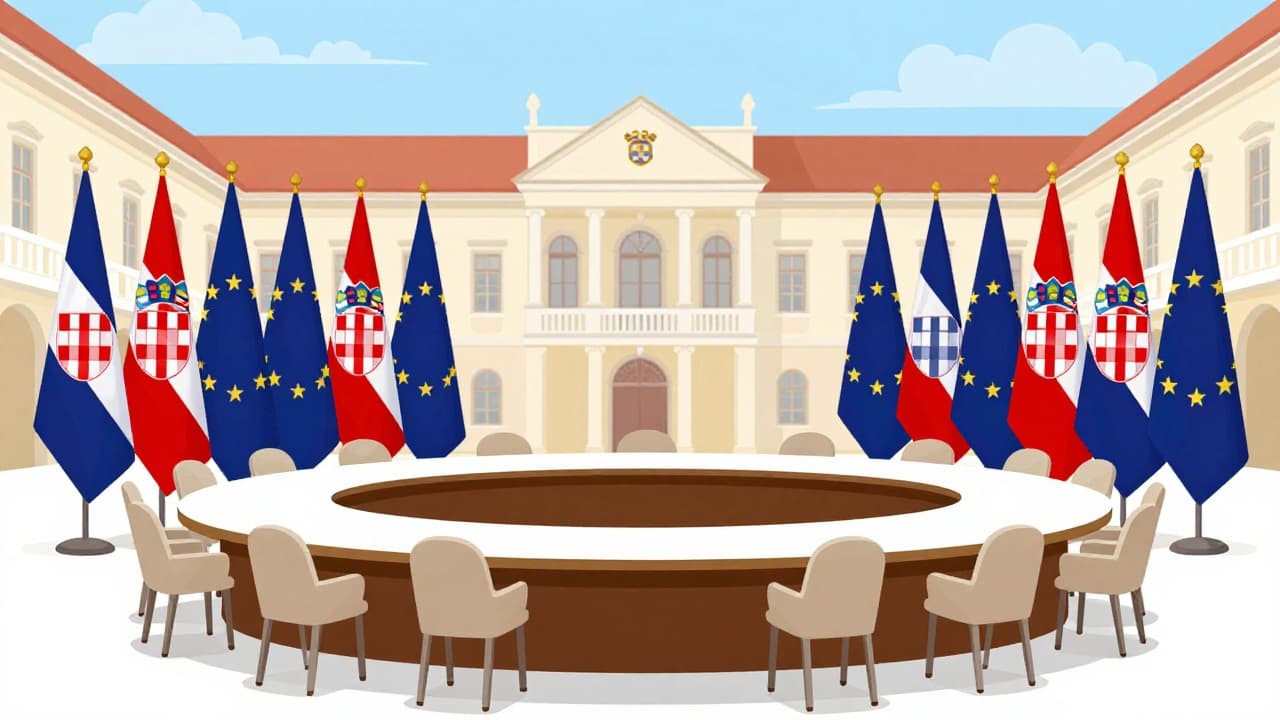
The meeting of ministers and state secretaries for European affairs in Trogro concluded the Croatian presidency of the MED9 group, with the group’s summit to be held on 7 October in Split. Croatia is presiding over the MED9, an informal format comprising Croatia, Cyprus, France, Greece, Italy, Malta, Portugal, Slovenia and Spain, for the first time this year.
The focus of the Trogir meeting was the future budget of the European Union and the security dimension of enlargement. Discussions covered European strategic priorities, the future multiannual financial framework of the EU, cooperation in the Mediterranean, and the security dimension of the Union’s enlargement.
Particular emphasis was placed on the negotiations for the new multiannual financial framework of the EU for the period 2028 to 2034, which are entering the final phase, with the ambition that an agreement be reached by the end of the year. For Croatia, the key issues in these negotiations are the cohesion, agricultural and fisheries policies, for which it is argued that sufficient funding must be secured, at least at the current level. Croatia also supports sufficient funding for the EU’s external action, including instruments for the Mediterranean, the external dimension of migration, and a visible and sufficient accession assistance, particularly for the countries of the Western Balkans.
The second part of the meeting was devoted to the geopolitical and security aspects of the EU’s enlargement policy. The European Commission’s Commissioner for the Mediterranean, Dubravka Šuica, participated in the discussion. Croatia considers enlargement to be the most important geopolitical and security instrument, and the enlargement process must remain based on individual achievements and the fulfilment of criteria, particularly in the area of the rule of law and fundamental rights.
The meeting was attended by the European Commission’s Commissioner for the Mediterranean, Dubravka Šuica, and participants confirmed their readiness to faithfully implement the Mediterranean Pact. During the Croatian presidency, three meetings of foreign ministers and five sectoral meetings were held, during which the geopolitical situation in the Mediterranean and current crises, illegal migration, the protection of the EU’s external borders, energy and environmental challenges, and agriculture and demographics were discussed. The aim of the Croatian presidency was to strengthen dialogue and coordination among the nine countries.