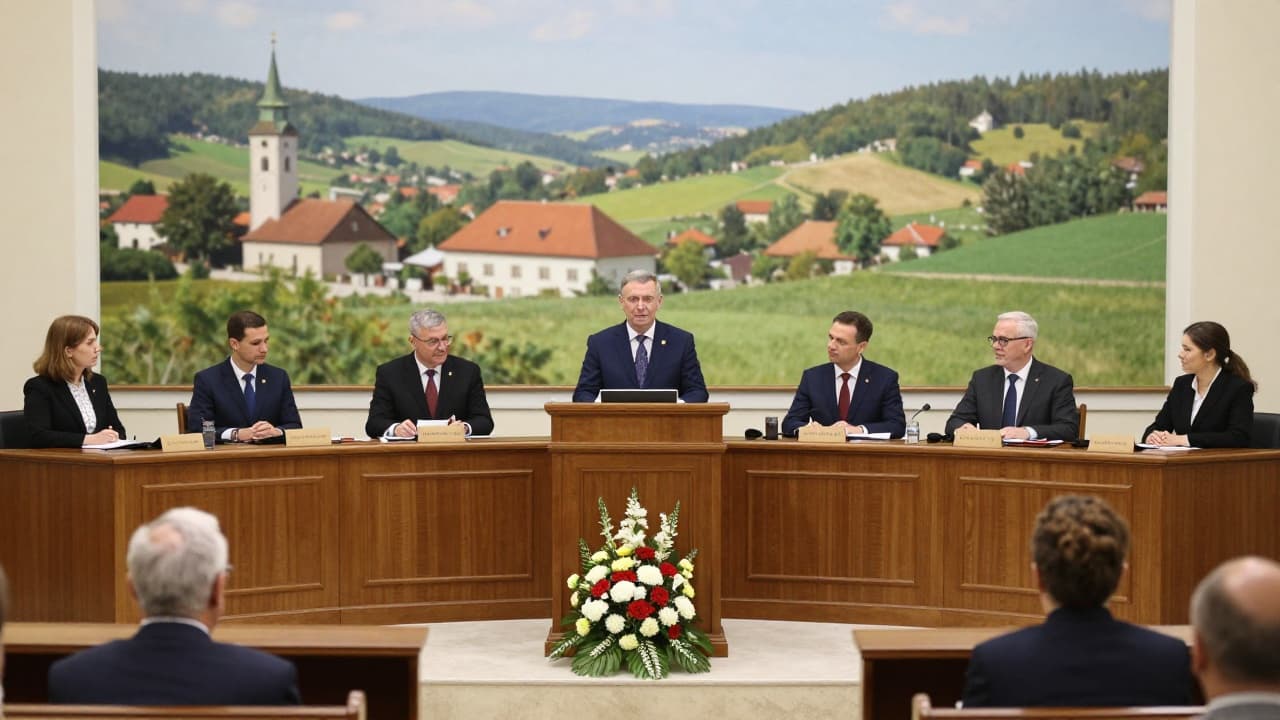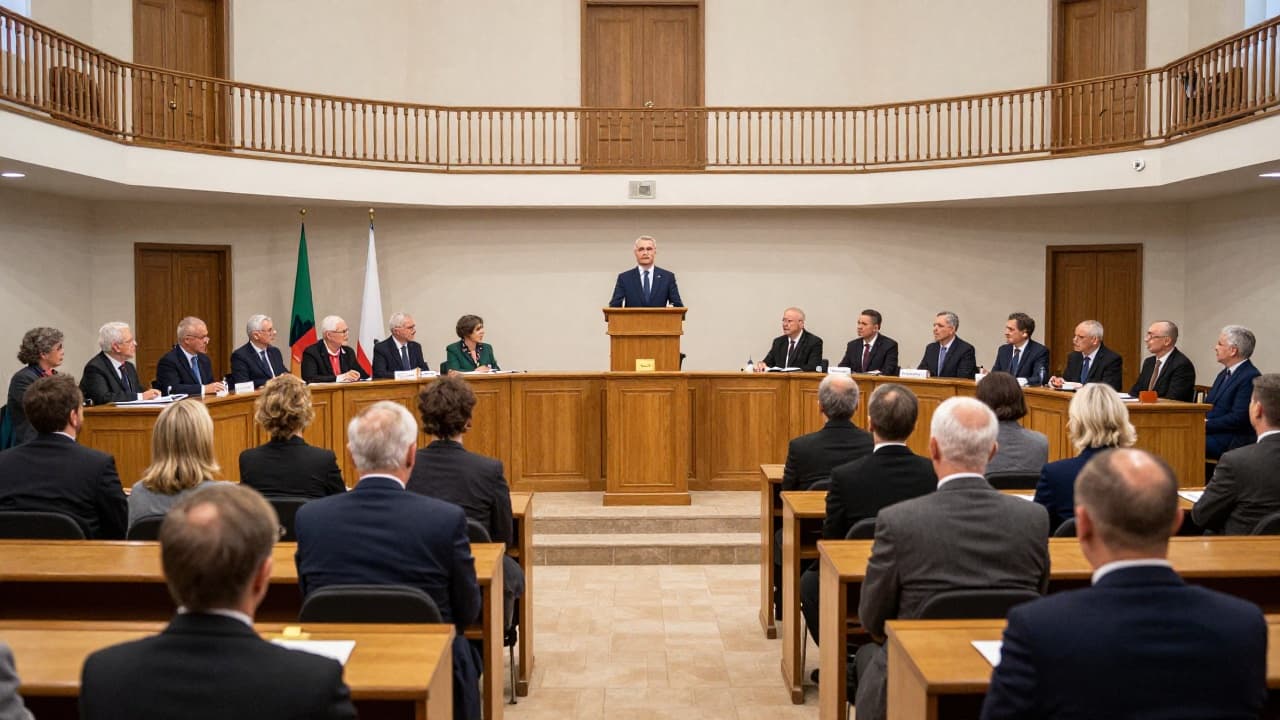
The Council for Slavonia, Baranja and Srem met on 28 September in Donji Miholec, the first meeting following the entry into force of the new Regional Development Act and the Government’s decision on the new composition of the Council. The meeting was chaired by Prime Minister Andrej Plenković.
The Council discussed the institutional framework for regional development, investments in transport infrastructure, investments in tourism in the regions of Slavonia, Baranja and Srem, and investments in defence infrastructure in eastern Croatia. The points on the agenda were presented by the Minister of Regional Development and European Union Funds, Nataša Mikuš Žigman, the Deputy Prime Minister and Minister of Sea, Transport and Infrastructure, Oleg Butković, and the Minister of Tourism and Sport, Tonč Glava. The topic of investment in defence infrastructure and the return of the Croatian Army to Baranja was presented by Deputy Prime Minister and Minister of Defence, Ivan Anušić, while the Minister of Culture and Media, Nina Obulj Koržinek, presented investments in cultural infrastructure. Deputy Prime Minister and Minister of Croatian Veterans, Tomo Medved, presented investments in veterans’ and ex-servicemen’s centres, including the Veterans’ Centres in Osijek and Virovitica.
Prime Minister Andrej Plenković highlighted that the goal of the Council is dialogue and cooperation, creating a high-quality business and living environment in eastern Croatia. The Council has so far held meetings in 21 towns and municipalities, the latest taking place immediately after the adoption of the 11th package of measures to protect citizens and the economy from inflationary pressures caused by the conflict in the Middle East.
Thirteen contracts and decisions with a total value of nearly €54 million were awarded ahead of the meeting. The awarded contracts and decisions cover investments in water management, nature protection and climate projects, as well as investment projects in urban development within the IPA framework. By September 2026, approximately 17,000 projects with a total value of €5.5 billion have been contracted across the five counties of Slavonia, of which €3.5 billion has been paid out. Through the Slavonia, Baranja and Srem project, over €5.5 billion has been allocated to 17,000 projects.
Funds amounting to €2.09 billion have been allocated to the Osijek-Baranja County, €1.14 billion to the Vukovar-Srijem County, €661.2 million to the Virovitica-Podravina County, €761.04 million to the Brod-Posavina County, and €499.8 million to the Požega-Slavonia County. Projects valued at €391.8 million are being implemented across multiple counties.
Representatives from the Virovitica-Podravina County, including County Prefect Igor Andrijić, Members of Parliament Josip Dakić and Vesna Bedek, State Secretary Sanja Bošnjak, and the Mayor of Virovitica, Ivica Kirin, attended the meeting, along with the director of VIDRA, Emina Kovač, and the director of the VPO, Martina Jelić.
The economy has seen growth of 1.7 per cent for 22 consecutive quarters, with the unemployment rate standing at 3.4 per cent. There are 1.8 million insured individuals, with 62,000 unemployed. Since 2016, the minimum wage has risen by 154 per cent, to €1,050 gross, while the average wage has risen by 108 per cent, to €1,542, and pensions have risen by 117 per cent, to €780 with an annual supplement.
Thanks to the policy of fiscal decentralisation, the revenues of the five counties have more than doubled, with the revenues of the five counties and the cities and municipalities within them increasing from €385 million to €904 million. At the level of Croatia, the revenues of counties, cities and municipalities have grown by €4 billion, from €3 billion to €7 billion, compared to 2017. Local and regional self-government units in 2025 had €4 billion more at their disposal than in 2017.
The number of unemployed in Slavonia, Baranja and Srem has decreased from over 60,000 in 2016 to 18,500 today, a 70 per cent reduction. At the same time, 37,000 more people are employed, 239,000, which is 18 per cent more than in 2016. Average net wages in all five counties have more than doubled. The balance of migration to and from abroad has changed from a minus of 9,171 people in 2016 to a plus of 1,561 people in 2025, and is positive in all five counties.
The new Act on Regional Development has strengthened strategic planning and the institutional framework for regional development.