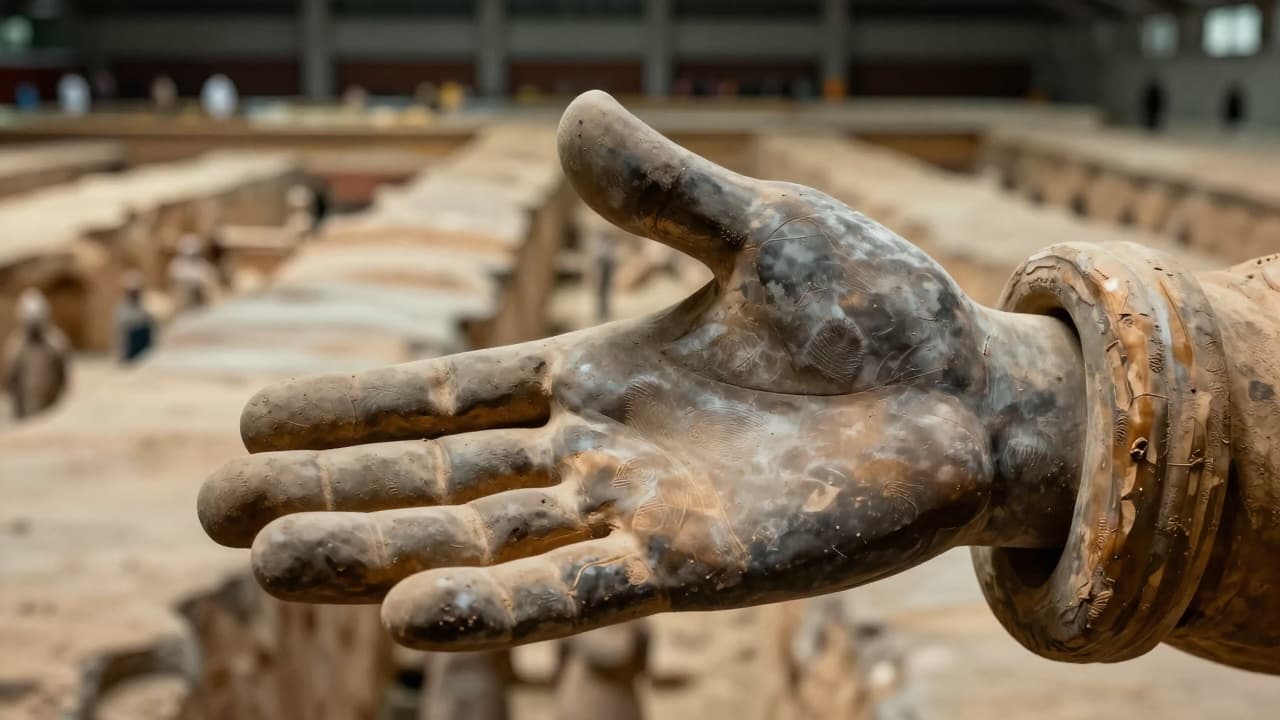
The clay army of Emperor Qin Shi Huang has stood in the darkness of his tomb for 2,200 years, and new research into fingerprints left in the clay points to women and children having taken part in its creation. For a long time it was believed that the terracotta warriors were made exclusively by adult men.
The research team was led by archaeologist Xiaoxi Li from the Emperor Qin Shi Huang's Mausoleum Site Museum (Mauzolej cara Qin Shi Huang). The study is based on 36 warriors from one excavation pit, on which 91 fingerprints were documented. After excluding 12 fingerprints that appeared to belong to the same individuals, 79 fingerprints remained for analysis.
Traces were left on heads, hands, armour, gauntlets, collars and even on one foot. There were 73 surface prints, while the remaining six relief prints were created when pre-shaped clay ornaments were pressed into the surface of the figure.
According to the model, only 45 per cent of the fingerprints were likely made by adult men. A further 32.7 per cent were attributed to adult women, and the remaining 22.3 per cent to children under the age of 15.
Historical records show that women and children also worked in state workshops during the Qin dynasty. Those records also describe a formal apprenticeship system, in which young people learned crafts under the supervision of experienced masters. According to records from the Yuelu Academy (Akademija Yuelu): "A skilled master teaches well, so an apprentice completes training in one year, and a new master in two."
The identities of the craftsmen who carried out this work remain largely unknown. The terracotta army was discovered in 1974, when farmers digging a well about a kilometre and a half from the emperor's tomb came across fragments of life-sized clay warriors. The known part of the army comprises around 8,000 warriors, 130 chariots with 520 horses and 150 cavalrymen, but the greater part of the vast necropolis has not yet been excavated.
The authors of the study also note limitations of their conclusions. The sample of 79 fingerprints comes from only 36 warriors from one part of the vast site, and reliance on modern European reference data introduces a degree of uncertainty into the estimates.