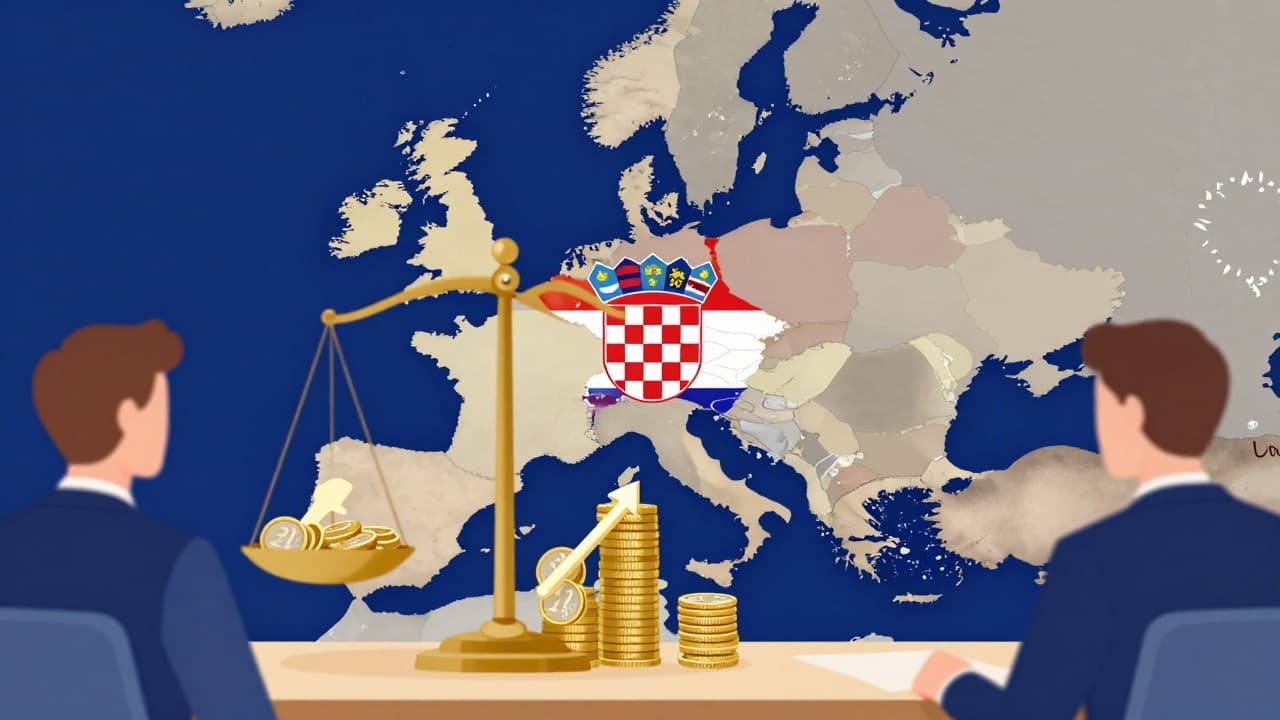
Croatia would be in a surplus of around €7 billion under the current proposal from the Irish presidency of the EU Council in the new multiannual financial framework, compared to the funds it will pay into the European budget. This was stated by Prime Minister Andrej Plenković at a conference on regional development and the use of EU funds in Šibenik, organised by the Ministry of Regional Development and European Funds. The conversation with the Prime Minister took place one day after he marked his 10th anniversary at the head of the Government.
Plenković clarified that the €7 billion surplus includes the difference between the amount Croatia will pay annually into the European budget and the funds apriori reserved for Croatia. He emphasised that Croatia has two ways of using European funds: fixed funds under the model of the negotiated financial framework, and competitiveness, where Croatian companies and other entities can apply for horizontal programmes. Looking cumulatively from 2016 to the end of the next seven-year package in 2034, Croatia will be in a surplus of more than €30 billion.
Speaking about the impact of European funds, the Prime Minister highlighted that Croatian GDP was €47 billion at the time, and by the end of this year it will be over €100 billion. He stated that without European funds, Croatian GDP would not have grown so strongly, nor would we have had such a strong support in crises.
Discussions on the new multiannual financial framework were held at the meeting of the European Council, but no agreement was reached. The new EU Multiannual Financial Framework covers the period 2028-2034. The European Parliament debated the matter this week. At the last European Council, talks covered EU competitiveness, migration, defence, the Middle East, enlargement, international trade and imbalances between the EU and China, as well as relations with the US in the context of their recent decisions regarding Ukraine. Ukrainian President Zelensky confirmed that decisions regarding Ukraine significantly change the situation on the ground.
Plenković highlighted to the leaders the issue of unresolved matters with Montenegro regarding Chapter 23 and Chapter 31. The Montenegrin Government made a decision to change the name of the pool in Kotor and subsequently approved and preserved a memorial plaque in the former Morinj camp. The Prime Minister clearly told Prime Minister Spajić that Croatia wants Montenegro to become an EU member, but also to fulfil certain activities important for relations. Plenković met with Prime Minister Spajić at the Berlin Process in Montenegro.
Regarding migration, it was noted that the migration wave of 2015 and 2016 influenced the development of new political parties and the weakening of mainstream parties in large states. At the European Council, almost no one is amenable to flexibility on migration anymore, with all being very firm on preventing illegal migration. Several large member states, which are the largest contributors, want to reduce the total volume of the budget as much as possible. The Irish, as the presidency, proposed certain reductions that did not affect the first pillar of the budget, known as National and Regional Partnership Plans (NRPP).