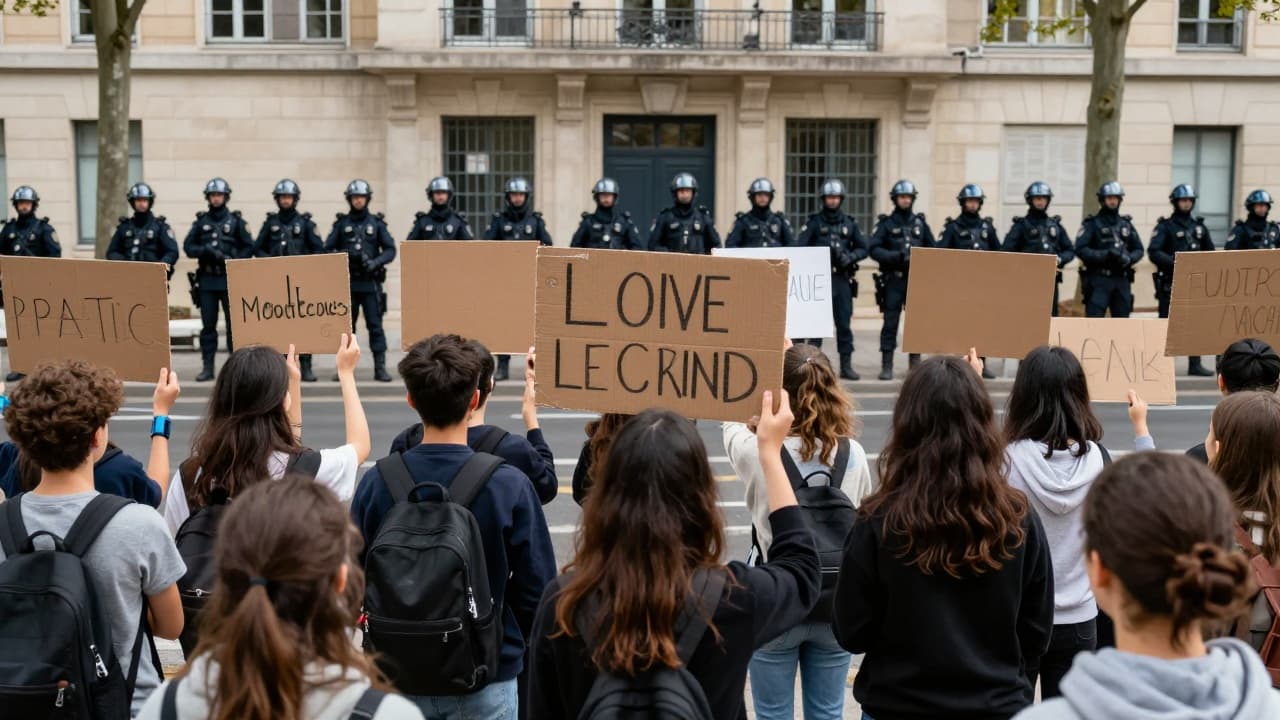
More than 400 people, mostly children, were arrested in France on Tuesday during protests by high school students who blocked schools across the country. The interior minister, Laurent Nunez, told BFMTV that 440 people were arrested on national territory, noting that the final number is not yet known and that two-thirds of those arrested ended up in police custody.
The Ministry of Education stated that 400 schools out of approximately 3,700 were affected by the protests on Tuesday. The demonstrations, which began in Paris last week, have since spread across the country. In the northern city of Lille, high school students threw bottles, stones, and other projectiles, while setting fire to bins. Police responded with tear gas after protesters vandalised bus stops and billboards. Clashes between students and police were also reported in Bordeaux, Rennes, and Nantes.
Nunez stated that on Tuesday, incidents occurred where hydrochloric acid was thrown at police officers, with seven officers affected. In total, 48 police officers were injured in clashes across the country. At the Lycée Lamartine in northern Paris, students waved placards protesting against exhausting schedules, with one reading: "8-18. More hours of school than sleep." In the Parisian suburb of Seine-Saint-Denis, local mayor Bally Baguette joined hundreds of students at the Lycée Paul-Elma. Leading the students in a performance of the national anthem, Baguette described the protests as "completely legitimate" and lamented that areas with lower incomes receive fewer resources than those with higher incomes. As the crowd gathered, police with shields pushed back against the students, according to local reports.
The prime minister, Sébastien Lecornu, had previously stated that an escalation of demonstrations would be "irresponsible." On X, he posted: "Fireworks, fires, violence near schools: nothing justifies endangering students, staff, or police." Jean-Luc Mélenchon, leader of the far-left France Unbowed (LFI), responded to the ministers' instructions with a post on X on Monday: "Students protesting are harmless. The government's response is a crackdown. This brutality is irresponsible and has a clear racist undertone. Hands off our youth. Politicians and activists, intervene wherever you can. Lecornu, in response to X, described the intervention as "an irresponsible escalation." "The duty of an elected official is to protect the young and call for peace. Exploiting their anger for political gain is wrong," he wrote, adding that the accusation of racism was an insult.
The protests followed strikes by French trade unions over government budget plans, which include a €54 billion cut in public spending. Many public sector workers stopped work on Tuesday, including an estimated 40 percent of primary school teachers. Ryad Rani, president of the Union Syndicale Lycéenne, called for a complete blockade of French high schools as a parallel action, but urged protesters to "remain peaceful." Rani stated that the union was protesting against a general lack of resources, overcrowded classrooms with sometimes 32-35 students, and a shortage of teachers and staff.
Rani described the circular issued by the ministries of the interior and education, instructing police to maintain public order in front of high schools "with proportional use of force," as "an absolute scandal." "We are talking about students aged 15 to 18, and the government's response is automatic and institutionalised repression. This is unacceptable. Students are taking action to demand fairer and more equitable conditions, but are met by the BAC [anti-riot police] and CRS [riot police]," said Rani. He added that some teachers and school staff had stood in front of students to protect them from the police. "These are the images we should be showing," said Rani to BFMTV. Caroline Chevé, general secretary of the main teachers' union, the Union Syndicale de l'Enseignement (FSU), joined the protest march in central Paris on Tuesday, stating that she understood the students' frustration. "They are facing the same challenges as us. They are in overcrowded classrooms. Sometimes there are not enough teachers due to a lack of staff. They see the same reality as we do and are angry," said Chevé.