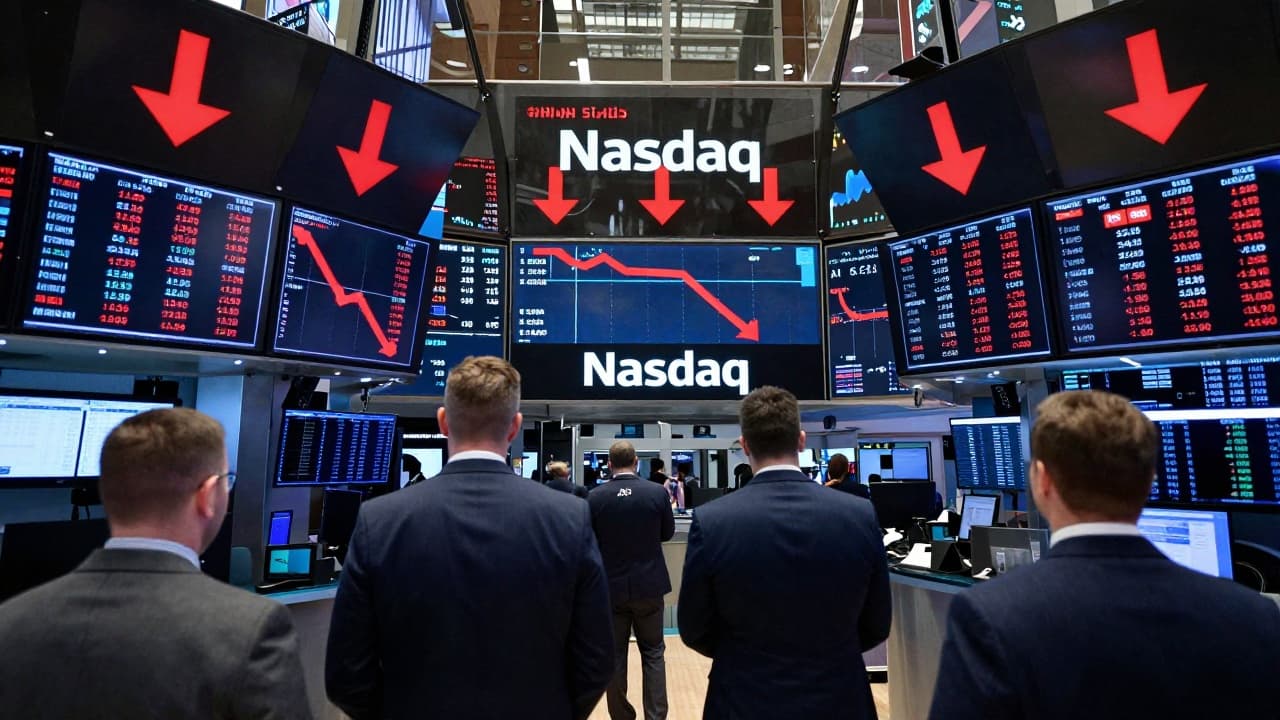
The Nasdaq technology index fell sharply on Thursday, recording its largest daily drop in the past 19 months and entering a technical correction zone, driven by the plunge in chipmaker shares. The Nasdaq index dropped 1,421 points or 5.52 per cent, to 24,314 points.
The decline also hit other leading US indices. The Dow Jones fell 3.44 per cent, to 51,523 points, while the S&P 500 dropped 4.36 per cent, to 7,353 points. The VIX index, a measure of market fear, jumped by as much as 70 per cent, its largest daily percentage increase in nearly two years, and is now at its highest level in seven months.
The Nasdaq recorded its biggest daily fall since April 2025, when US President Donald Trump declared "Liberation Day", imposing tariffs on goods imported into the US. This is the second day of heavy selling of AI shares on the stock exchange and the fifth time the Nasdaq has fallen by more than 500 points in a single day since mid-October. The Nasdaq has lost nearly 12 per cent from its record high reached on 6 October. The index enters a correction zone when it falls 10 per cent from its recent peak.
The biggest losers on the market were chipmakers supplying components for data centres, such as Nvidia, which saw its share price fall by 9.3 per cent. Meta Platforms, Amazon.com and Alphabet shares also suffered sharp declines. Shares in Musk's Tesla dropped 11 per cent, while SpaceX fell by nine per cent.
President Trump reacted to the correction on Wall Street, blaming the Democratic election results for the drop. "The stock market has suffered one of its worst days in history based on election results. However, do not be afraid; soon we will, in one way or another, be BIGGER AND STRONGER THAN EVER BEFORE," Trump stated.
European stock exchanges recorded slight losses, with the Frankfurt DAX weakening by 0.43 per cent, to 26,325 points, and the London FTSE falling by 0.43 per cent, to 10,782 points. The Paris CAC rose by 0.34 per cent, to 8,205 points. European futures indices are signalling a tough day for European stock markets as well.
The selling of technology shares and the sharp drop in stock indices continued this morning in Asia. The Japanese Nikkei fell by as much as seven per cent during the day. The South Korean and Taiwanese exchanges were down by more than eight per cent, after which these regional markets stabilised somewhat. Currently, the Japanese Nikkei is down 5.5 per cent and is in a correction zone, having fallen more than 10 per cent from its peak.
The decisive victory of the Democrats in the US mid-term elections on Tuesday wiped out 2,500 billion dollars from the Nasdaq through a sharp correction in technology share prices. Shares in Samsung Electronics and SK Hynix recorded a price drop of 10 and 12 per cent respectively this morning. The share price of Japanese Kioxia fell by 14 per cent, while that of Taiwan's TSMC dropped by 8.5 per cent. Shares in Japanese SoftBank Group became cheaper by 11 per cent. The cost of insurance against the risk that SoftBank Group will not be able to service its debts jumped to its highest level in the last four years.
Melissa Brown of SimCorp stated that investors recognise that some of the newly elected members of Congress and governors are considering slowing the pace of AI infrastructure development. Around 30 per cent of the planned increase in data centre capacity in the US during 2028 could be at risk due to potential construction delays, UBS analysts estimate. Some are wondering whether the drop will affect the timing of Anthropic's initial public offering, which is expected this autumn.
Dong Baozhen, president of asset management firm Lingtong Shengtai, asserted that such a sell-off shows that prices of shares linked to artificial intelligence were based on rosy illusions about the future and that this illusion has vanished. He added that Wall Street had been the leader and backbone of the global upward trend linked to artificial intelligence.