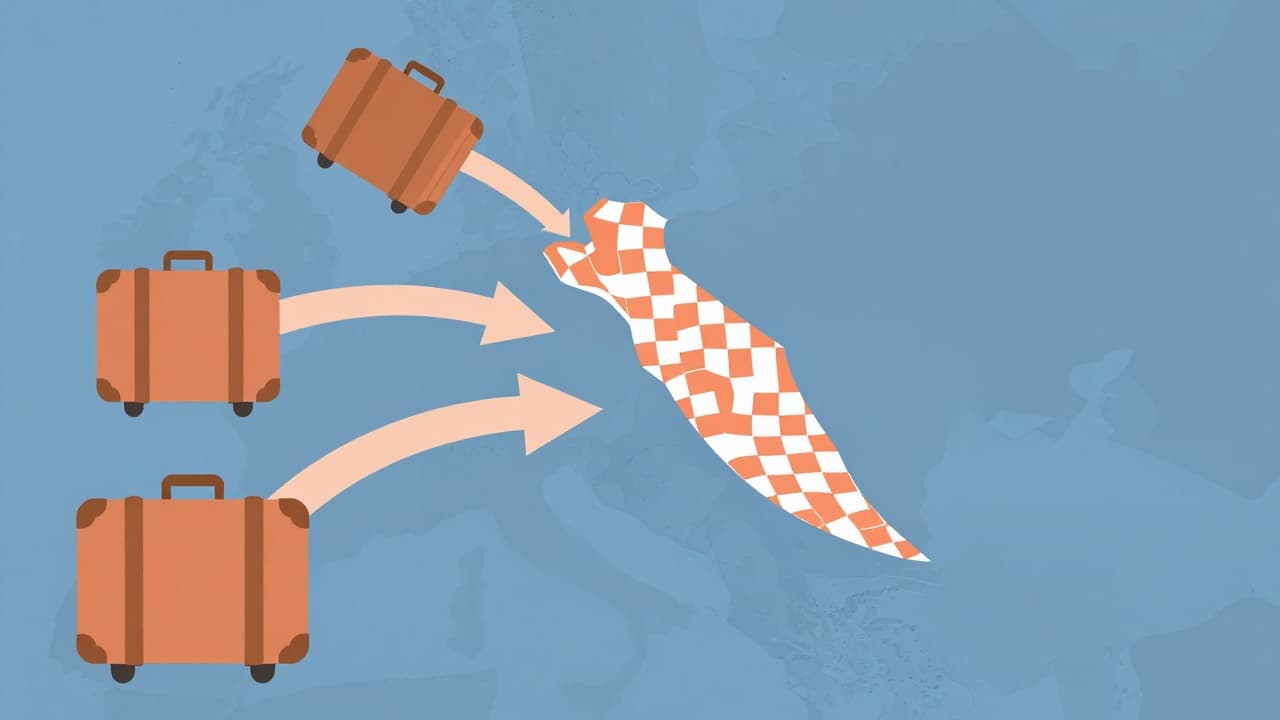
Croatia, in 2025, had more residents moving in than moving out, but the difference compared to the previous year has nearly halved: the migration balance fell from 31,000 to 19,180 people, according to new data from the Croatian Bureau of Statistics (DZS).
56,665 people moved into Croatia from abroad last year, while 37,485 left. The positive trend, which has been in place since 2022, continues to rely on foreigners — 29.7 per cent of those arriving are Croatian citizens. Among those leaving, a significantly higher proportion are domestic: Croatian citizens make up 35 per cent of those who left the country.
The largest number of arrivals came from Germany, at 17 per cent, followed by Bosnia and Herzegovina and Nepal, each with 11.1 per cent. Looking only at foreign nationals, Nepal leads with 6,264 arriving people, followed by Bosnia and Herzegovina (4,731), the Philippines (4,500), Serbia (3,696) and Ukraine (2,986). Germany is, in fact, the main destination for emigrants from Croatia.
Among those arriving, men predominate, at 66.3 per cent, and men aged 20 to 39 make up the largest share of those leaving. The Croatian Bureau of Statistics notes that a significant portion of the total figures are foreigners with residence and work permits, and that the displaced from Ukraine, for whom temporary protection has been granted, are included in the count.
73,838 people changed their address within the country, the highest number since 2016. Unlike external migration, in internal migration, women predominate with a share of 54.3 per cent, while just over 30,000 people moved to a different county.
When external and internal migration are combined, the greatest beneficiary is the Zagreb County, with 3,475 more people moving in than out, followed by the Istria, Split-Dalmatia, and Primorje-Gorski Kotar counties, and the City of Zagreb. Negative balances are recorded in the Sisak-Moslavina, Brod-Posavina, Koprivnica-Križevci, and Virovitica-Podravina counties.
In movements between counties, the Zagreb County attracted the most new residents, while the most people left the Brod-Posavina and Vukovar-Syrmia counties.