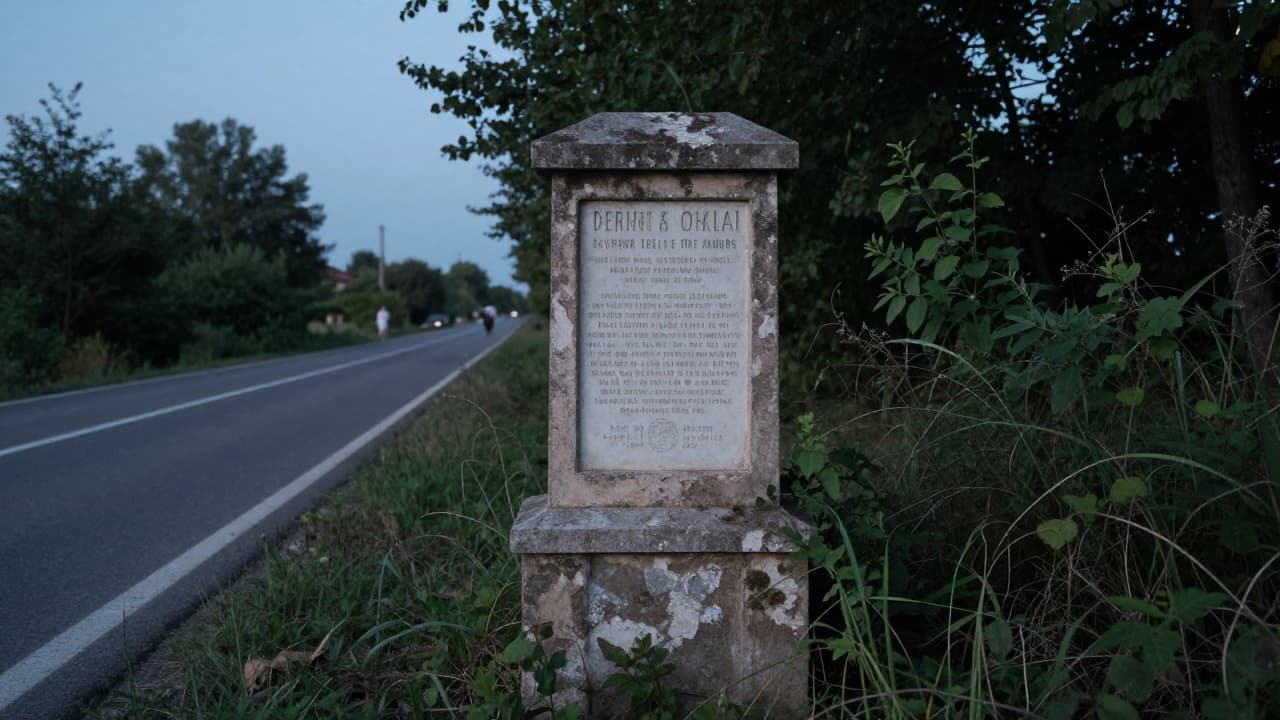
Vjekoslav Širinić, a teacher and political activist from Drniš, was killed in an ambush on 20 October 1945 in the village of Razvođe, on the road between Drniš and Oklaj. His driver, Josip Bitunjac, was also killed in the attack. Širinić was returning by motorcycle from a meeting where he had spoken as a candidate for a seat in the Constituent Assembly of Yugoslavia.
Širinić was killed by a group of križari, Ustaše guerrillas who continued fighting after the defeat in the Second World War. He was buried in the cemetery in Drniš. A school in Oklaj bore his name, as did a street in Drniš, and a bust of him was erected in the town. The only remaining memorial to Vjeku Širinić today is a dilapidated plaque by the Drniš – Oklaj road, at the site of his murder.
Širinić’s political engagement began in the years when the Communist Party of Yugoslavia was extending its influence into the Dalmatian hinterland. He moved in circles of progressive intellectuals and communists, including Marin Franičević, Vinko Lalić, Ivan Leko and Petar Đaković, as well as other teachers from the Knin region. In the autumn of 1939, upon the establishment of a party cell in Drniš, he became its first secretary. He also acted politically through the Knin Teachers’ Society, which published the newspaper Naši dani, banned after two issues were published. He became a member of the Communist Party of Yugoslavia on 15 October 1939.
The April War of 1941 caught him in the ranks of the 12th Replacement Regiment of the Adriatic Division, which surrendered in Promina on 12 April. He was arrested on 7 June 1941 together with Dano Jerković, but was released after a few days. During the national uprising, on 27 July 1941, he was mobilised as an officer and sent to a Home Guard unit in Knin. He fled this unit with Ivan Leko and continued to operate semi-legally.
In early 1942, when the Bukovica People’s Liberation Detachment was formed, strong links already existed across the Krka and Promina to Drniš, where Širinić served as secretary of the Local Committee of the Communist Party of Yugoslavia. According to the recollections of his contemporary Nikola Lončar, Širinić left Drniš on 29 March 1942 and joined the insurgents in Petrovo Polje, where he collaborated with Bogdan Njeguš and others. After the formation of the District Committee of the Communist Party of Croatia for Knin in mid-August of the same year, he carried out propaganda work and acted as a field political activist.
In early 1943, he went to Bukovica, to the village of Ervenik, from where he directed political work until the end of the war in Dalmatia. After the Italian capitulation, Bukovica became a liberated area from which partisan forces frequently attacked Ustaše garrisons in Promina. Širinić regularly crossed the Krka and acted politically among the population of Promina and Petrovo Polje. At the end of May 1944, he participated, together with Nikola Pongar, in the exchange of captured partisans and German soldiers near the village of Mratova. He also participated in the organisation of partisan schools in Bukovica as a member of the Executive Committee for the Knin district, and for a period taught at courses in the headquarters of the 19th Division in Parčići.
After the liberation of Drniš on 5 November 1944, he returned to his home town with the district organisations and worked intensively on mobilising people into the ranks of the Yugoslav People’s Liberation Army and partisan detachments. In March 1945, he was elected a member of the Executive People’s Council of Šibenik and a member of the District Committee of the Communist Party of Croatia for Šibenik. In the post-war months, he continued his political work, and in the autumn of 1945 he participated in pre-election activities as a candidate for a seat in parliament.
Vjekoslav Širinić was born on 1 May 1913 in Drniš. In his home town, he completed primary and secondary school. Due to good academic performance, he continued his education at the Teachers’ College in Šibenik, which he enrolled in for the 1930/1931 academic year and completed in 1934. He got his first job as a teacher in the village of Hrgud, in the Stolac district. After Hrgud, he was transferred to Cetina, in the Sinj district. From 1938, he worked in Kričke near Drniš, where he remained until he went underground in 1941.