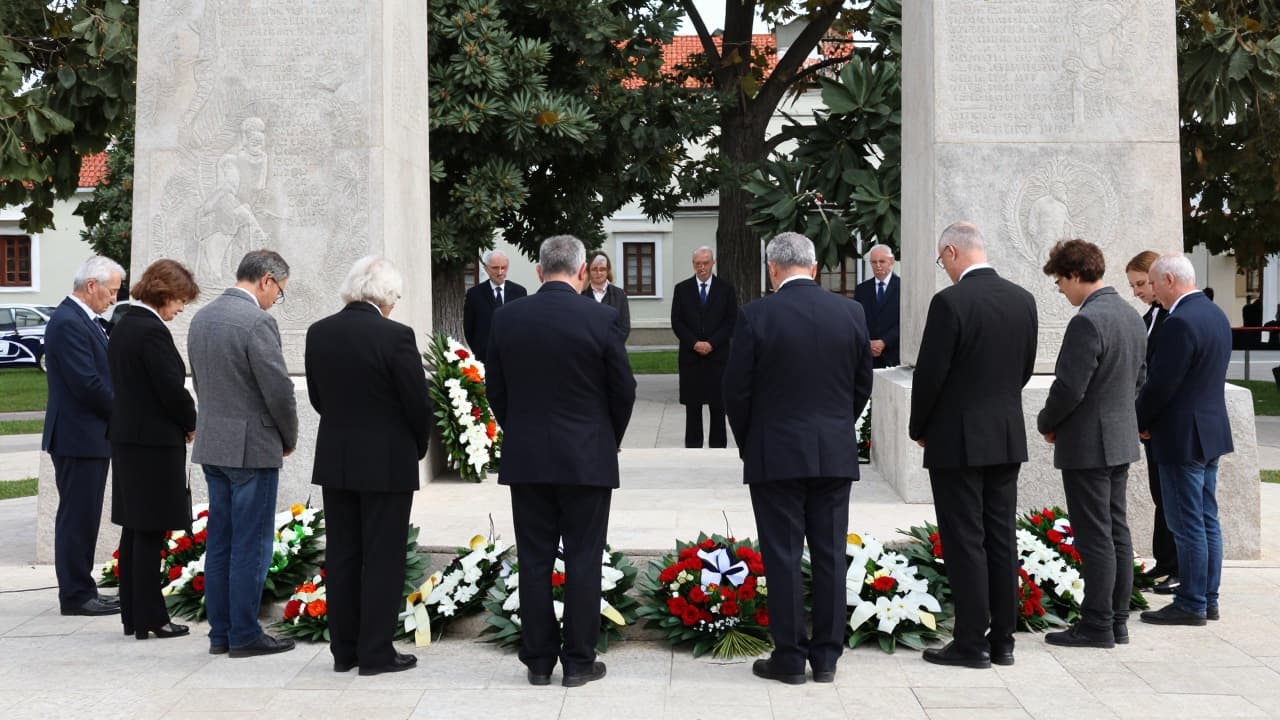
The 35th anniversary of City Day in Zadar was marked by a solemn academic ceremony, in memory of the days when Croatian defenders repelled superior enemy forces and defended the city.
At the site where Croatian defender Željko Vujić stopped a tank 35 years ago, veterans and the families of deceased and fallen defenders gathered. Representatives of the Government, the Croatian Parliament, the Split-Dalmatia County and the City of Zadar, the Croatian Armed Forces and the police, as well as many citizens, were present. A message of gratitude was expressed to all Croatian defenders and civilians who, in the most difficult days of 1991, kept the city alive.
The Deputy Prime Minister and Minister of Veterans, Tomo Medved, highlighted that Croatian defenders showed endurance, strength, faith, unity, pride and defiance in the most critical moments. He assessed that the defence of Zadar holds a special place in the Homeland War. He stated that the truth about the Homeland War must be passed on to younger generations, reminding them of the time when residents of Zadar lived under the threat of artillery bombardment. Medved stated that the Homeland War was just, legitimate, defensive and liberating, and warned against the distortion of historical facts. He thanked the veterans, military commanders, the families of fallen and deceased defenders, and the families of civilian victims of the war.
Josip Bulaver, the County Prefect, recalled that Zadar was attacked from the air, sea and land, but was defended thanks to the Croatian defenders and civilians. "A far more powerful enemy was broken here – they did not succeed here," said Bulaver. He stated that it is important to preserve the memory of the Homeland War, the defence of the city, and this day.
The Mayor of Zadar, Šime Erlić, highlighted that the Croatian defenders, 35 years ago, were not only defending a line, but the city and its people. He said that behind the defenders was a living city – houses, schools, kindergartens, hospitals, and the waterfront, where people lived without water and electricity, under artillery fire. He recalled that the credit for the city's defence belongs to doctors, nurses, firefighters, public service workers, workers, mothers and fathers who, in wartime conditions, kept the city alive. He announced that the City of Zadar, in cooperation with veterans' associations and the Split-Dalmatia County, would continue its work on establishing a memorial room and a future Homeland War Museum on the Square of the Nation.
Marko Čulina, a commander in the 112th Brigade of the Croatian Army, spoke on behalf of the Croatian defenders. He recalled the months-long resistance of Croatian forces in the wider Zadar hinterland and the defenders who held off the enemy before the decisive battle for the city. "We were not looking at which party one was from, whether one was the son of a Partisan, a home guard, or a Ustasha, nor where one was from. All of us had only one party – Croatia," he said.
In Sinj, on Tuesday, the 35th anniversary of the establishment of the 126th Brigade of the Croatian Army was marked. The Mayor, Miro Bulj, said that the unity and courage of those who defended Croatia in the Homeland War must not be forgotten. Wreaths were laid and candles lit at the monument to fallen Croatian defenders in the memorial park in front of the Sinj town hall. Members of the families of the fallen and missing veterans, their comrades, and representatives of veterans' associations and state and local authorities paid their respects.
"The courage, heroism and heart of those days must not be forgotten. Nor must we forget the unity of all of us. And the children must know this," Bulj said. He highlighted the contribution of the 126th Brigade, the police, the gendarmerie, and the volunteer battalions to the defence of the Cetina region. "Today we are remembering a time when we were young people ready to give our lives for our homeland. Bare-handed, unarmed, in jeans and sneakers. Literally with hunting rifles, the Croatian people stood firm against the Serb-Croat hordes led by the war criminal Ratko Mladić," he said.
Bulj criticised the treatment of veterans and the funding of Serbian cultural centres. He referred to a gathering that had taken place three days earlier in Otišić, describing it as a 'Chetnik gathering' and stating that 'Chetniks from all over the world' were gathering there. 'We must not hate anyone, but we must not pay for the Chetniks' gatherings,' he added. He stated that all services were aware of this – the police, the security services, the President of the Republic and the Prime Minister.