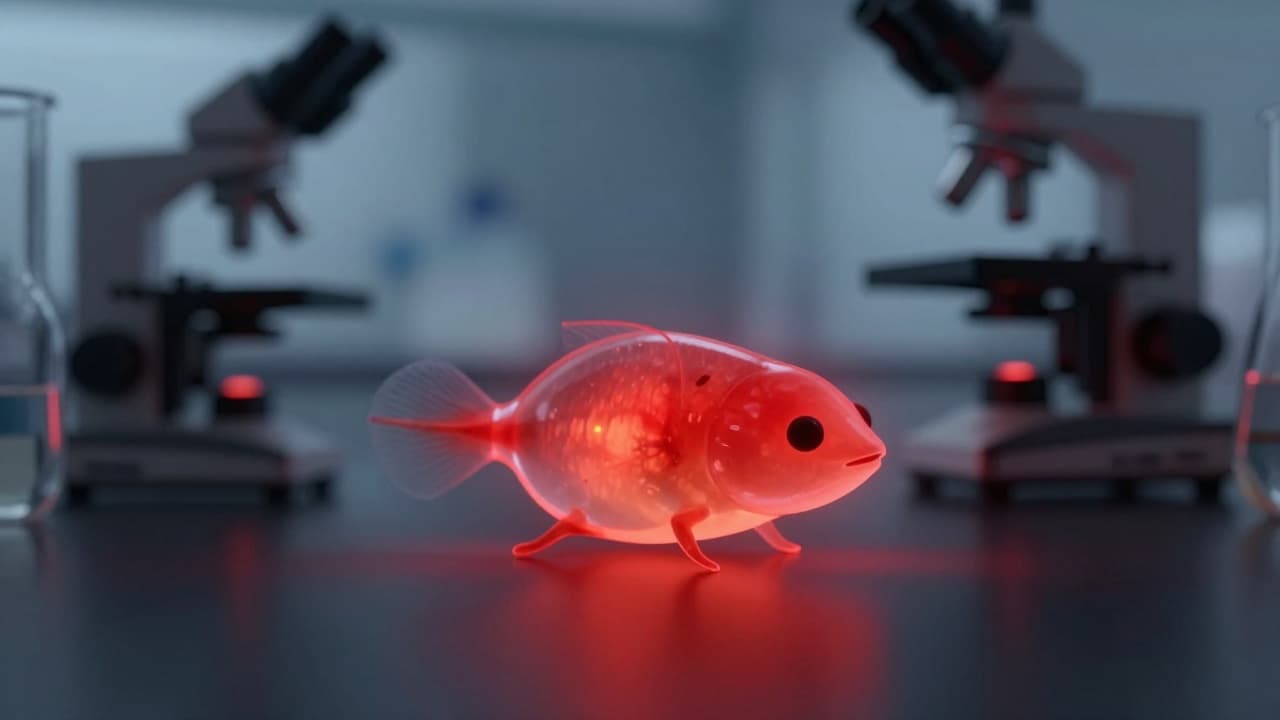
A team of scientists led by neuroscientist Tess Montague at Columbia University has created the first cuttlefish that glow red under fluorescent light. The result, published in the journal Science, was previously posted as a preprint on the bioRxiv platform.
For the first time in history, someone has successfully inserted a completely new gene into a cephalopod. The cuttlefish were created by injecting synthetic genes directly into their embryos, with every cell in their bodies carrying the gene for a synthetic fluorescent protein, including the egg and sperm cells. Their offspring also glow.
Montague said that when she first heard about CRISPR, a cuttlefish immediately came to mind. CRISPR is a system for precise gene editing, and the scientist had long dreamed of inserting genes into cuttlefish embryos so that the neurons would glow every time they sent signals. These light flashes would allow her to track how the cuttlefish brain manages camouflage, specifically by mapping patterns from the environment directly onto the skin. Cuttlefish, unlike most other animals, can display what they see through their skin.
The path to the goal was extremely arduous. Injecting the gene-editing tool into the fertilised egg required peeling back dozens of layers of the gelatinous protective covering. Special clamps were needed to hold the egg with the exact amount of pressure, and a needle with a specific angle was crafted to pierce the almost invisible lens-like embryo. It was also necessary to keep the young cuttlefish alive after hatching. Montague stated: 'It seems to me that we have experienced every possible failure.'
After six years of work and thousands of destroyed embryos, Montague created seven cuttlefish that glow red under fluorescent light. The creation of neurons that glow when active is the next step. Joshua Rosenthal, a biologist, stated: 'This is a fantastic breakthrough in our ability to create transgenic organisms.' This discovery opens up a range of new possibilities.