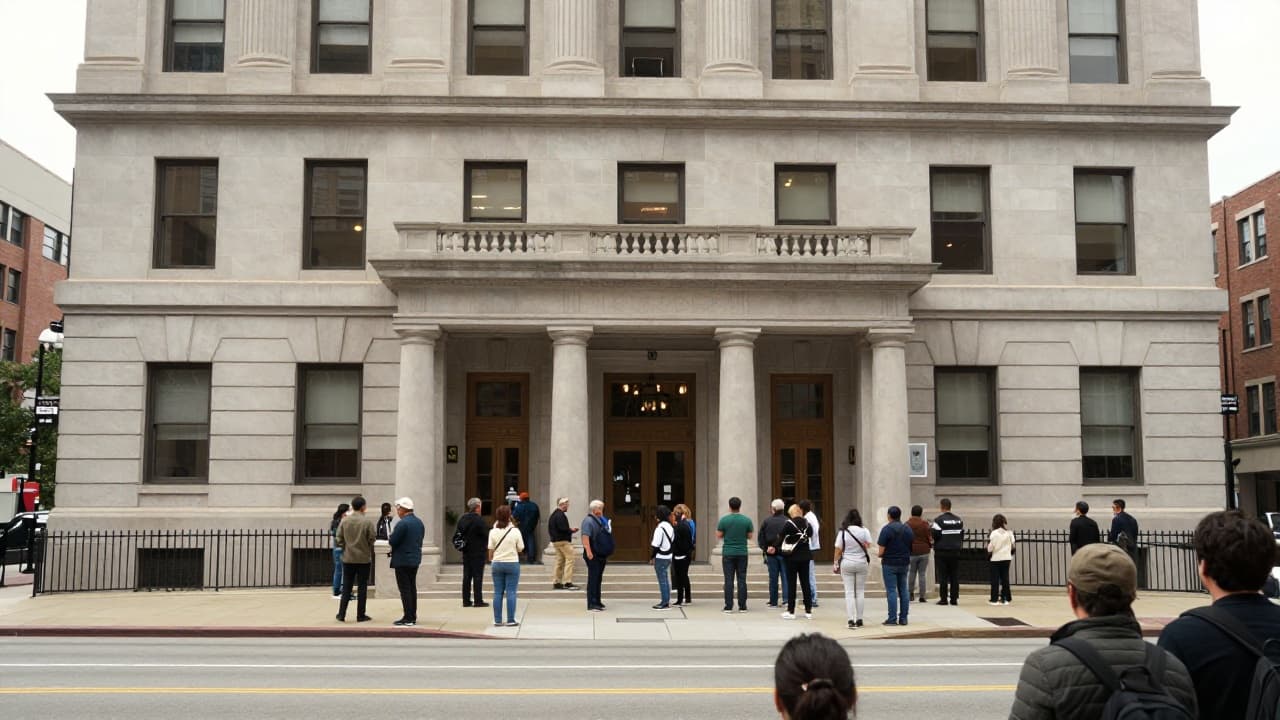
Nikhil Gupta, 55, was sentenced on Friday to more than 19 years in prison in the United States. The 235-month sentence was handed down by US District Judge Victor Marrero at a hearing at the federal court in Manhattan.
Gupta pleaded guilty in February to ordering a murder, conspiracy to commit murder and conspiracy to launder money. Prosecutors alleged that he conspired with an Indian government official to kill Gurpatwant Singh Pannun, a lawyer for Sikhs for Justice in New York and a dual US-Canadian citizen. Pannun advocates for a sovereign Sikh state in northern India.
According to the indictment, Gupta and Indian government official Vikash Yadav agreed to deliver $15,000 in cash to an alleged hitman, who was actually a secret US government agent. Yadav is also charged in the case but is not in US custody, and it is unclear whether he has retained a defence attorney. Prosecutors claimed that Gupta was recruited by Yadav, an Indian intelligence officer, in May 2023 to carry out Pannun's murder, and that Yadav provided Pannun's personal details, including his New York address and information about his daily activities. Gupta then contacted a person to broker the murder, but that person was a US informant who introduced him to the 'hitman', who was a secret agent from the Drug Enforcement Administration. Gupta was arrested at an airport in Prague, Czech Republic, in June 2023, and extradited to the US, where he was held in a New York jail until sentencing.
The US Attorney's Office for the Southern District of New York recommended a sentence of approximately 24 years in prison. Prosecutor Ashley Nicolas told the court: 'This case strikes at the heart of American values' and 'We never condone the use of violence to silence voices in this country.' Gupta expressed regret for straying from the non-violent example of Indian leader Mahatma Gandhi. 'I am sorry to Mr Pannun, I am sorry to the community I have hurt, I am sorry to my own family,' Gupta said. Pannun told the court that he was grateful to the US for prosecuting Gupta and that he would continue to advocate for Sikh sovereignty. 'The self-determination of my people and my homeland, Punjab, is my life's goal,' Pannun said. The judge stated that Gupta would likely be deported or removed after serving his sentence.
The Indian government commented on the case, rejecting any involvement in plots against Pannun and stating that this was contrary to government policy. India has also labelled Pannun a terrorist, a claim he denies. Pannun is a US citizen and a leading figure in the Khalistan movement, which advocates for an independent homeland for Sikhs. India opposes the Khalistan movement, and its political parties remain opposed to the issue. Sikhs are a religious minority making up about 2 per cent of India's population, and some groups have long called for a separate homeland for Sikhs.
The revelation of alleged murder plots against Sikh separatists in the US and Canada has tested relations with India, which has denied involvement in such plots. US and Canadian authorities have called the plot part of a broader effort to target Indian dissidents. Gupta pleaded guilty in February, and then-US Attorney General Jay Clayton said in a statement: 'He thought that from outside this country he could kill someone inside it without consequence, simply because he exercised his American right to free speech.'
Gupta's case has placed additional focus on a separate incident, the murder of a Sikh separatist leader in British Columbia in 2023, which led to increased tensions between India and Canada. In September 2023, then-Canadian Prime Minister Justin Trudeau said there were 'credible allegations that potentially link' India to the killing of Hardeep Singh Nijjar. Nijjar was another advocate for the creation of Khalistan and a Pannun associate, and was shot by two attackers outside a Sikh temple in British Columbia. India has also denied involvement in Nijjar's death. The day after Nijjar's murder, US prosecutors alleged that Gupta told a secret agent that Nijjar was 'also a target' and that 'we have so many targets'.
Narinder Singh Randhawa, a Sikh separatist and successor to Hardeep Singh Nijjar as the head of the temple in Surrey, British Columbia, told the BBC that the verdict marks 'the first time we see justice' against what he calls the historic and systemic persecution of Sikhs by the Indian government in India and abroad. Inderjeet Gosal, another Sikh separatist advocate based in Ontario, called the verdict a 'major event for the community'. 'It is for the whole community to finally witness someone caught in the act,' Gosal said.