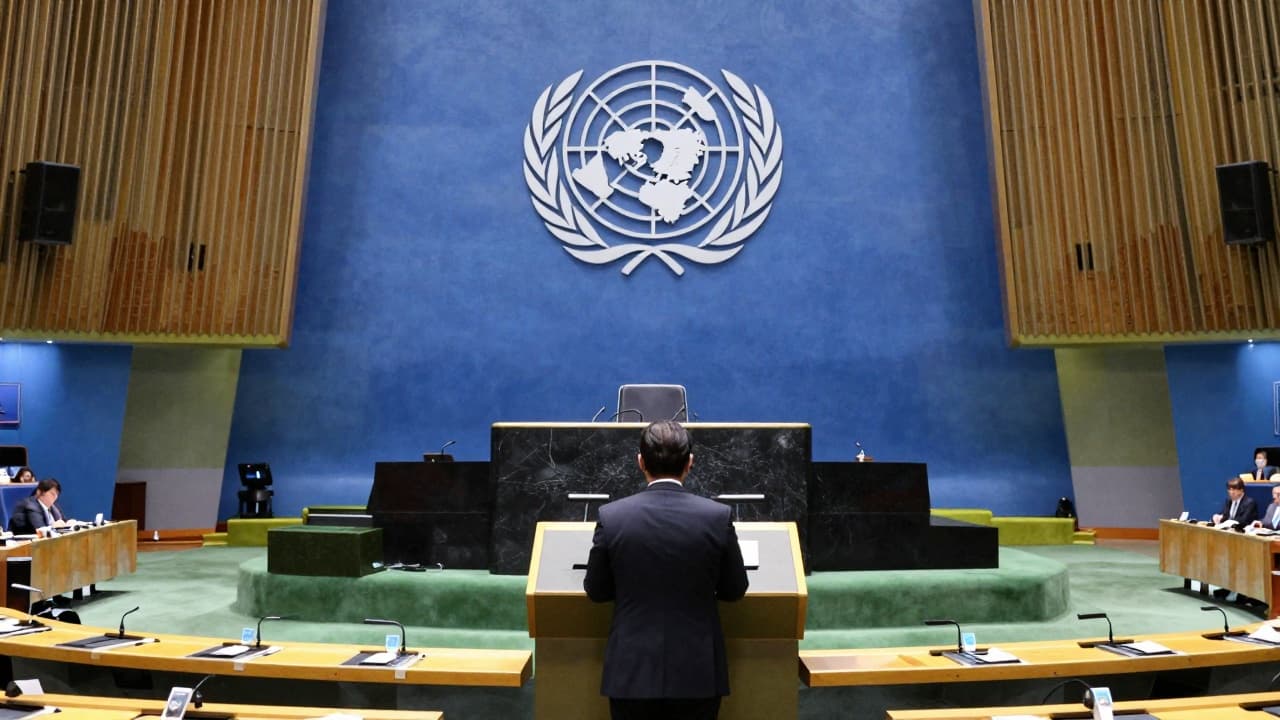
British foreign secretary Ed Miliband has stated that the national security of all countries is threatened by the climate crisis, a warning he will deliver to world leaders gathered in Turkey on Wednesday. He arrived in Antalya on Tuesday evening and will address world leaders and governments at the UN's Cop31 conference.
Miliband will tell the summit that security and defence objectives are the new "front" of climate action. According to him, rapid planetary warming will lead to food shortages, widespread economic disruption, migration and conflict. "National security is the next front in the fight for climate action – scenarios that were once science fiction are now a regular feature of the daily news," Miliband told the Guardian ahead of his addresses.
Miliband emphasised that climate breakdown represents one of the greatest threats to national security. "We need to be clear that climate breakdown is one of the greatest threats to national security we face: food security, threats to infrastructure and population movements [stem from the climate crisis]," he said. He added that those who "bury their heads in the sand" on climate are endangering national security.
Miliband will argue that the world must now confront the consequences of failing to reduce carbon emissions over the past three decades. "It is a catastrophe for people and the planet and we must confront its implications," he will tell the assembly on Wednesday. He will warn that this will "bring hardship and insecurity to billions of people". He will also note that "overshooting" the key threshold of 1.5°C of global warming above pre-industrial levels is now inevitable. Temperatures have already exceeded 1.5°C for two years and it is unlikely they will fall significantly. This "overshoot" requires stronger policies to ensure warming does not accelerate and to find ways to return temperatures to safer levels in the coming decades.
Shocks in the fossil fuel market, such as this year's oil price spike following the war with Iran, have led to uncontrolled inflation and increases in central bank interest rates in an attempt to curb it. "A new era of global insecurity means that fossil fuel shocks are now the norm – the fossil fuel rollercoaster is here to stay," Miliband told the Guardian. "First Russia, now Iran, next others, have identified global chokepoints and systemic over-reliance [on fossil fuels] and the vulnerability of countries around the world that they expose," he added.
Miliband believes the only answer is to "double" efforts on measures to reduce greenhouse gas emissions and build resilience to the effects of extreme weather. "Next year will be the year of climate counter-attack, as governments, movements and communities around the world strengthen the defence of our shared home," he said. He will also call for greater investment in clean energy and efforts to use it for transport and heating, as well as urgent action to reduce methane and to protect and expand forests.
The two-day segment of the leaders' summit takes place on Wednesday and Thursday, and will be opened by Australian prime minister Anthony Albanese and Turkish president Recep Tayyip Erdoğan. Cop31 began on Monday. British prime minister Andy Burnham is expected to travel on Wednesday for a series of bilateral meetings with world leaders on Thursday. Among the participants are UN secretary-general António Guterres, Brazilian president Luiz Inácio Lula da Silva – whose country hosted last year's Cop – and Ethiopian prime minister Abiy Ahmed, as Ethiopia hosts the next meeting. European Commission president Ursula von der Leyen will also attend, while this year's Cop is being skipped by Chinese president Xi Jinping, Indian prime minister Narendra Modi, French president Emmanuel Macron and German chancellor Friedrich Merz.
Burnham's government in Britain is under pressure due to a series of recent and upcoming policy interventions which activists claim will take the country off track to achieving its net-zero greenhouse gas emissions target by 2050 and set a bad example for the rest of the world. The government plans to weaken the obligation for car manufacturers to ensure that more of their vehicles are electric by 2030. It has also given the green light for the new Jackdaw gas field in the North Sea and is considering licensing the new Rosebank oil field.