The government of Panama declared a state of emergency on Saturday following two strong earthquake sequences that struck the Central American country on Friday. The earthquakes measured 7.7 and 6.6 in magnitude, with seismologists recording more than 100 aftershocks, including those of magnitude 5.8, 5.5 and 5.2.
The state of emergency was announced by the presidential spokesperson, Juan Carlos Orillac, at a press conference in the capital, Panama. Damage was reported in all 10 provinces of Panama and in two indigenous regions, with the earthquakes having toppled buildings near the epicentre and prompted evacuations across the country.
According to data from the US Geological Survey, the first earthquake was centred approximately 10 miles west of the remote community of Pitalito Arriba in the central province of Herrera, at a depth of 10 miles. It was also felt in neighbouring Colombia.
The deputy director of the National Civil Protection System, Malitzia Rivera, reported that 27 people were injured with injuries ranging from minor to moderate. The majority of damage was concentrated in the central provinces of Veraguas, Herrera, Cocle and Los Santos, where approximately 420 homes and the same number of public schools were damaged. Among the damaged structures were homes, schools, health facilities, roads and hotels, with seven hotels affected, along with at least 13 churches and nine bridges.
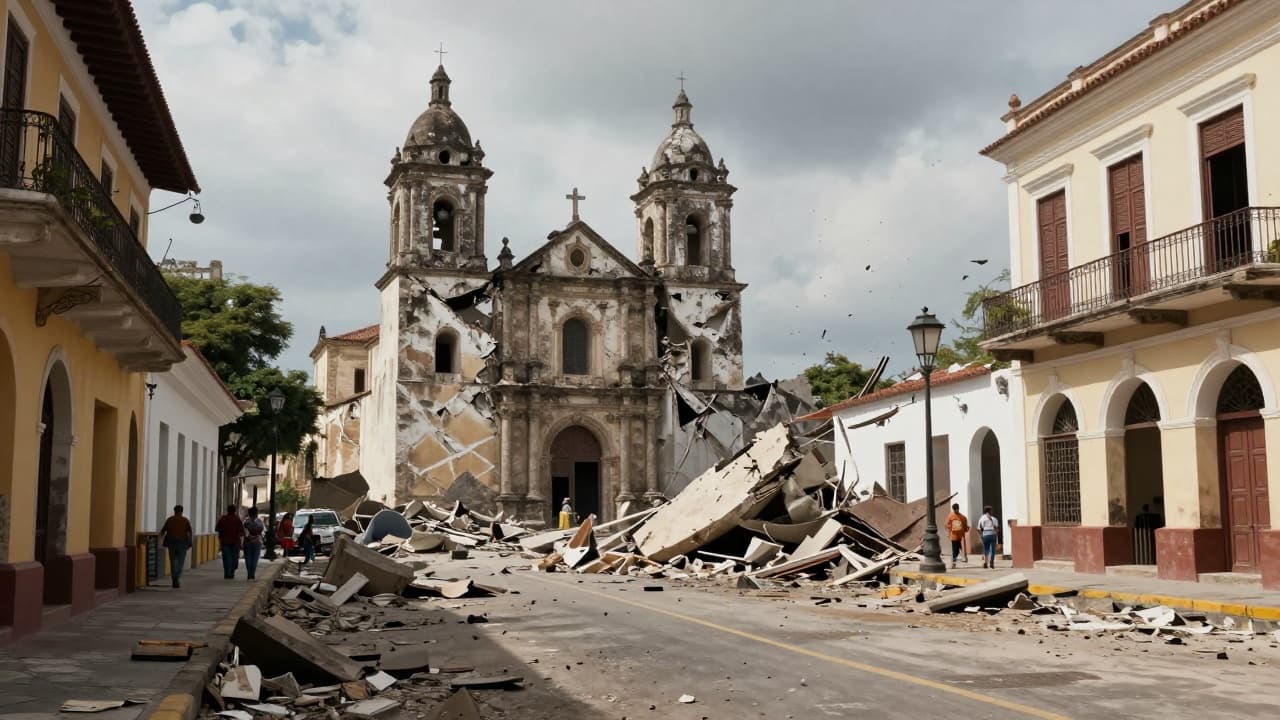
In La Villa de Los Santos, a colonial town approximately 64 miles from the epicentre, homes and a historic Catholic church collapsed. Residents who had spent the night outdoors waited for government instructions on further steps. Tony Jimenez, whose home was partially collapsed, stated: "We have been here since 1pm yesterday; we have not moved." He added: "It was a terrible thing. I can tell you with absolute certainty that in my 90 years I have never experienced anything like it. It was intense – truly intense."
Officials on Saturday reported no missing persons, although some communities remained cut off due to landslides and damaged roads. Carlos Valdes, head of the seismology department at the National Autonomous University of Mexico, assessed that the country had avoided mass casualties thanks to strict building codes, particularly those regulating the construction of skyscrapers in the capital.
Following the earthquake, messages of support and offers of aid arrived from across the region. President Mulino on Friday thanked fellow Latin American leaders for their support, noting that he had spoken with the presidents of Chile, Uruguay and Guatemala, among others. The US State Department on Saturday announced that it had deployed a disaster response team to assist local authorities in search and rescue operations, as well as in aerial and ground assessments. The US government pledged $5 million in aid, while the Southern Command reported that two helicopters, supported by the State Department's office, had delivered 2,000 pounds (907 kilograms) of food to those affected.