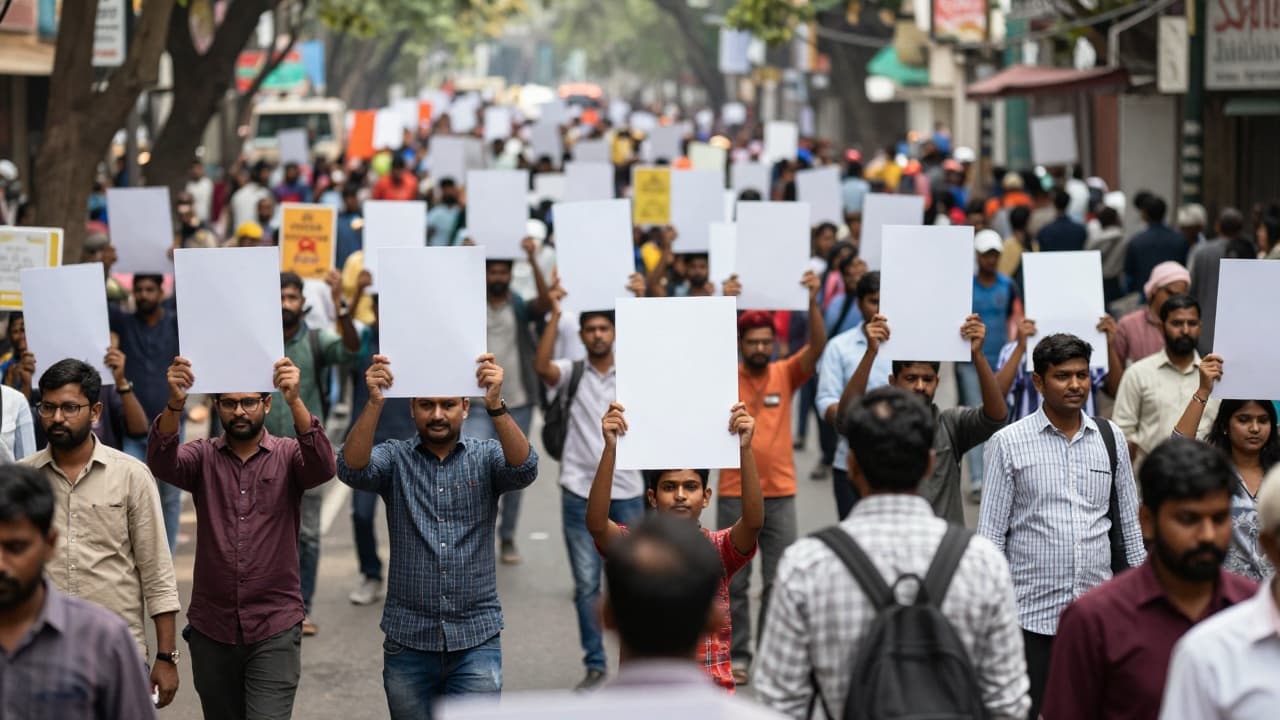
Hundreds of protesters were arrested in Delhi during the latest protest by the Cockroach Janta Party (CJP), led by Generation Z, which advocates for electoral reform. The group stated that its founder, Abhijeet Dipke, was arrested alongside other leaders shortly after landing in Delhi. The Delhi police did not comment on the arrests.
Before arriving in Delhi, Dipke stated: "If you think you can stop us with threats of prison or by instilling fear of prison, you are mistaken." Dipke, along with two other leaders, Saurav Das and Ashutosh Ranka, was arrested on Saturday after flying from Mumbai. The group stated that the three men were taken to an unknown location. Ajinkya Shinde was appointed as the new leader of the CJP while the others remained in custody. Shinde posted a video telling protesters that, "if the Delhi police try to stop you, the place where they stop you will become your Jantar Mantar." Student activist Neha Bora, who was also arrested, urged demonstrators to "endure."
Despite the ban, the CJP insisted on holding the protest. The Delhi police had previously refused permission for the protest at Jantar Mantar, a landmark in the Indian capital. Dozens of security personnel were deployed, and roads were blocked. A large number of expected protesters were unable to reach Jantar Mand due to the heavy presence of security forces and roadblocks. Proclamations calling on people to cooperate with the police were heard throughout the city.
One protester, Sabika Muzaffar, told the BBC that she expected she and her mother would be arrested. "On the way to the protest site, instead of reciting prayers and verses as we usually do, my mother and I were memorising the number of our lawyer," said Muzaffar. She said that coming to the protest was "her way of defending the country and its democracy." Minutes after speaking to the BBC, she was taken away by the police. Buses full of arrested protesters were seen leaving the protest site. Several trains to and from major Delhi stations were cancelled, and dozens of metro stations were closed from Friday evening.
The CJP is calling for electoral reform just months before the state elections. It has demanded the resignation of the Chief Election Commissioner (CEC) following allegations of manipulation in the voter rolls. The Election Commission has dismissed these allegations. Under the leadership of the commission, a massive exercise of updating voter rolls was carried out, with the commission claiming it was a routine procedure of removing deceased, duplicate, or ineligible voters. In many states, this process was met with controversy, with tens of thousands of people claiming they had been incorrectly removed. The CJP and opposition parties accuse the commission of favouring the Bharatiya Janata Party (BJP) of Prime Minister Narendra Modi in the way voter rolls are updated. The election commission and the BJP have denied allegations of favouring the BJP.
The CJP first emerged as a significant protest movement during the summer, when it demanded the resignation of the education minister following weeks of demonstrations. The group was formed from a joke made by Dipke in response to a statement by Indian Chief Justice Surya Kant, who compared unemployed youth to "cockroaches." Surya Kant later stated that his comments had been misinterpreted. Dipke had previously worked with the opposition Aam Aadmi Party. He had just completed his master's degree when, in May, he posted a question on X: "What if all the cockroaches united?" The post went viral and the CJP was born. The momentum of the movement grew on the wave of anger over unemployment, leaked exam papers, and government accountability. In July, Dipke watched from the sidelines as a five-week protest ended in celebration following the resignation of the Indian education minister.