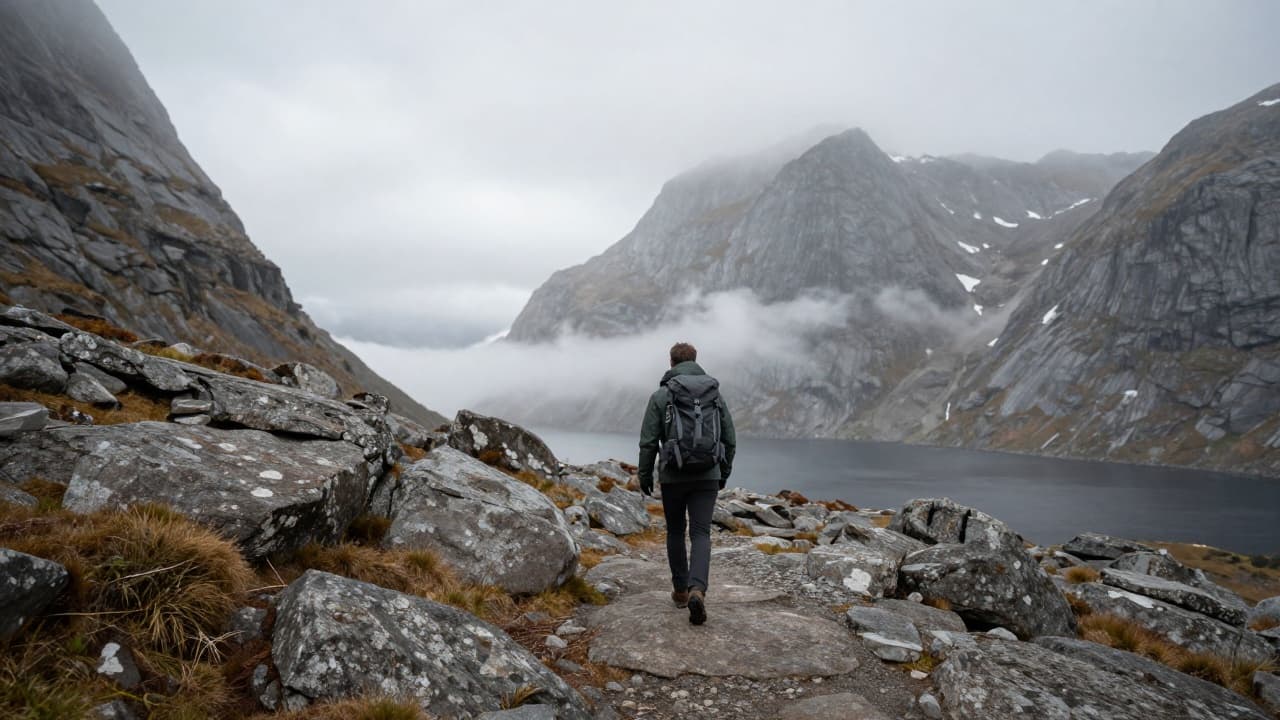
The Split-born climber and former member of the Croatian Mountain Rescue Service, Željko Bockovac, independently covered 110km of terrain, from the settlement of Kapisillit to the capital, Nuuk. The journey took six days, with Bockovac carrying all necessary equipment, food, and a tent.
The expedition to Greenland had been prepared for almost a year. The original plan was for him and a friend, also from Split but working in Iceland, to cover 60km and climb the 2,300-metre-high Storebrisor. However, ten days before the departure, the friend had to withdraw due to family reasons, so Bock decided to go alone. He chose the route on the west coast of Greenland.
During the six-day walk, he met only three people. He walked from seven or eight in the morning until four in the afternoon, covering about 20km in the first two days, while afterwards he covered 15 to 17km. He set up his tent next to a stream or lake, and at six o'clock he would retreat into his sleeping bag. For breakfast, he ate tortillas with bacon and hard cheese, with coffee or tea; during the day he did not eat, but after walking he prepared pasta from a pouch. He poured the contents into half a litre of water and, after five minutes, had a meal, changing the pasta flavours: mushroom, carbonara, bolognese. He did not carry cans because they were heavy and, as waste, he ate the same dish for six days. He did not carry books due to their weight and the dampness, while the battery of his mobile was saved for navigation.
The journey was made difficult by rain, swampy terrain, and numerous streams. For four days, he had completely wet feet, constantly pouring water out of his shoes and wringing out his socks. During the journey, he fell twice but managed without serious injury. He crossed hundreds of streams and was surprised that he did not get blisters. Out of the ten sunny days predicted, he received only a few.
There was a danger of polar bears on his route. Before setting off, he learned that a polar bear had killed a climber in that area six years previously. He did not have a satellite phone with him, although his mother and wife, Livia Puljak, a long-time medical columnist for Index, had asked him to take one. He had insurance for rescue, but in the event of an accident, he would not be able to call for help. He used his mobile only for navigation via pre-downloaded maps, telling his wife and a friend from the Croatian Mountain Rescue Service that they should start a search if he did not report back after eight days.
The most dramatic moment occurred just before the end of the expedition. He found shelter on the edge of a cliff, above a 200-metre deep abyss. During the night, a strong storm hit the area, and the wind was so strong that the object was shaken. The hut was attached to the rock with ropes. Bock prepared for a possible escape and spent the night awake, continuing his journey towards Nuqu in the early morning.
He met a pair of Danes whom he overtook after two days, and an American, Eliot, from North Carolina, who was going in the opposite direction. He spoke to them for five minutes. He asked Eliot if he had a satellite phone, and Eliot did. Bock did not tell Eliot that he did not have a satellite phone.
The journey by boat to Kapisillit was part of the trip. He was the only passenger on the boat, which was driven by two young Inuit women. The friend who was going with him worked in Reykjavik as a chef and offered him hiking in Iceland. After two days of walking in Copenhagen, Nuuk was a cold shower. In Nuuk, motorised sleds parked near the houses, but there were few dogs and dog sleds in the area, and the main street was sometimes without a sidewalk. Accommodation in Nuuk was scarce and very expensive; there were a few small hotels, but the rest were apartments rented out via Airbnb and Booking. The tent could be set up almost anywhere, even in the central park, but not in front of someone's door.
The last day, he came across a hut with the best view of the fjord. He spread out his tent, clothes, and socks to dry, thinking that he was finished and that he had only a few kilometres left to reach Nuuk. Bock has almost 45 years of mountaineering experience and 30 years of experience in alpinism, having climbed many of the world's most challenging peaks, including the Himalayas and the Swiss Eiger. He has written four books about his adventures. He stated that he would not repeat such a trek.