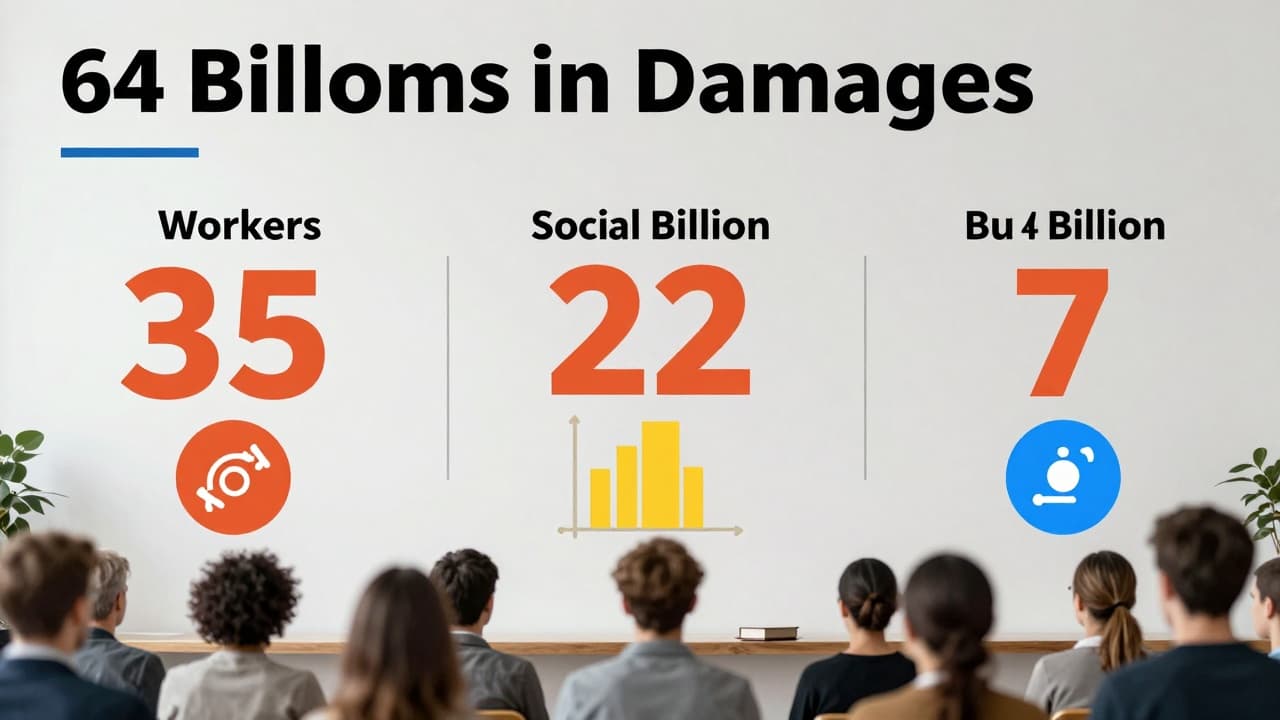
Workers in Slovenia are entitled this year to a mandatory winter bonus of at least 740.94 euros, which is half the Slovenian minimum wage. The minimum wage in Slovenia for 2026 is 1481.88 euros, and employers must pay the winter bonus in cash by 18 December at the latest. Employees who worked full-time for the entire year with the same employer should receive at least 740.94 euros, while those who were not employed for the whole year or work part-time are entitled to a proportional share of the amount.
In Slovenia, Christmas pay is prescribed by law, and the winter bonus up to the prescribed amount is exempt from income tax. A joint tax limit applies to the winter bonus and additional bonuses for business performance. Employers may pay higher amounts depending on business results and rules in individual companies, but the mandatory winter bonus differs from additional performance bonuses. The Slovenian Constitutional Court considered last year’s payment of the winter bonus to employees outside the public sector and ruled that the measure was contrary to the Constitution due to an unjustified retroactive effect, but did not annul it. The court did not challenge the introduction of the mandatory winter bonus itself.
In Croatia, however, there is no general legal obligation to pay Christmas pay to all employees. The right to payment and its amount depend on collective agreements, work rules, employment contracts or the employer’s decision. As a result, amounts vary significantly, and according to some surveys, 25 per cent of workers do not receive Christmas pay at all, while it is mostly the rule in the public sector. At HEP, it will amount to 500 euros this year, at FINI 350 euros, in ministries 300 euros, and at Hrvatske ceste and HŽ 250 euros each. Hrvatske autoceste predict a payment of 200 euros. Civil servants and officials are entitled to a Christmas bonus of 300 euros under the collective agreement, and the same amount is planned for employees of the Croatian Parliament who will be in civil service on 25 December, regardless of length of service, but this does not apply to parliamentary members. Employees of the Ministry of Finance, the Ministry of Spatial Planning, Construction and State Property, and the Ministry of Regional Development and EU Funds will also receive 300 euros each, unless otherwise agreed in the meantime.
In the private sector, there are no rules, and amounts range from around a hundred euros to a top of about 1900 euros, which DM pays. PBZ will pay 1333 euros, Kaufland 400 euros, Konzum 360 euros, and INA 330 euros. It is estimated that a quarter of workers receive nothing or only vouchers. Željko Stipić, president of the Preporod union, stated that an amount of 300 euros is not enough and that it is certainly not a reward that could meet workers’ expectations. He explained that there are situations where there is literally no Christmas pay, which should be resolved legally by following the Slovenian example.
Economist Ljubo Jurčić proposes introducing a mandatory Christmas bonus of at least 400 euros per worker, net. He believes that Slovenia made a completely correct decision and in that way protects the Slovenian man and worker. Jurčić said that Croatia can do it, but only if it has the political strength and political will, and that it is a matter of political decision alone. He added that Slovenia has income about 30 per cent higher and salaries 30 per cent higher, so they can afford it more easily. In Croatia, there is no such political decision for now, and workers still depend on the goodwill of employers. Citizens support the idea of a minimum Christmas bonus. Anela from Zagreb thinks that 700 euros is quite a lot and that some Croatian salaries do not amount to that much, but that around 500 euros would be very nice. Vladimir from Zagreb says that if Slovenians have 740, he would gladly have the same, but believes that at least 600 euros should be the minimum. Zagreb restaurateur Hrvoje said that since becoming a private entrepreneur, his employees have received Christmas bonuses every year, sometimes more, sometimes less, and that people should be rewarded before Christmas. Marjan Trobiš from the Association of Slovenian Employers says that representatives of employers, unions and the Government should sit at the same table and discuss the method of paying the Christmas bonus.