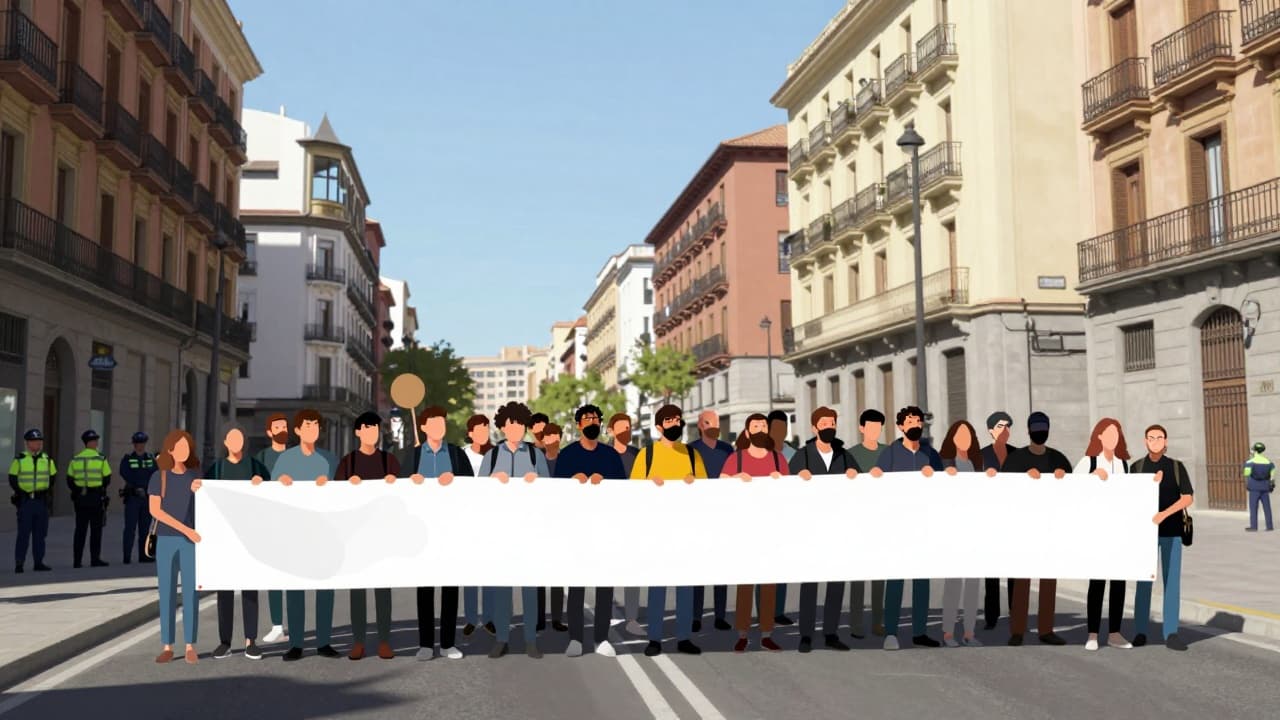
Thousands of people took to the streets in Madrid and other Spanish cities on Saturday to amplify their demands for a resolution to the growing housing crisis. Protests were held in 50 Spanish cities, with 70,000 people taking to the streets according to official figures, while organisers claim the number reached 500,000.
The protests followed the rejection on Friday by parliament of the government's measures to address the housing crisis. The measures were designed as a response to the public outrage following the eviction of an 87-year-old woman in Madrid. Protesters on Saturday carried banners calling for a general strike.
On Friday, the coalition led by Prime Minister Pedro Sánchez proposed two decrees on measures to improve access to housing, including a ban on evictions until 2030 and regulation of temporary and shared rentals. The conservative People's Party, the far-right Vox, and the Catalan pro-independence Junts party voted against both decrees. The People's Party stated that it voted in line with its conviction that building, rather than regulation, is the best way to address the crisis. A representative stated: "Housing does not become more affordable through decrees; it becomes affordable by building more homes."
The protests on Saturday were peaceful in 50 Spanish cities, but demonstrators clashed with police in Valencia, who fired rubber bullets and tear gas to break up the protest. Around 30 people managed to enter the City of Arts and Sciences before being dispersed by police.
Among those protesting in Madrid was 26-year-old Nando de Anguulo. Marcos Sainz, 26, a librarian, said he used to rent a two-bedroom flat with friends for a monthly rent of 900 euros ($1,000). Sainz added that a one-bedroom flat now costs 1,000 euros, which is half the median monthly salary in the capital. Javier, a 31-year-old installer of solar panels, said he spends half his salary on a small room. Valeria Racu is one of the spokespeople for the Tenants' Union, which is organising the protest.
Spanish media reported on Friday that Prime Minister Pedro Sánchez could call for early elections in November following the rejection of the legislation. Sánchez is expected to monitor the strength of the Saturday protests before making a decision.
Maricarmen Abascal, 87, who uses a wheelchair, was evicted from the home where she had lived for 70 years. Abascal said she could not afford the 230 per cent increase in rent demanded by the investment fund that had purchased her building.