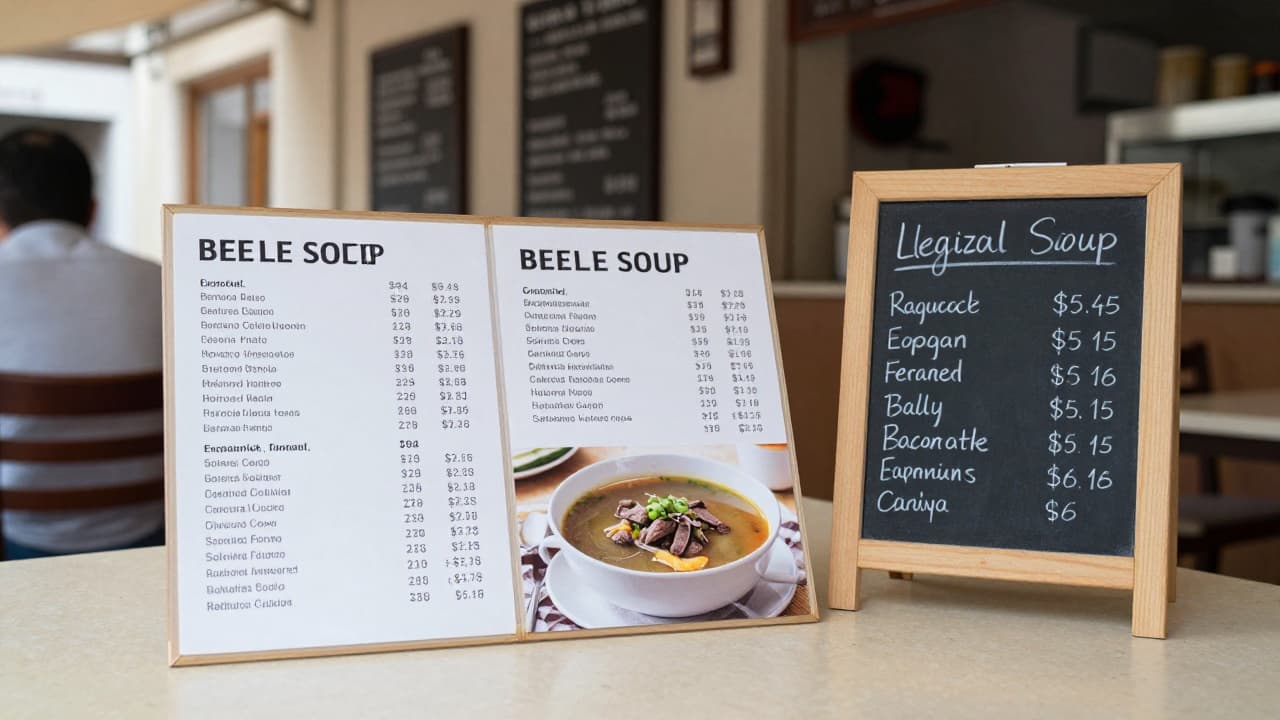
All restaurants and bars will be required to list the price of each product alongside the current price, starting from 1 October. The price listed must be the price the product had on 10 September 2026. If the product was not available on 10 September, the price listed should be the price at the time it was added to the menu.
The Ministry of Economy has stated that anchor prices will also apply to all service providers. The Croatian Chamber of Economy has demonstrated how this decision would work in practice by creating a price list for a fictional florist who buys flowers daily and changes prices. In the example restaurant, which is imaginary and imagined by the Chamber, the beef soup is listed at 3.50 euros, with a side note of 3 euros — the lower price being valid on 10 September 2026.
The Chamber explained a more complex scenario. If a florist decides to offer roses at a promotional price 30 per cent lower, they must display four prices: the initial price, the promotional price reduced by 30 per cent, the lowest price in the last 30 days, and the price of the same product on 10 September 2026. The same rule applies to caterers who have a board outside their premises where they write prices in chalk; this board will also need to display anchor prices.
Caterers spoken to were revolted by the new obligations taking effect from 1 October, with some threatening legal action. Fran Ljutić, president of the Association of Caterers in Zagreb, stated that three ministers of economy had attempted to introduce order among wholesalers. He claimed that wholesalers had shamelessly raised margins and enriched themselves, while describing caterers and other service providers as collateral damage. Ljutić blamed traders for the inflation, stating that caterers are dependent on wholesale prices, with margins rising to obscene levels, sometimes by 900 per cent. The deadline for printing new price lists is 25 October.
Restaurant owner Marin Medak highlighted how the new regulations are absurd. He stated that hospitality is one of the most heavily taxed sectors in the country, and that running a restaurant is not a social service requiring state regulation. Medak believes the decision is part of a law primarily aimed at traders, and that the state has not yet conducted a study proving that displaying anchor prices has an effect on inflation. Medak calculated that if 200,000 service providers must change their price lists, and the average cost is 1,000 euros per establishment, this results in a one-off cost of 200 million euros.