
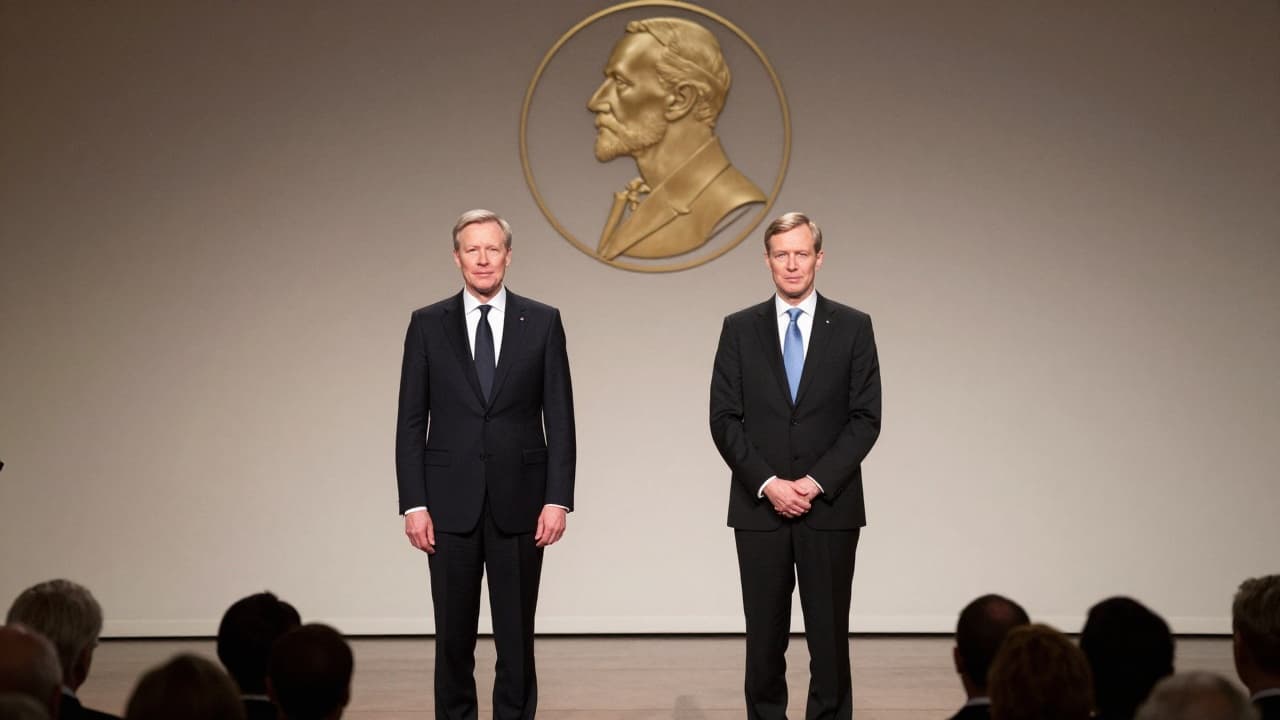
Two American economists, Robert Hall of Stanford University and Michael Woodford of Columbia University, are the recipients of the 2026 Nobel Prize in Economics. They are awarded for developing models that help central banks and finance ministers stabilise economies.
The Royal Swedish Academy of Sciences announced that it is awarding the prize for developing "the microeconomic foundations of macroeconomic stability". The Academy highlighted that this is a "paradigm shift in policy". The prize is worth a total of $1.2 million, or approximately £900,000.
According to the Academy's statement, the models developed through their research allow for an explanation and quantification of how stabilisation policy affects business cycles. These models are currently used by central banks and finance ministries around the world. These models have improved upon stabilisation models, which had struggled to cope with the consequences of the oil shock in the 1970s, when countries simultaneously experienced high inflation, weak growth and high unemployment.
Hall and Woodford demonstrated how traditional models could be reconstructed based on how households and businesses collectively affect the economy. Hall's work was based on forward-looking consumer behaviour, rather than the mechanical rules used by Keynes. Woodford built upon this work, creating a new Keynesian model, a comprehensive framework for macroeconomic stabilisation that is now a primary tool for policymakers. This model has also been used following the 2008 financial crisis.
John Hassler, chairman of the prize committee, stated that the laureates' work provided a stable theoretical foundation for the models used by central banks and governments worldwide. He stated that we are better equipped to deal with economic shocks, such as energy crises or sudden changes in household spending, thanks to them.
The work of Hall and Woodford also led to the development of forward guidance, the practice where central bankers communicate where they expect interest rates to be in the future. This instrument has become an important tool following the 2008 financial crisis and the COVID pandemic, when interest rates were cut to record low levels.
Hall is also known for the idea that American economists can be divided into freshwater and saltwater schools. The freshwater school, primarily operating at universities in the interior, near the Great Lakes, such as the University of Chicago, advocates for free markets, neoclassical price theory, rational expectations and monetarism. Economists gathered at coastal universities, such as Harvard, MIT, UC Berkeley, Yale, Princeton, UCLA and Columbia, lean towards a Keynesian and New Keynesian approach.