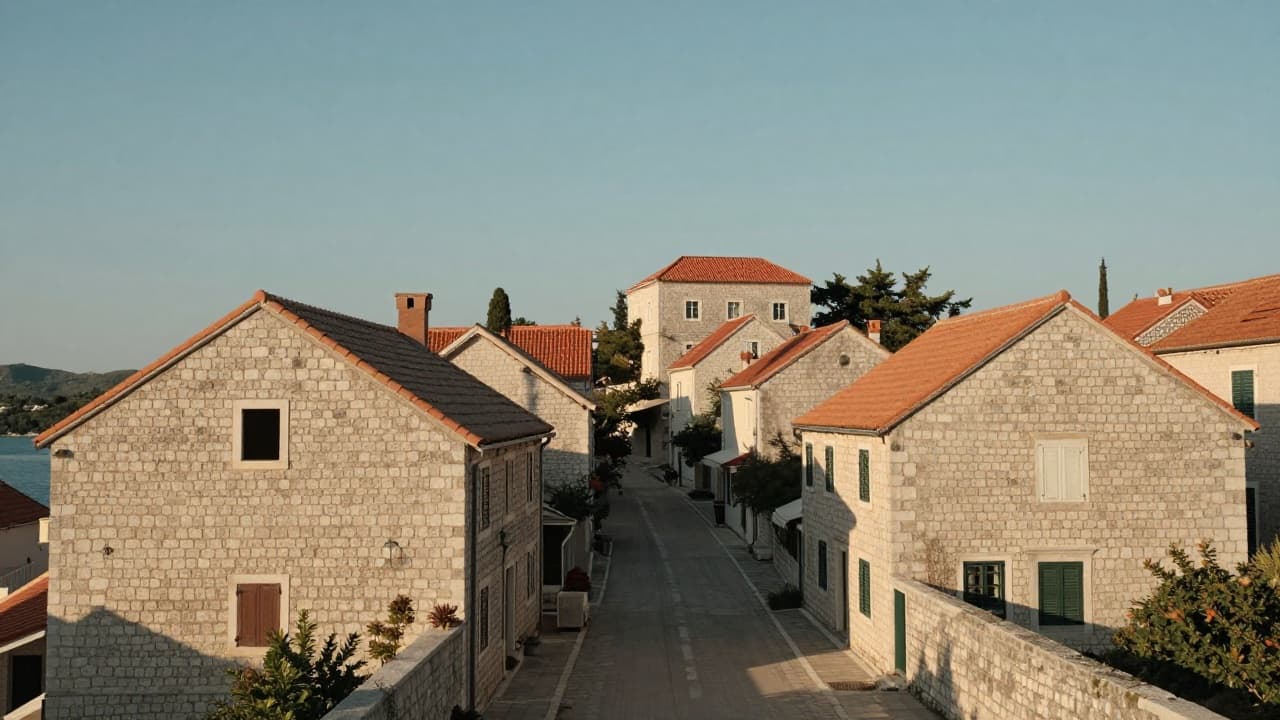
Josip Bepi Biočina was just 12 and a half years old when he lost his mother and sister in Postira, yet every year he returns to the place on the anniversary. He goes to the cemetery, lights a candle for his mother and sister, and always visits the grave of Don Ante Marušić. Postira now appears to him, as he says, almost unreal in its vastness compared to the place he remembers.
Biočina, as a boy, survived one of the gravest tragedies that Postisa experienced during the Second World War. He says he was one minute away from death. On that day, neighbours had gathered in a shelter in a house next to the parish office, which was considered one of the safest places.
Don Tonči Jelinčić, in his book Poneka postirska zbivanja s drugog ugla (Postisa Events from Another Angle, 2019), recorded that German troops on the other side of the Brač channel would occasionally open fire, with the cannon firing every afternoon. The villagers, according to the record, would finish their household chores and have a modest lunch in order to settle into the shelter in time.
On that day, Biočina had a reason to leave the shelter. He says that he was a lively but obedient child, but on that day he never said 'no' to his mother. As he was walking down, he heard the first cannon fire. He returned to the house, left the first limb, and then went out again to tell his friend that he needed to make a second limb for the hedge. At that moment, his mother began to shout: 'Bepi, come here quickly!'. He was at the church and ran the 100 meters in less than a minute. And then the shell fell. He fell to the ground from the pressure, and when he managed to stand up, he went to that friend and said: 'They have killed my mother.'
According to the record of the tragedy, on 25 September the cannon hit the shelter in the house opposite the parish office. In the book Postisa in the Whirlwind of Violence (2009), published by the Parish Office of St John the Baptist, it states that 'the Germans, the Nazis, hit the safe room (as it was thought) opposite the priest's house'. The villagers had taken shelter in the belief that they were protected by thick walls and the position of the house, but the shell hit the window on the facade, piercing the internal partitions and exploding among the people.
There were twenty people in the shelter according to the data in the Annals of the Parish of Postira 1939–1974 by Don Ante Marušić. Twelve people died, and there were also serious injuries among the survivors. Among the twelve who died was one of the sisters of Josip Bepi. He went back up as soon as the shooting stopped, thinking he was the first to arrive. The entrance, he says, looked like a cave and there was no door, with intestines, pieces of body and blood everywhere. He found his mother's hand 48 days later and recognised it by the ring on her hand.
There are different interpretations and testimonies as to who fired the fatal shots on that day. In local historical records, the attack is attributed to the Germans, but Biočina claims that the Ustasha killed his mother, stating that the Germans had already withdrawn by September 1944. The records of the war events in Brač mention German troops on the other side of the Brač channel and their occasional cannon fire on the island, but these records do not give a clear answer to the question of who fired the fatal shots on 25 September.
After the war, Biočina went first to Korčula with one of the sisters. He entered the military school thanks to family connections and the help of people who knew of his wartime fate, and became a marine. He spent years sailing on military ships and spent seven years at sea, being among other things in the escort of the then President of Yugoslavia, Josip Broz Tito, saying that he had narrowly escaped 'death by a hundred per cent' three times.
A few months before the tragedy in September, Biočina had already found himself in a situation which he says could have been fatal. In March 1944, as he recalls, the occupiers gathered and lined up the men born between 1932 and 1938. He stood in the first row with his father and brother. Don Ante Marušić, who had baptised him, warned that the boy was actually a year younger than they had thought, confirming that he knew him because he had baptised him. Biočina says that Don Ante Marušić came to Postisa in 1939 and lied to save him. After that, a general, as he remembers, pushed him with a cane, giving him the signal that he could leave. His second birthday was the day when Postisa was bombarded and he was separated from death by a minute.