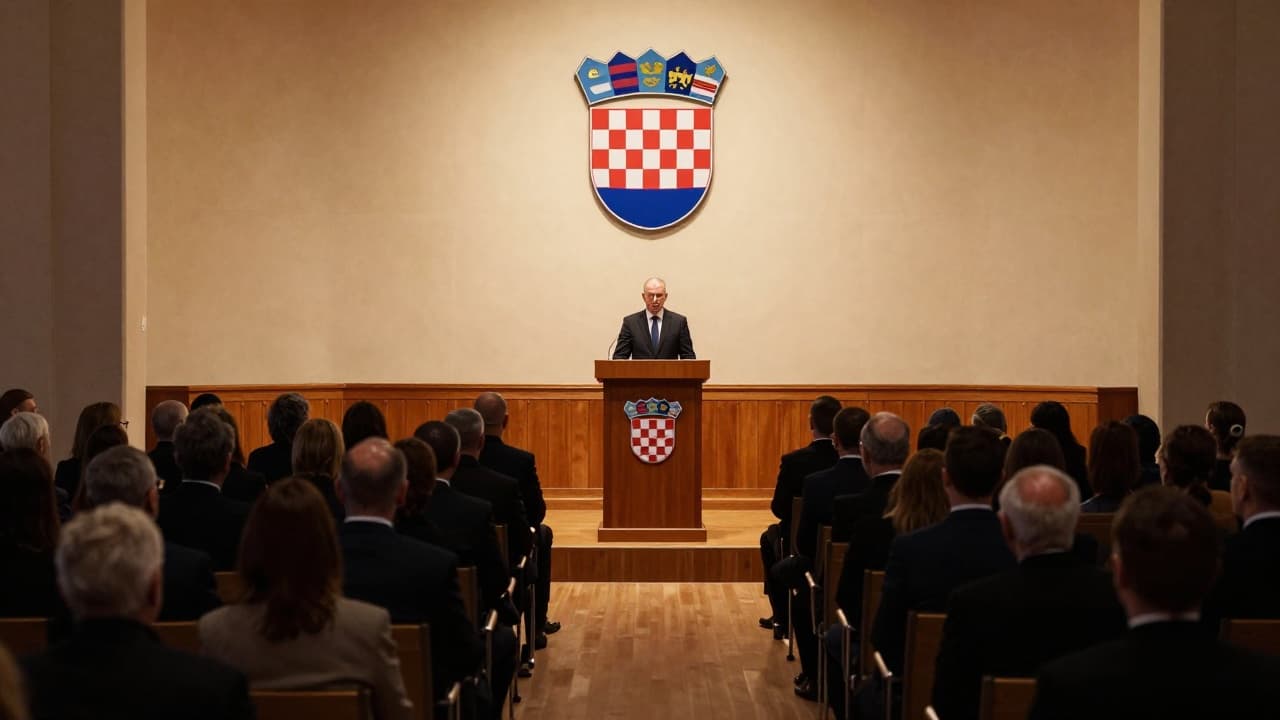
Formal education is increasingly losing the battle to peers and social media, including the so-called 'manosphere' which pushes young men towards radicalisation, experts warned at a debate on low political knowledge and young people's trust in institutions.
Dragan Bagić from the University of Zagreb, one of the initiators of the first wave of the survey almost 17 years ago, said he had moved from an enthusiast who believed in the power of formal education to a pessimist. 'Today I am no longer convinced that the formal education system can make a significant difference, due to all the other agents of socialisation that have become much more significant and influential in the meantime,' said Bagić at a debate organised to present the results of the 'Youth Political Competence' study by the Institute of Social Research in Zagreb (IDIZ).
Bagić noted that schools are losing authority in an increasingly polarised society, where topics that should be part of the basic consensus, such as human rights or democratic values, are becoming controversial. He particularly highlighted the role of peer groups in combination with social media as a growing, hard-to-grasp force of socialisation. 'I think the biggest challenge is the emergence of subgroups, pockets, where extremely dangerous socialisation is taking place, in which views directly opposite to the basic principles of liberal democracy are developed,' said Bagić.
Krešimir Krolo from the University of Zadar, commenting on the gender differences observed in the survey, said there is a 'gateway' to the political radicalisation of young men via the so-called manosphere, an online space of 'male influencers'. According to Krosh, male influencers amplify the status frustration of young men facing the reality that women today have greater autonomy and do not have to accept traditional expectations.
He described a pattern where young men, seeking answers online, start with seemingly harmless content about self-discipline, such as exercise or daily organisation, but this quickly escalates into a sense that 'space for their dignity is being taken away', which then turns into a backlash against feminism and women's rights. 'If you look at the research, this is then linked to the choice of political parties and political options that support these radical perspectives,' said Kroš.
As an example, he cited voting patterns where young women are more likely to vote for the left, while young men lean towards far-right parties such as Germany's AfD. He added that influencers such as Andrew Tate or Elon Musk's comments are part of a broader narrative of 'imaginary, classic masculinity' which, he said, 'is quite hostile to everything achieved in the last hundred or so years'. He also noted that a similar polarisation is occurring on the opposite side, as young people with more liberal views increasingly remain within their own 'media bubble', without real communication with the other side.
Lucija Dumančić Jovanović from GONG said that, despite civic and political education not being a separate mandatory subject in Croatia, civil society has been trying to introduce such content into schools through cities and counties that have recognised it as important, such as the Rijeka model which has gradually spread to other areas. She highlighted that students who are otherwise uninterested in classical teaching, when presented with politics through practical, informal experience, often become very engaged, and that there are always enthusiastic teachers who manage to introduce these topics into their overloaded curricula.
However, the main obstacle is school principals, some of whom actively support such topics, while others do not allow teachers additional training or the introduction of this content into lessons. 'I cannot but mention the openness, or rather lack of openness, of the ministry itself. Our policy makers are not interested in much, or rather they are implementing their own political agenda,' said Dumančić Jovanović, citing the example of the abolition of the subject Politics and Economy in secondary vocational schools.
The survey shows that students have highly divided, and at times contradictory, views on the legacy of the Second World War. 59.4 per cent of students agree that the current Croatian state grew out of the anti-fascist struggle of the partisans, while only 18.4 per cent support banning the 'Za dom spremni' slogan by law. More than half of students, 50.4 per cent, are explicitly opposed to banning the slogan. In contrast, 36.1 per cent of students are in favour of banning fascist and Ustaše symbols, such as the letter U.
Girls are significantly more likely to support the anti-fascist narrative and the ban on Ustaše symbols and salutes, while young men are more likely to state that the Socialist Federal Republic of Yugoslavia was a 'prison for the Croatian people'. Differences also exist according to the type of secondary school programme and parental education. Students at grammar schools and children of more highly educated parents consistently show a greater tendency towards the anti-fascist narrative and support for bans, while students in three-year vocational programmes show the opposite pattern.
According to political orientation, the majority of students, 57.4 per cent, place themselves in the centre, while 27.1 per cent identify as right-leaning, and 15.6 per cent as left-leaning. The survey shows that students, on average, show a slightly right-wing orientation compared to female students, with differences also existing according to the type of secondary school programme.