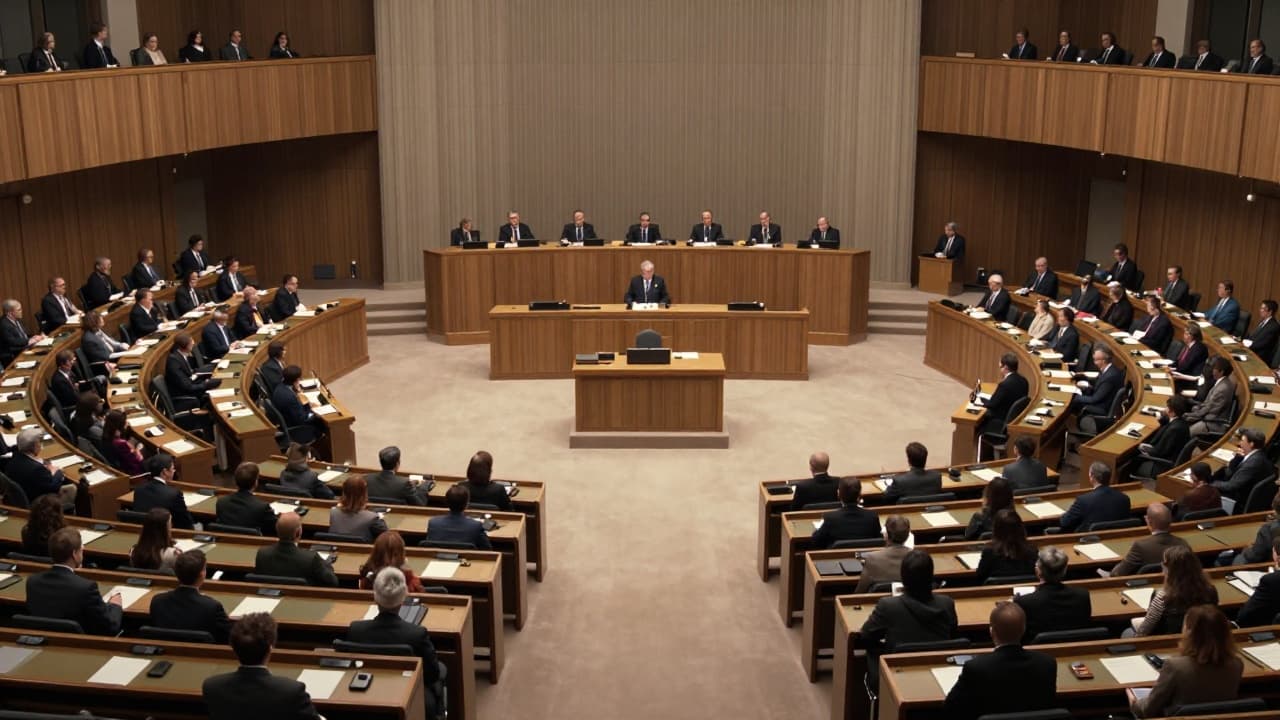
Prime Minister Andrej Plenković presented the budget for the coming year in the Croatian Parliament (Sabor), followed by a series of rebuttals, primarily from opposition ranks. MPs sought clarification on numerous budget items, with the debate focusing most heavily on the compensation for Salonit workers, pensioners, education, healthcare and affordable housing.
SDP MPs Sabina Glasovac and Možemo! MP Jelena Miloš warned that the "heavy" 41 billion euro budget did not provide for 5.2 million euros to compensate 179 Salonit workers. They highlighted that the Government was deducting from these workers' compensation on the basis of health hazards because they had previously received compensation for the loss of their jobs. Centar MP Damir Barbir compared the expenditure on official air transport and public relations with the amount needed to compensate workers exposed to asbestos, while Dušica Radojčić (Možemo!) criticised the Government and the Environmental Protection Fund for the "failed" remediation of the Sovjak pit and the "false" remediation of the Salonit factory.
Prime Minister Plenković responded that these were damages incurred before his Government. "They could have resolved it themselves. It started to be resolved, but a legal problem arose with Sovjak. Regarding the Salonit workers, we will consider everything we can do to resolve that situation on the basis of a valid legal foundation. Our Government has shown, in various inherited problems, a willingness to resolve those issues," Plenković said.
Marko Krička (SDP) warned that the lowest maternity allowances for employed women were still lower than the minimum wage, including allowances for mothers with three or more children, and asked how this was possible at a time of a "record" budget. Plenković briefly replied that the Government would consider this issue as well. MP Darko Klasić (HSLS) pointed out that only every 55th euro was allocated for the growth and development of those who fill the budget, and asked whether such a budget was sustainable in the long term. Plenković responded that 600 million euros were provided for in the positions of the Ministry of Economy and the Ministry of Science and Education, with an additional billion euros in projections for 2028 and 2029, and he expected that part of the new European financial envelope would be directed towards investments in the Croatian economy. "The budget is sustainable because we strive to make it so all these years," Plenković said, highlighting that Croatia is recording 22 consecutive quarters of economic growth and rejecting claims that Croatia will run out of European money.
Anka Mrak Taritaš (GLAS) and SDP MPs warned about the state of healthcare, the shortage of doctors, particularly gynaecologists and paediatricians, long waiting lists and hospital debts despite large investments in healthcare. Plenković said: "In our mandate, more than three billion euros have been invested in healthcare, and salaries have been increased more than ever. The prerequisites have been created for the construction of the new University Hospitals in Osijek and Split, all hospitals in Zagreb have been modernised after the earthquake, and a new Children's Hospital is being built in Blato. Work is also being done to reduce waiting lists, with greater controls through the Croatian Health Insurance Fund (HZZO) being one of the ways to make the system more efficient." He added that wherever there is a problem, the health inspectorate will react.
Ivica Baksa (NPS) reopened the issue of exempting pensioners from paying the HRT fee, and Plenković announced that he would consider that proposal. SDP MP Sanja Radolović problematised the announcement of the construction of only 1,000 apartments for affordable housing and warned of a shortage of 236,000 apartments, rising real estate prices and construction costs. Plenković said: "The problem of affordable housing is one of the fundamental problems that exists on the European continent," claiming that the market, in terms of square metre prices, had stabilised and announcing the continuation of measures to facilitate the resolution of the housing issue, especially for young families. Marin Živković (Možemo!) highlighted that, contrary to the Prime Minister's claims, real estate prices had not stabilised and that the housing crisis for young people had worsened, while Plenković said that 32,000 young people had used the loan subsidy measure.
Anja Šimpraga (SDSS) was interested in whether the announced investments in water and sanitation projects would include the final construction of the water network in about 15 Benkovac settlements, villages in Knin, and the areas of Gračac and Skradin, and Plenković confirmed that these projects would continue. Independent MP Josip Jurčević asked about the disposal of illegally imported waste and the possibility that the costs would be borne by the countries from which the waste originated, as well as about the war reparations that Croatia should claim from Serbia. Plenković reported that 100 million euros were provided for 2027 for the remediation of landfills in Gospić, Pazin, Samobor and Poznanovac, through higher revenues of the Environmental Protection Fund. Regarding war reparations, he said that previous governments had not raised the issue, but that Croatia would insist on information about the missing and the resolution of open issues from the new Serbian government.
Tanja Sokolić (SDP) was interested in whether the Government intended to raise teachers' salaries, who receive 200 euros less than the average Zagreb salary. Plenković stated that the state would allocate 342 million euros for increases, that these funds were in the position of the Ministry of Finance, and that the increases would follow the formula of three per cent of the base from 1 January, one per cent of the base from 1 August, 30 euros from 1 April for a hot meal plus another 20 euros for a hot meal from 1 October. Independent MP Marijana Petir advocated for young farmers who need support in the form of agricultural infrastructure for daily operations and asked whether these funds could be found in the increased allocations for defence, of 1.5 per cent for NATO. Plenković praised her efforts in developing agricultural policy.