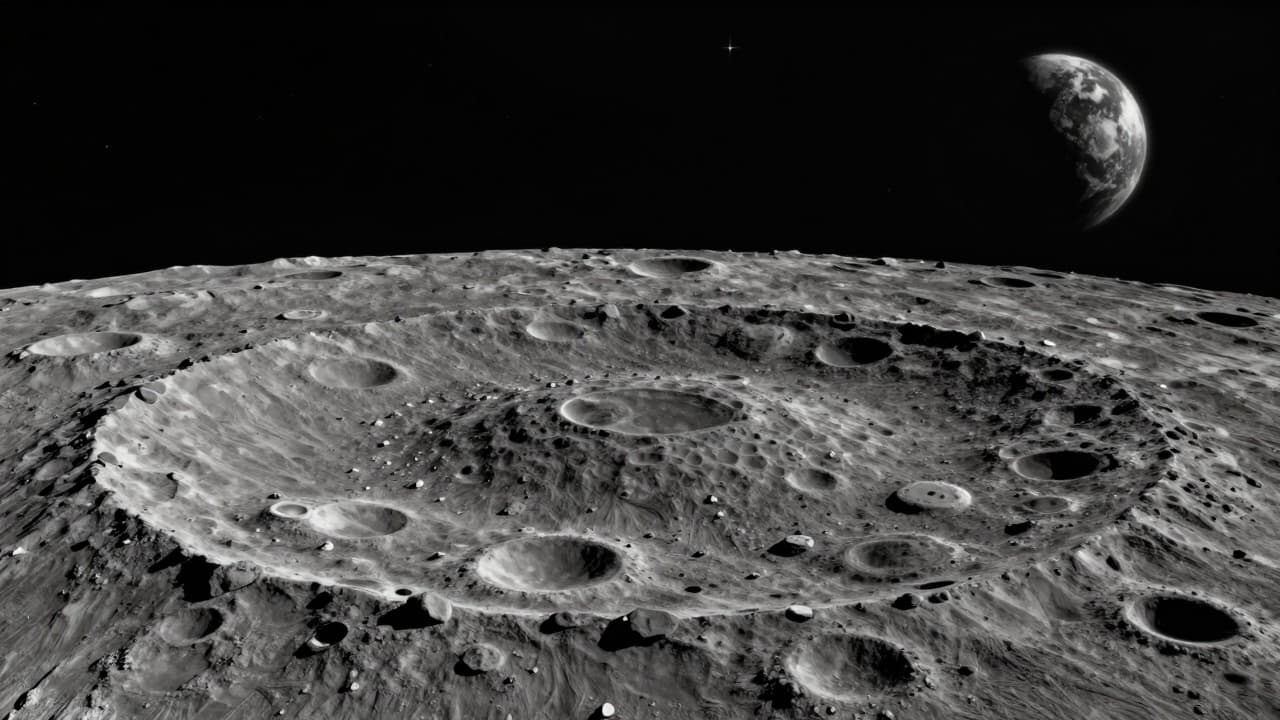
Researchers have discovered a vast rock formation buried beneath the surface on the far side of the Moon. The team analysed data from lunar probes and found a structure significantly denser and more strongly magnetised than the surrounding terrain, with results published on 23 September in the journal Science Advances.
According to the study, the subsurface structure could be an ancient volcanic complex. The rock magnetised as magma from the Moon's interior cooled and solidified before erupting onto the surface. The formation is approximately 60km wide and 9km thick, and its characteristics suggest that the Moon, at the time of its formation, some 4.2 billion years ago, had a magnetic field.
The researchers estimate that this field was likely between one-fifth and one-third the strength of Earth's magnetic field. Data from NASA shows that the Moon's field weakened significantly approximately 3.2 billion years ago, as the Moon's interior cooled. Without strong protection, solar radiation destroyed the remnants of the Moon's atmosphere.
The debate over the origin and duration of the ancient magnetic field has been ongoing since the 1970s, when Apollo missions first brought back samples of lunar rock that showed traces of a magnetic field, said study co-author Anna Mittelholz, a lecturer at the Swiss institute ETH Zurich. Mittelholz explains that there was long-standing consensus that the lunar dynamo was active approximately from 4.25 to 3.5 billion years ago. In the last decade, new analyses of Apollo samples have not found a magnetic signal for that period, Mittelholz explained in a written response to CNN, leading some researchers to question whether the early dynamo existed at all.
The new study provides evidence for the existence of that early dynamo, but without using samples from Apollo missions. Researchers used data collected from orbit to analyse the region of Dewar on the far side of the Moon, which is not visible from Earth, where they discovered the magnetised rock. The study's co-author is a researcher at the German Aerospace Center. Broquet stated that the Earth and Moon have had drastically different geological histories, that the Moon was smaller and long completely molten, and that it had strong volcanic activity in its early phase. He added that analysing the magnetic field is a good way to estimate the early appearance of the Moon.
Mittelholz said the findings could be applied beyond the Moon. If the Moon managed to sustain a dynamo, this speaks to the minimum conditions required for its operation, she noted. Researchers used data from NASA probes, including the Lunar Prospector launched in 1998, the Japanese Kaguya probe from 2007, and the GRAIL mission from 2011. Anna Mittelholz notes that samples taken from the Moon were removed from their geological context more than 50 years ago, and she clarifies that the magnetic record of samples can be easily disrupted by heating, impacts, or even routine handling and storage in a laboratory.
Mittelhoff said that other studies using satellite data have typically only observed the magnetic signal and attempted to deduce which type of rock produced it. In one model, they combined magnetic data with gravity data, where gravity measurements described the density of the discovered rock, while magnetic data showed how strongly magnetised it was. Researchers were unable to estimate how long the dynamo had been active, and it remains unclear how the Moon's small core could have generated a magnetic field that, according to some earlier studies, was potentially as strong as Earth's.
The authors of the new study believe their findings shift the debate from whether the Moon had a dynamo to how it functioned. A 2025 study suggested that an asteroid impact may have temporarily strengthened the existing, weaker magnetic field, while a study from February this year was based on samples from Apollo.