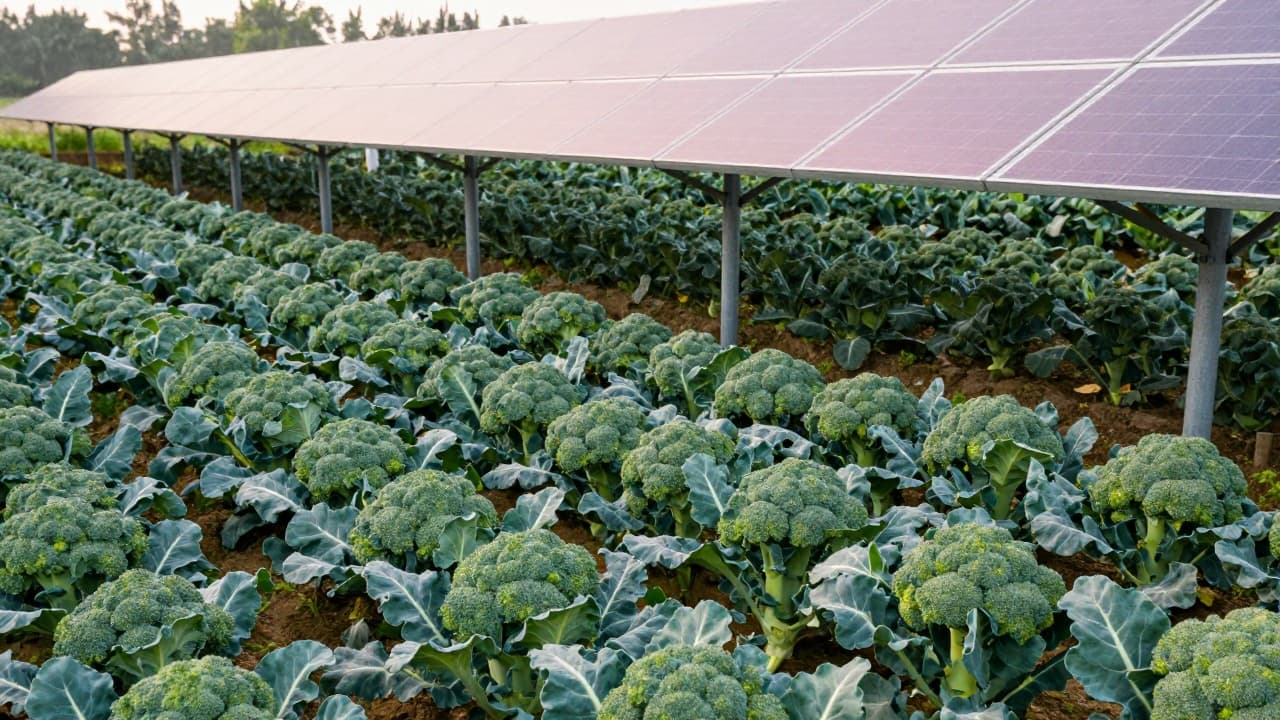
Scientists have developed semi-transparent, pink solar panels that simultaneously generate electricity and transmit light necessary for plant growth. A team from Sweden’s Mälardalen University, led by Silvia Ma Lu, tested the prototype on broccoli crops, with results published in the journal Cell Reports Physical Science.
The concept is based on the idea that plants are natural solar panels, using primarily the red and blue parts of the light spectrum for photosynthesis. The new panels are therefore designed to transmit red and blue wavelengths to the crops, while using the rest of the light to generate electricity. Broccoli was chosen for testing because it belongs to the same species as cabbage, cauliflower, kale, and Brussels sprouts.
The researchers set up three plots of 20 square metres. Broccoli grew in direct sunlight on one plot as a control group, while on the other two it was grown under the pink panels — one set of panels had 50 per cent transparency, and the other 70 per cent. The panels used in the experiment were a prototype whose pink colour filters out the green part of the spectrum, and the solar cell in this phase does not actually harvest the energy of green light.
All plants ultimately had equal yields. However, plants grown under the panels took 25 days longer to reach maturity for harvest. It was also shown that plants under the panels used light more efficiently — 4.5 times more efficiently under the denser panels and 2.8 times more efficiently under the more transparent ones.
The active component of the panels is opaque cadmium telluride (CdTe), embedded in the form of strips. A denser arrangement of strips means higher electricity generation, but also less light for the plants. The pink colour of the panels is not essential; the panels were originally intended for architectural purposes and were used in the experiment because they were commercially available.
It is not entirely clear whether the growth of the broccoli was affected by the filtered light, the reduced amount of light overall, or the greenhouse effect created by the glass surface. Ma Lu believes that such panels in their current form could be useful for smaller applications, such as community gardens or integration into greenhouse roofs.
During the growing period, the pink panels generated approximately 224.7 MWh of electricity per hectare, which is roughly 100 MWh less than conventional solar panels. Ramesh Rayudu, a specialist in energy systems engineering who was not involved in the study, made the calculation that this loss in electricity generation would require an additional yield of 1.2 to 3.2 tonnes of broccoli per hectare to compensate. Rayudu concluded that the key question remains whether the additional agricultural value provides enough benefit to justify the lower electricity production.
Note: the previous translation was rejected (hero caption dropped).