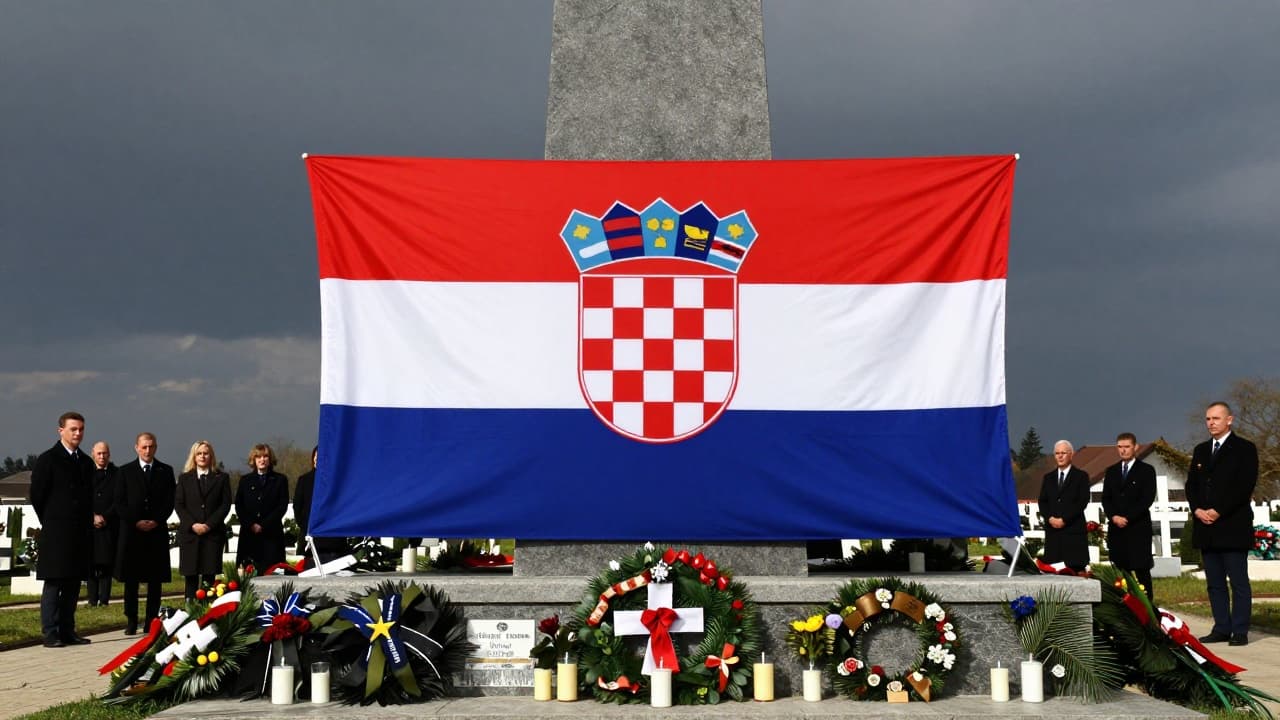
The European Parliament adopted a resolution on Vukovar on the 35th anniversary of the fall and destruction of the city. The resolution honours the victims, condemns the glorification of war criminals and calls on Serbia to open its archives so that the fate of the missing can be clarified. The issue was discussed in HRT's programme Otvoreno.
Karlo Ressler (HDZ), a Member of the European Parliament, said the initiative was cross-party and was supported by all Croatian MEPs. Ressler said that it was important to speak openly about Vukovar in the European Parliament 35 years after its fall, and that the main objectives of the resolution had been achieved. He stressed that the resolution conveys the message that Vukovar is a symbol of resistance by a small number of defenders against a superior aggressor, honours all Croatian defenders and civilian victims, and raises questions about the missing and other issues arising from the Homeland War. He added that the resolution calls on Serbian authorities to prevent the glorification of convicted war criminals, explicitly mentioning the funeral of Ratko Mladic with full state honours and the horrific crimes at Ovčara. It also specifically mentions camps to which Croatian defenders were taken. Ressler stressed the importance of discussing Vukovar based on clear historical facts, concluding that Vukovar is a topic that unites Croatia but carries strong lessons for the entire European continent.
Ana Filko, director of the Directorate for Detained and Missing Persons at the Ministry of Croatian Defenders, said that Croatia has not received any substantively usable information from Serbia to date to help find the missing. Croatia still searches for 1,725 persons, of whom 320 are from the Vukovar area. Filko said they had identified concrete documentation, specific units — mainly rear engineering units that participated in the clearance or concealment of graves — and persons located in Serbia who may have that knowledge. This information was passed to the Serbian commission, but no concrete response was received. She stressed that the 'pact of silence' is one of the key problems in the search for the missing, linked to fear of revenge on the Serbian side and to the fact that finding the missing is tied to uncovering the crime committed. She added that Croatia's search does not depend on Serbia, as shown by results — 343 missing persons have been identified over the past ten years without any help from Serbia. She said Serbia could speed up the process to ease the agony of families, that we cannot change the past but we can influence the future of each family, and that they will not give up until the last missing person is found.
Nataša Kandić, founder of the Humanitarian Law Fund, believes the key message lies at the end of the resolution but hardly communicates with everything said before. Ressler replied to Kandić that they wanted to be clear, not to speak about the suffering of Vukovar in abstract, general terms. He said they speak of killings, rapes and persecution of the Croatian population after the occupation of the city, speak of the causes of the war, and that it is important that 35 years after Vukovar there is no relativisation about it, and that they now seek to embed it in a shared European memory. The resolution mentions Boris Tadić's visit to Ovčara in 2010, when he apologised for the crimes. Kandić said that apology remains forever and is an admission of how much the crimes and destruction of Vukovar are a shame belonging not only to the JNA but also to Serbian citizens who were mobilised, taken, many of them against their will. She added that she would like the resolution to expand the paragraph on joint responsibility and bring all countries together.
Sandra Rapčak Škomrlj, president of the Association of Children of Fallen and Missing Croatian Defenders of the Homeland War, said that a change of power in Serbia does not necessarily mean a change of rhetoric. The new leadership must be aware that without resolving the past we cannot build the future, she said, calling on Serbian authorities to cooperate. She said someone must answer for the war crimes committed and called on Serbian authorities to bring those who committed crimes to justice, to open military archives so they can deliver information on the missing, rather than letting future generations bear the burden of the past. Through the association, families have been filing lawsuits for war reparations from Serbia for years. Over 20 lawsuits have been filed and war reparations paid, with some proceedings still under way. Rapčak Škomrlj called on anyone whose loved ones were killed and identified at Ovčara to come forward if they wish to file a lawsuit.