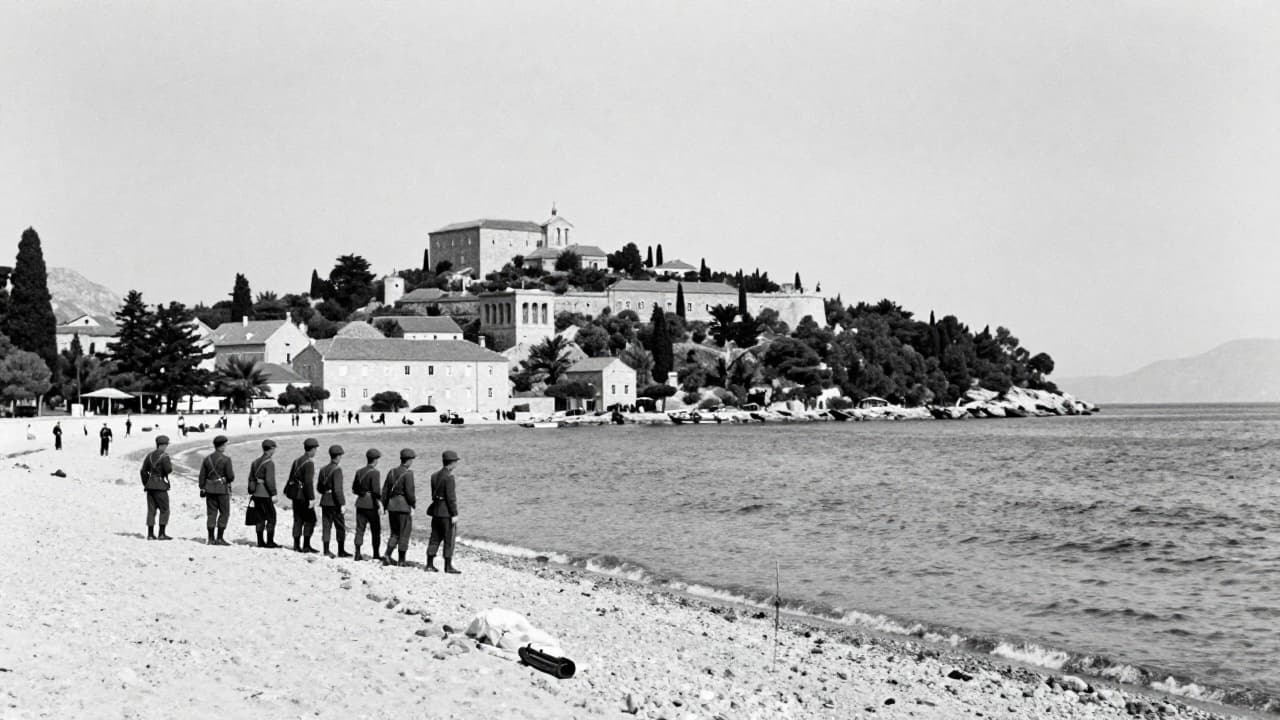
The Italian army occupied the Dalmatian island of Lastovo on 11 November 1918, a date remembered in history as the end of the First World War. On that day, the signing of an armistice with Germany marked the conclusion of the Great War, while simultaneously placing Lastovo under Italian military administration. The island had belonged to the Republic of Dubrovnik for centuries, and subsequently to the Habsburg Monarchy, before finding itself within the Italian occupation zone after the war ended.
During the First World War, the Austro-Hungarian Empire maintained a military garrison in the fortress on Glavica hill. Blackout regulations were introduced on the island, and authorities banned the ringing of church bells. Towards the end of 1917, French aircraft bombed the island, followed by military activities by French and Italian forces. News of the end of hostilities with Austro-Hungary reached Lastovo from the air – on 4 November 1918, a French aircraft dropped informational leaflets over the island.
The Italian army occupied Lastovo on 11 November, and two years later the occupation was transformed into internationally recognised Italian authority. The island remained under Italian rule until September 1943. The Italians called Lastovo Lagosta, and Italian rule left a deep mark on the island, particularly after the fascists came to power in Italy in 1922. The policy of Italianisation affected public life, administration and education, while the Croatian language was gradually pushed out of official use.
Italian claims on the eastern Adriatic coast had their roots in the secret Treaty of London, signed on 26 April 1915 by Great Britain, France and Russia with Italy. In exchange for Italy's entry into the war on the side of the Entente, the treaty promised Italy a significant portion of Austro-Hungarian territory. Among the areas designated for Italian expansion were Istria, parts of Dalmatia including Zadar and Šibenik, and a large number of Adriatic islands, including Lastovo. Italian forces gradually occupied parts of the eastern Adriatic coast, including Zadar, Šibenik and certain islands, while Lastovo held particular strategic importance due to its position in the southern Adriatic.
On 12 November 1920, representatives of the Kingdom of Serbs, Croats and Slovenes and the Kingdom of Italy signed the Treaty of Rapallo, which established the borders between the two states. Istria, Zadar, Cres, Lošinj, Lastovo and Palagruža, along with other areas, were ceded to Italy, while the majority of Dalmatia remained outside Italian state borders. Ante Trumbić, the then Minister of Foreign Affairs of the Kingdom of SHS, the famous Split politician and former mayor of Split, participated in the negotiations. Trumbić resigned after the signing of the Treaty of Rapallo.