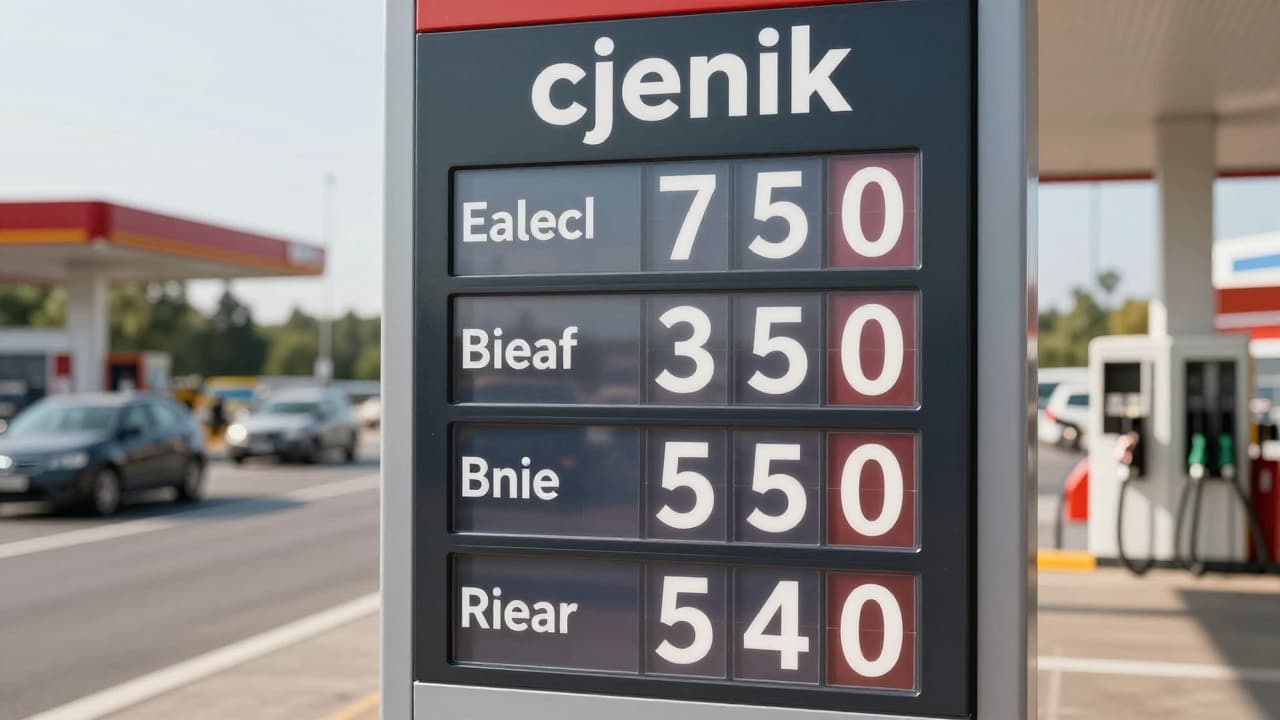
The price of diesel from 22 September is 1.91 euros per litre, while super unleaded is at 1.74 euros. The government has reduced excise duties to below the minimum set by the European directive, but forecasts for the following week point to diesel at 1.96 euros per litre, which would be a record.
With a consumption of 5.5 to 6.5 litres, driving 100 kilometres costs between 10.50 and 12.40 euros today. Sixteen months ago, the same distance could be driven for eight to nine euros, showing how much driving costs have increased in the meantime.
For electric vehicles, the ELEN tariff by HEP from 1 April 2025 no longer has seasonal variations. The summer rate of 0.85 euros per kilowatt-hour has been replaced by a uniform price throughout the year. On motorways, the price is now 0.43 euros per kWh for chargers up to 22.1 kW, 0.57 euros for those up to 50 kW and 0.78 euros for all above that. Outside motorways, prices are 0.35 and 0.45 euros per kWh, a tariff that remains valid in September 2026.
According to the tariff valid from 1 November 2025, registered users of the OneCharge app pay 0.37 euros per kWh on AC chargers, 0.47 euros for up to 50 kW and 0.66 euros for above 50 kW. Anonymous users and those paying at the terminal pay 0.41, 0.51 and 0.73 euros per kWh respectively. Just a year ago, registered users paid 0.73 euros for the fastest charging.
MOL Plugged at Tifon stations charge 0.45 euros per kWh for AC and 0.66 euros for DC, while unregistered users pay 0.55 and 0.76. The price reaches 0.86 euros per kWh only with the purchase of a package at the till. Ionity in Croatia charges 0.73 euros per kWh without a subscription, and with a monthly subscription of 11.99 euros the price drops to 0.44 euros. Lidl and Kaufland hold 0.35 euros for AC and 0.45 euros for DC charging, while Tesla's superchargers range from 0.23 to 0.60 euros per kWh, depending on location and time of day. The highest ad hoc price from major operators today is 0.78 euros per kWh, not 0.85.
With a consumption of around 20 kWh per 100 km at 130 km/h, or around 16 kWh in the city, home charging in the lower tariff costs 2.00–2.50 euros for 100 km. Public AC in the city costs 5.60–7.20 euros for 100 km, and a hybrid in the city (4.5 l) costs around 7.80 euros for 100 km. DC up to 50 kW outside motorways costs 9.00–10.20 euros for 100 km, while Ionity with subscription costs around 8.80 euros plus subscription for 100 km. Diesel on motorways (5.5–6.5 l) costs 10.50–12.40 euros for 100 km, and ultra-fast DC on motorways without subscription costs 13.20–15.60 euros for 100 km.
The figures of 0.05 euros per kWh for the night tariff refer only to energy. When the network charge, renewable energy levy and VAT are added, the kilowatt-hour in the lower tariff costs around 0.125 euros, and in the higher tariff around 0.20 euros. Households consuming more than 3,000 kWh in six months pay 35 per cent more for everything above that. An electric car with 15,000 kilometres per year consumes around 2,700 kWh, a regime that is valid until 30 September.
ELEN outside motorways charges 0.06 euros per minute, or 3.60 euros per hour, after the free time expires. On motorways, this is 0.14 euros per minute, or 8.40 euros per hour, with the caveat that on the strongest chargers, free time is only 45 minutes. Petrol charges 0.15 euros per minute on DC chargers, and 0.04 euros per minute on AC chargers, but only from 7 to 20 hours. ELEN reserves 53 euros on the card for DC and 33 euros for AC charging, with the bank releasing the funds within a few hours or days.