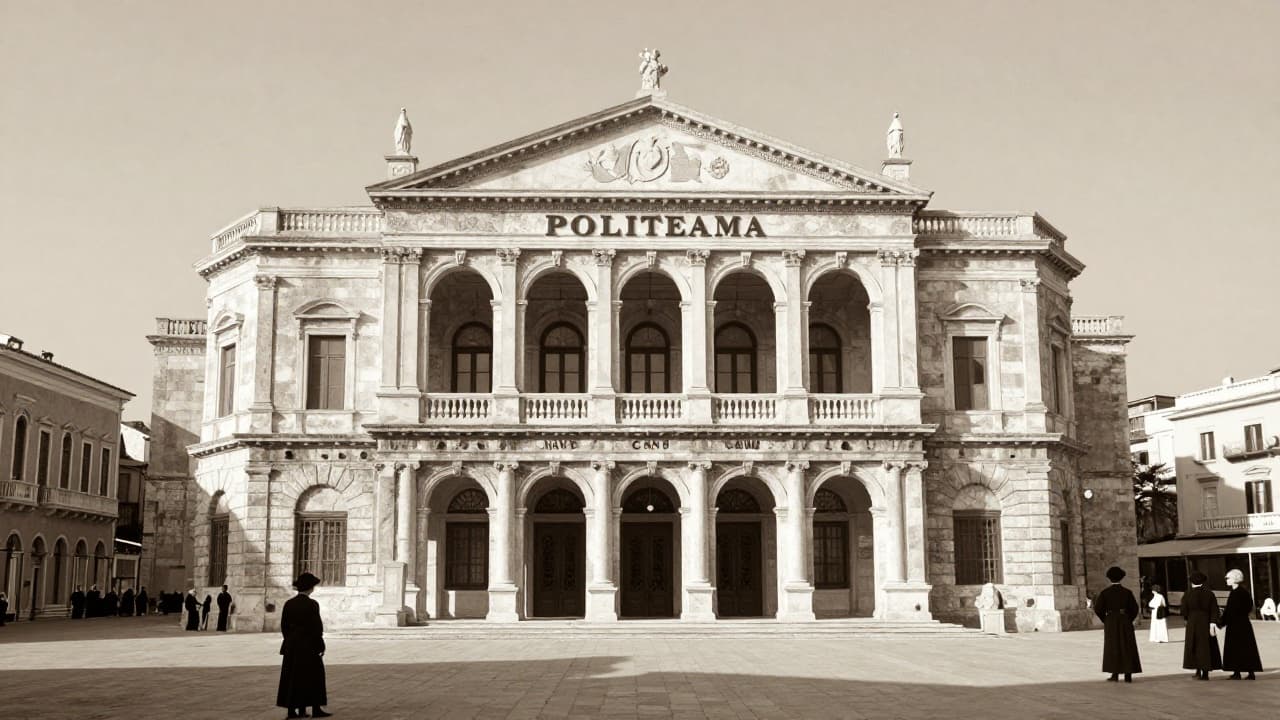
Pula, the largest city in Istria, has had a theatre for 145 years. The new Politeama Ciscutti was opened on 24 September 1881, and the city received it thanks to the blacksmith from the Italian town of Maniago, Pietro Ciscutti.
Ciscutti was born in 1822, and arrived in Pula, then the imperial and royal naval metropolis, as a 25-year-old. He was employed in a metal foundry in the naval base of the imperial and royal navy, but soon opened his own workshop and foundry. As a skilled and respected craftsman, he began to produce metal structures for the construction of the arsenal's halls, and his company built roads, municipal infrastructure and houses. He built the settlement of Portarata, the Piazza Dante and part of the Kandler Street.
Through profitable business, he acquired a vast fortune, which he bestowed without sparing on the urban and cultural vision of Pula. When he died in 1882, overcome by illness and bankruptcy, L'Eco di Pola wrote: 'If this man, to use a colloquial expression, earned a million – he invested more than that million in Pula. It would be a laborious task to list the benefits he distributed to all social classes. Everything beautiful in Pula is his work.'
Ciscutti wished to gift the city a theatre, which he did twice. In 1851, the building of the Augustinian monastery next to the church of Our Lady of Mercy was burned. Three years later, Ciscutti restored the church, and next to it he built the first modern theatre in Pula – the Teatro Nuovo. The night of 26 December 1854 remains remembered as the opening night of the Teatro Nuovo, whose building was designed by the Trieste architect Giovanni Quadri. When on 9 December 1856 the foundation stone of the Naval Arsenal was solemnly laid in the presence of Emperor Franz Joseph, the married couple went to the city theatre, where two performances were held with lay actors, naval officers and army officers with their ladies. The Emperor appreciated Pietro Ciscutti's contribution to the culture and development of Pula, so in 1881, on the occasion of the opening of the Politeama, he decorated him with the title of Knight of the Order of Franz Joseph.
The Teatro Nuovo became too small, so Ciscutti gifted the city a larger theatre and named it after himself – the Politeama Ciscutti. He entrusted the construction work to the young Trieste architect Ruggiero Berlam (1854–1920), who was then only 25 years old. Berlam designed and personally supervised the construction from 1879 to 1881, and the foundation stone was laid on 22 August 1879. The building was designed as a monumental edifice opposite the Naval Casino (today's House of Croatian Veterans), and its auditorium could hold around 800 people at the time. This project was a huge success for the young architect and became the architectural pride of Pula at the time. The Berlam family, including Ruggiero's father Giovanni and son Arduino, generally shaped the visual identity of the northern Adriatic, but Ruggiero's signature on the Pula theatre remains one of the most important monuments of theatre architecture. Ciscutti's idea and desire for Pula to receive a Politeama worthy of a capital city was realized.
The official beginning of institutional theatre life in Vienna is considered to be 1741, but Pula received its equipped theatre, a theatre in the full sense of the word, on 24 September 1881 with a solemn inauguration with the first performance, the opera 'Ruy Blas' by Filippo Marchetti. In the following evenings, Verdi's 'Traviata' and 'Rigoletto' and Donizetti's 'Poliuta' followed. No city in present-day Croatia had such a large auditorium at that time – only later did Rijeka (1885), Split (1893) and Zagreb (1895) receive theatres. On the stage of the Politeama Ciscutti, operas from the most famous Italian theatres performed, masquerades and charity events were held, the proceeds of which were donated for humanitarian purposes. Politeama denotes a multi-purpose, polyvalent theatre, so theatrical performances and musical programmes of visiting theatre groups, film screenings, dance and charity parties, circus performances, even boxing, wrestling and fencing competitions were held there.
The National Theatre in Pula was founded in 1948, when it also received the name Istrian National Theatre – City Theatre Pula. The first performance was Držić's 'Dundo Maroje' in January 1949. Due to the dilapidation of the building, the city authorities closed the theatre and disbanded the acting ensemble in 1970, and the building was renovated for years. The newly renovated Great Hall of the Istrian National Theatre – City Theatre Pula received its name in 2022.