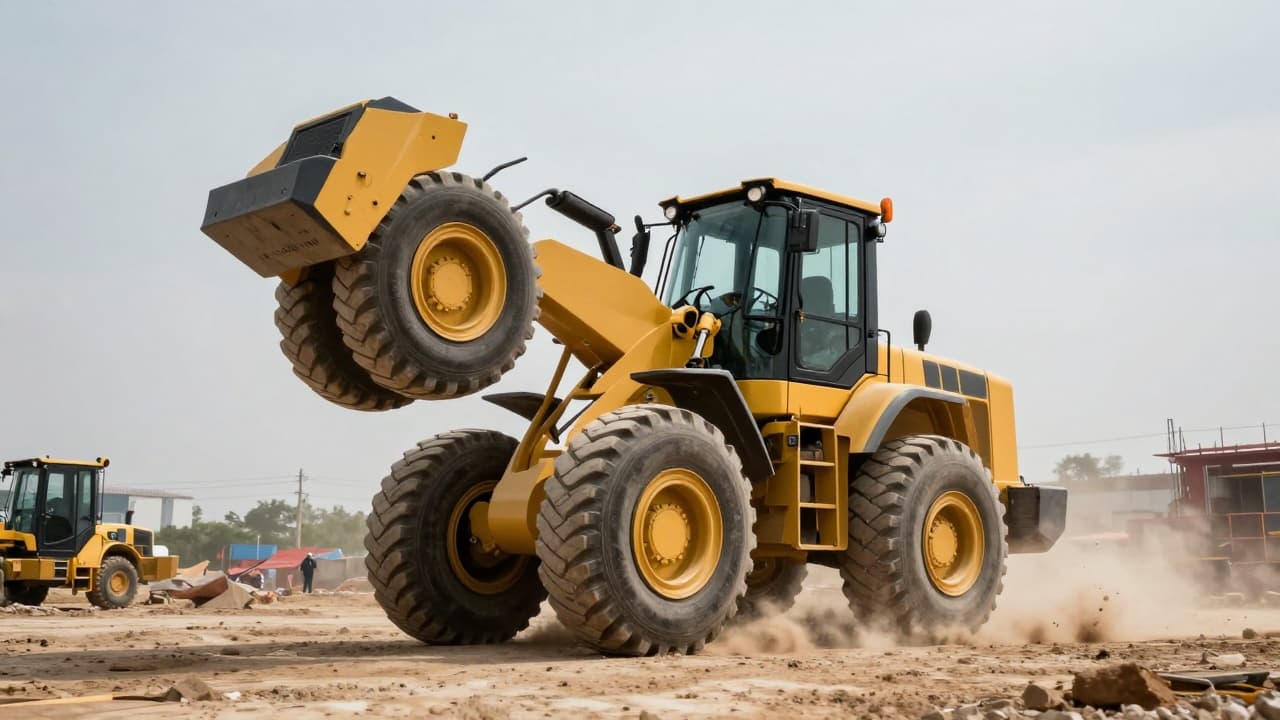
Researchers have enabled a five-tonne John Deere 332G wheel loader to independently perform demanding acrobatic manoeuvres using machine learning and sim-to-real transfer. The demonstration of applied reinforcement learning comes from ETH Zurich University.
Using reinforcement learning techniques, the researchers 'taught' the compact five-tonne John Deere 332G wheel loader to autonomously execute complex acrobatic manoeuvres. The system was first trained in a computer simulation, and the learned control commands were then transferred to the real working machine.
The learned movements allow the construction loader to independently lift onto two wheels, drive over uneven terrain while balancing, and follow designated paths. The machine can perform rotations around its axis and move the loading bucket forward and backward before safely lowering itself back onto all four wheels.
The automation of heavy machinery opens up opportunities to increase productivity in mechanised industries such as construction, mining and materials handling. However, automating such machines faces significant technical hurdles due to their complex dynamics.
This complex dynamics partly stems from the hydraulic drive, which involves fluids, flexible elements and non-linear delays in system response. An additional obstacle is the large mass and dimensions of the machines themselves, which makes direct testing on physical systems extremely dangerous.
Therefore, the researchers conducted the learning process in a safe simulation environment before successfully transferring the acquired skills to the real loader. The results of this work confirm that reinforcement learning and sim-to-real transfer enable dynamic autonomous control of heavy machinery.