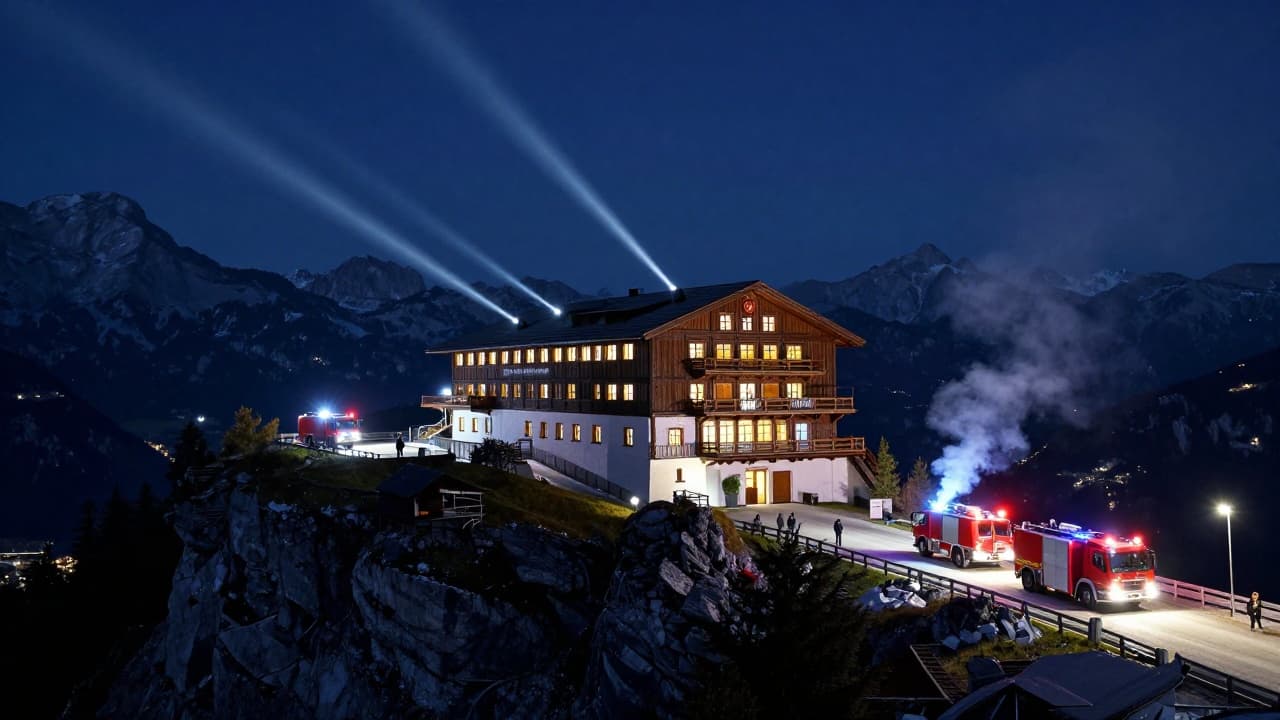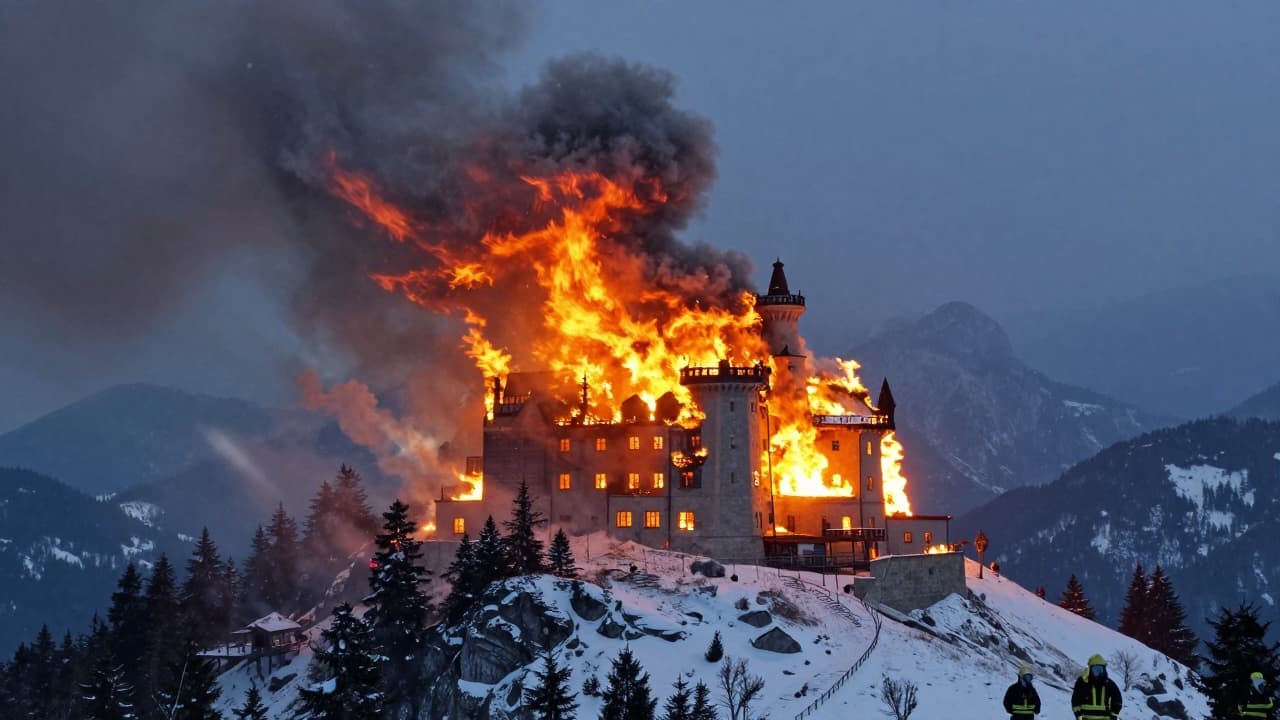
German police announced on Saturday that they had detained a suspect following a fire at Adolf Hitler's former mountain retreat, known as the Eagle's Nest, in the federal state of Bavaria.
Around 200 firefighters took part in extinguishing the fire at the Kehlsteinhaus building, located at the top of the Obersalzberg in southern Germany. The firefighters, according to police, saw flames rising high into the air upon arrival at the scene and found the building "completely engulfed in flames". No one was injured in the fire.
Police spokesperson Lisa Maier stated that the firefighters struggled with the blaze due to its location at an altitude of 1,834 metres. Access to the building, Maier said, was possible only with "heavy breathing equipment". The firefighters found no one inside the building.
Authorities were notified of the fire on Friday evening. Although police did not specify a possible cause, German media reported that investigators suspect arson. As a time-lapse camera showed, while snow was falling on the alpine peak, the Eagle's Nest was still engulfed in flames in the early hours of Saturday. Access to the road leading to the retreat was blocked.
Maier said that police were still investigating and would hold a press conference later on Saturday. German tabloid Bild reported that authorities had arrested a motorcyclist they encountered on the road towards the scene. A criminal investigation is underway to determine whether the suspect is connected to the fire.
The Eagle's Nest was built between 1937 and 1938 and is part of the toxic legacy of Hitler's Third Reich. It was conceived as a monument to Hitler's rule, although the dictator rarely visited the complex. Hitler used the retreat above the town of Berchtesgaden as a temporary seat of government and met with commanders there to plan the invasion of the USSR in 1941. The area was also used as a backdrop for propaganda films in which he was portrayed as a lover of animals and nature.
The Nazis completed the building in 1938, and after their defeat in 1945, it escaped destruction. Since 1952, it has housed an exhibition detailing the Nazi history of the house, as well as a restaurant, and has become a popular tourist destination with a mountain hut.