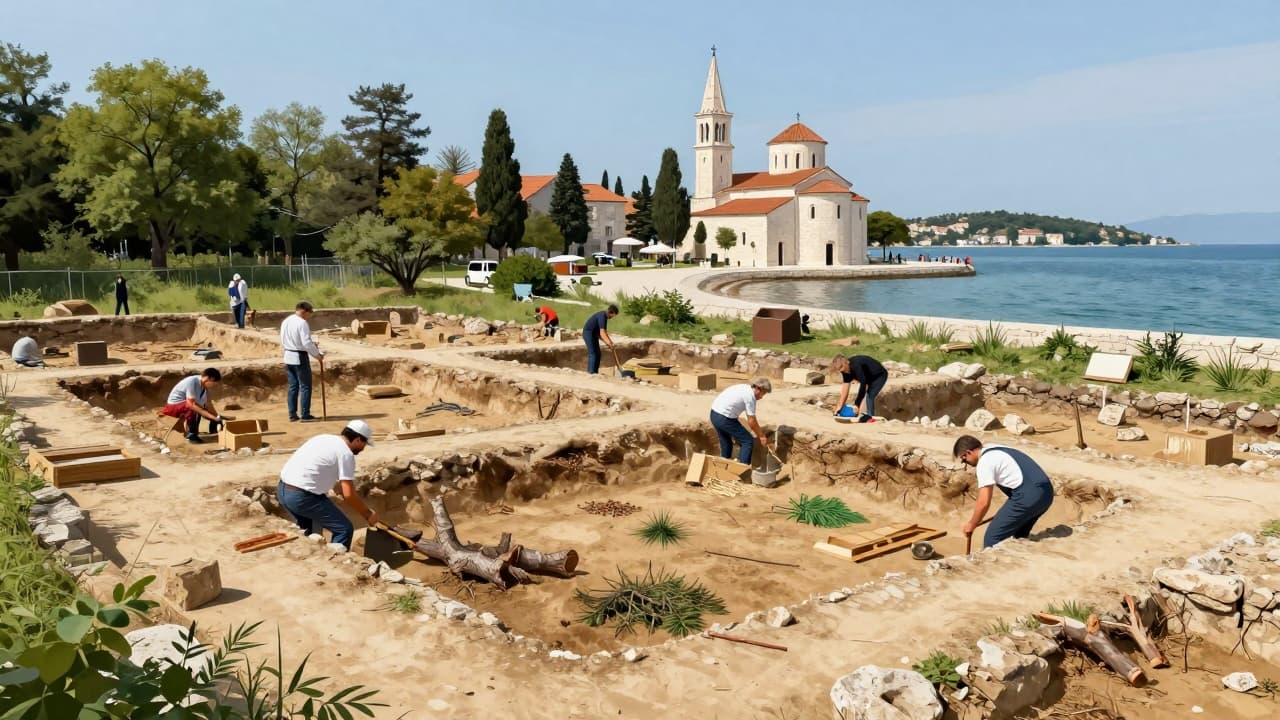
Archaeological research at the St. Peter's Peninsula in Makarska has continued, with this year's campaign also covering the remaining part of the complex extending westward from St. Peter's Church. The work is being carried out by professors and students of the University of Zadar (Sveučilište u Zadru), with fieldwork scheduled to run until early October.
This is the final research campaign, after which the archaeological park will be arranged and presented. The aim of this year's investigations is to link the surfaces explored during previous campaigns in order to gain a clearer picture of the spatial organisation of the site, the relationships between individual archaeological structures and the different phases of its use.
In a relatively small area, traces stretch from prehistory through the antique and late antique periods and the Middle Ages all the way to modern times. It is a space where the long and complex development of Makarska can be traced, said Dr. Silvia Bekavac, adjunct professor and head of the Department of Art History at the University of Zadar.
Alongside the excavation itself, a large part of the work involves precise recording and documentation of everything that is uncovered. In collaboration with the Centre for Geospatial Technologies at the University of Zadar, the archaeological structures and investigated surfaces are being documented spatially and digitally, creating a basis for professional treatment, conservation and future interpretation.
Special attention has been given to preserving the current appearance of the peninsula. The works have been organised so that no tree or valuable vegetation has been removed or damaged due to the archaeological research. The aim is for archaeological heritage and existing greenery to together shape the future archaeological park, while preserving the recognisable identity of St. Peter's.
In early October, the archaeological research will be concluded, after which the arrangement and presentation of the discovered remains will follow. The intention is to make the uncovered remains visible and understandable, and to enable citizens and visitors to get to know the peninsula's past by strolling through St. Peter's, right where that history unfolded.
The discovered and documented remains will not remain available only to the professional and scientific community, but will become part of the city's contemporary life. With the arrangement of the St. Peter's archaeological park, Makarska will gain a space where centuries of the peninsula's and the city's history can be experienced in one place.