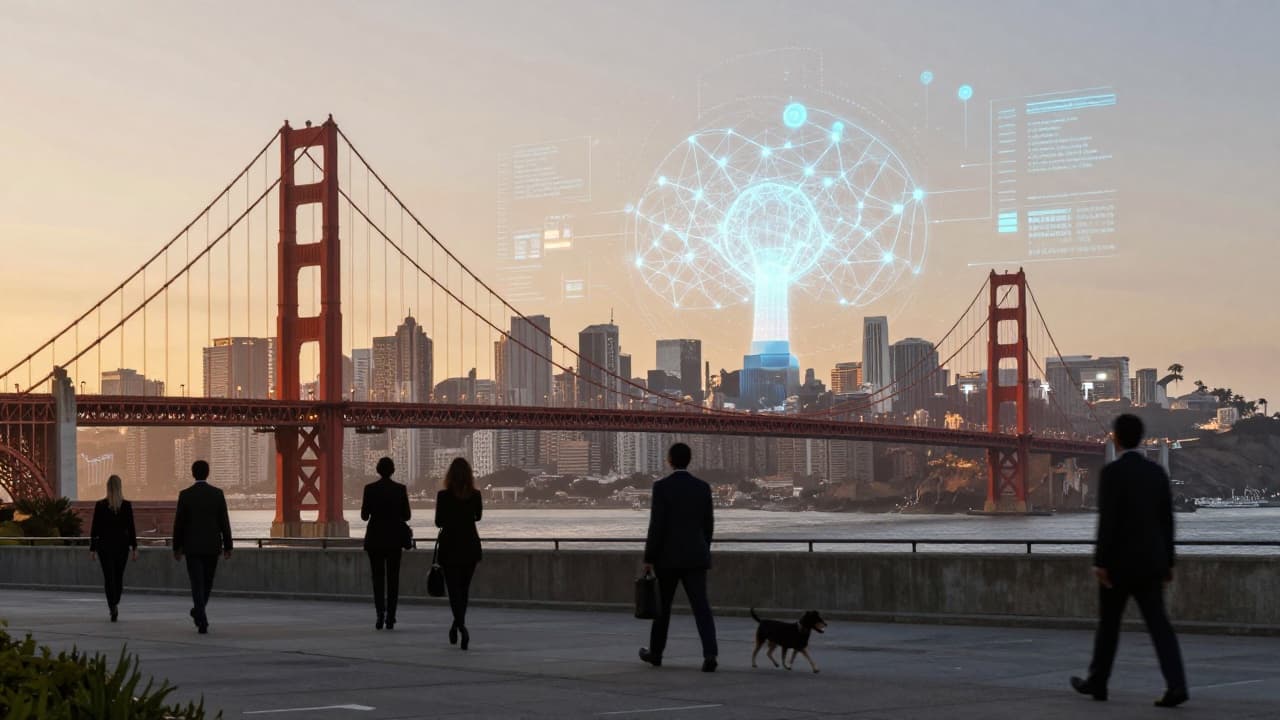
San Francisco is experiencing an economic revival driven by artificial intelligence, but concerns are growing that the sector could face a significant downturn. Workers in the city's AI industry fear the market is overheated, while economists warn a correction could be particularly painful for the city.
Signs of the boom are visible everywhere: rents and housing prices are rising, office spaces are becoming less vacant, and buses and advertising billboards are flooded with cryptic ads for AI companies. The city is home to leading AI firms OpenAI and Anthropic, which employ top-tier engineers, often at dizzying salaries. Anthropic, the company behind the Claude chatbot, was listed on the Nasdaq in New York last week. Thousands of other AI start-ups have also sprung up in San Francisco.
The boom has also boosted small local businesses. Lauren Goldboss, owner of a small dog-walking company in San Francisco, is hiring new staff and buying vans. Her new office dog-walking service, called Paw Perk, is popular among local AI start-ups. However, the city's rise follows a difficult period: during the pandemic, San Francisco experienced an exodus of residents, and the city centre was weakened by remote work.
Despite the optimism, fear of a crash does not subside. The International Monetary Fund warned last month that a significant downward correction in AI stock prices is possible, which would lead to a major drop in investment in the industry. Concerns were further fuelled by the scandal involving Jensen Huang, former head of AI company Nvidia, located south of San Francisco, which caused some AI stocks to fall. Nvidia, however, remained highly profitable – the company reported that its latest quarterly profit doubled compared to the previous year, reaching $65 billion.
One worker in the AI sector, employed by one of the largest companies in the city, is convinced a crash is coming. "I am sure the house of cards will collapse... and I am sure it will affect me," he said, requesting not to be named. He is questioning whether leading US AI companies can generate enough revenue to justify their enormous spending obligations, as cheaper and increasingly capable AI models emerge, particularly from China. However, he says this does not keep him awake at night. "Why worry about things I cannot influence?" he added.
Another AI sector worker in San Francisco, who also requested anonymity, believes a significant market correction is "entirely possible". Nevertheless, he claims most people do not see this as the key risk. In his circles, and in his own view, the greater concern is the existential risk that AI may pose to humanity. "In a strange way, a market correction as the worst scenario sounds great," he said.
If a crash does occur, San Francisco could be hit much harder than Silicon Valley, which is located 40 miles to the south. The AI industry boom is focused precisely on the city, rather than the wider San Francisco Bay Area. One study showed that 60 per cent of total venture capital invested in US AI companies from 2023 to 2025 went to companies based in San Francisco, while a significantly smaller percentage went to companies in Silicon Valley.
AI companies employ relatively few workers in the city compared to previous tech booms, so in the event of a downturn, there may not be many jobs to lose. Jeff Bellisario, executive director of the Bay Area Council Economic Institute, a think tank linked to the economy, said: "Employment is not necessarily at the level we would expect given the amount of venture capital and new company formations." Ted Egan, chief economist for the city and county of San Francisco, highlighted: "Because of AI, it is a good time for technology in the city again, but we do not see a huge overall growth in tech jobs."
The city is still around 35,000 jobs below its pre-pandemic peak, according to Enrico Moretti, a professor of economics at the University of California, Berkeley. Most spending by US AI companies goes towards data centres and computing power, with relatively little located in the Bay Area. San Francisco may be the brain of the AI boom, but it is not its muscle.
A significant correction could still be "very painful" for San Francisco, Moretti warns. Reduced employment in the AI sector and potential layoffs would spill over into the local service sector, likely affecting jobs from restaurants and retail to personal services such as dog walking. "The spillover into service jobs would be the main effect," Moretti said. Office vacancy rates could also rise, reducing footfall in the city centre, while rents and housing prices could weaken.
AI is not the only driving force behind San Francisco's recovery. Healthcare and tourism are also growing, which could cushion a potential AI sector downturn. The city is working to boost these sectors, including improving safety and cleanliness in the centre. "Tourism has not fully returned, but growth has been healthy," Egan said, adding that this is a sign of confidence in San Francisco. Egan does not expect an AI crash to fundamentally change the city's economic trajectory. "The city's economy was not screaming during this AI boom, so I would not expect it to stop if there is a slowdown in AI spending," he said. "I look at that primarily as a hiccup to expect, rather than a major turning point."