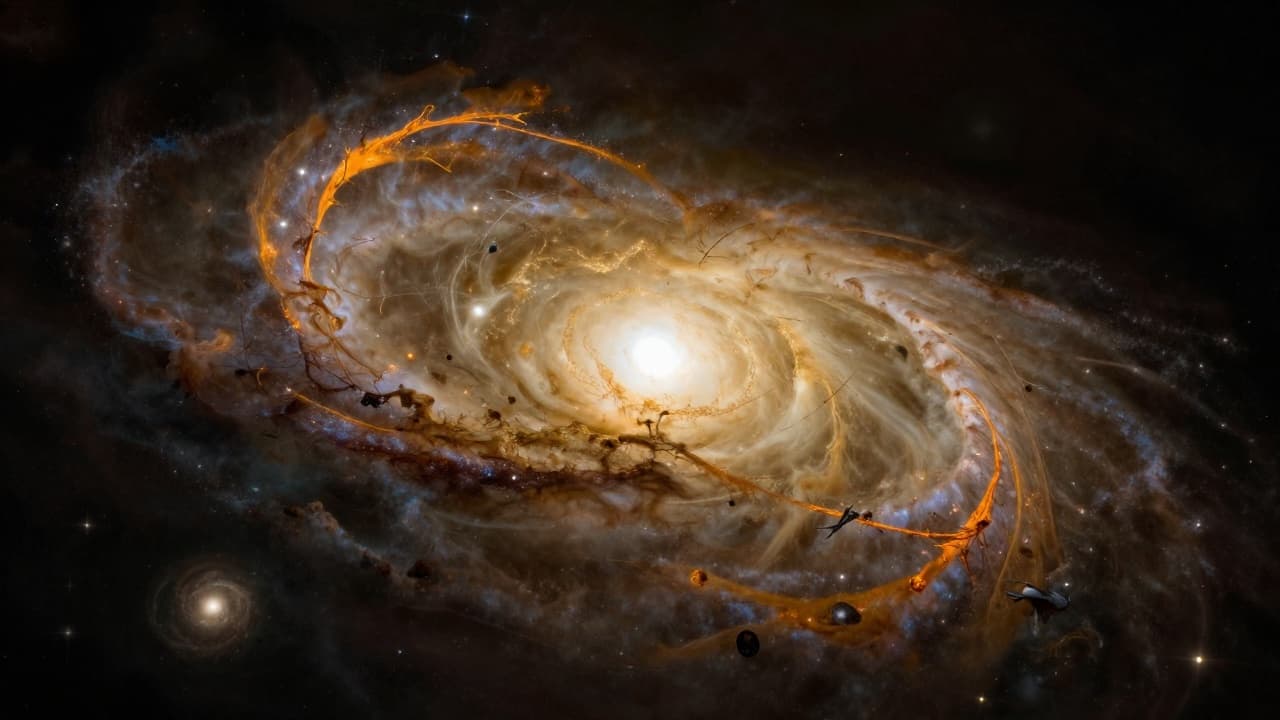
NASA announced on 29 September that the James Webb Space Telescope had captured an image in which galaxies appear distorted and multiplied as in a mirror, the space agency said.
The image highlights bright golden galaxies belonging to a cluster named MACS J0451.3. The cluster acts as a gravitational lens: its mass bends and amplifies the light of objects located far behind it, which is why their reflection appears multiple times on the image in a distorted form.
The orange galaxies clustered on one side are not part of that group, but are located much further away. Thanks to the gravitational lens effect, their light is multiplied on the image and stretched into arcs, creating the impression of multiple, mutually displaced copies of the same object.
Such images allow astronomers to study galaxies that would otherwise be too faint to observe directly. The distorted and multiplied images serve as a sort of magnifying glass through which the structure of the early universe can be glimpsed.
The telescope, which observes the universe in the infrared spectrum, has previously recorded a number of similar gravitational lensing scenes. The new image of the MACS J0451.3 cluster joins this series and further confirms the extent to which the mass of galaxy clusters can distort light travelling towards Earth.