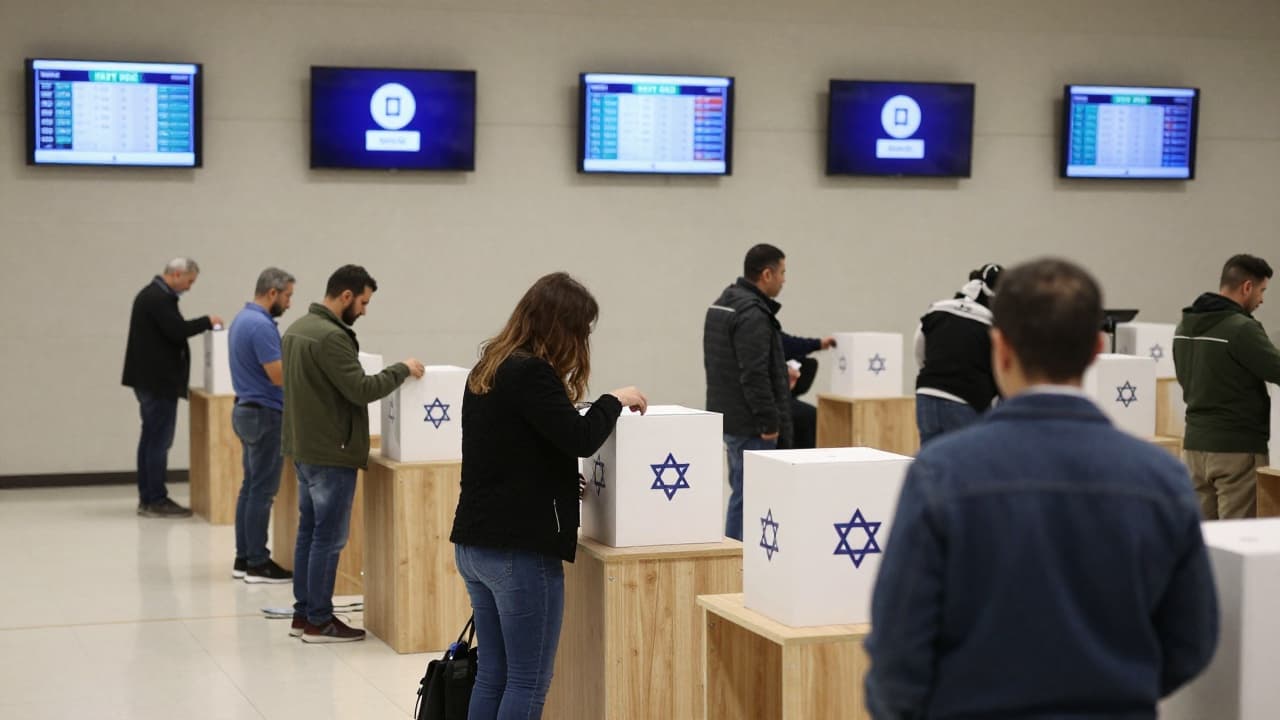
The first exit polls following the parliamentary elections in Israel show that the opposition block led by Gadi Eisenkot has won more parliamentary seats than the coalition of Prime Minister Benjamin Netanyahu. However, neither side has the necessary majority to form a government.
According to provisional results, after counting 57.3 per cent of ballot boxes, the block of parties supporting Prime Minister Benjamin Netanyahu has 55 mandates, the opposition block 49, and the Arab parties 16 mandates. A majority in the Knesset requires 61 of the total 120 mandates. Israeli television stations estimated that both blocks would win around 51 mandates.
Exit polls showed a strong rise in support for Arab parties, which could together win 17 or 18 mandates, representing record projections. Netanyahu's Likud remains the largest single party in parliament. Two Arab parties could play a decisive role.
The first exit polls, published immediately after the polling stations closed, caused excitement among supporters of Eisenkot's Yashar party in Tel Aviv, who chanted: "Bibi, go home!". Initial projections indicated that the opposition block could win between 52 and 53 mandates, while Netanyahu's allies would win around 50. Eisenkot stated that his supporters had "written history" and promised to turn the citizens' electoral decision into a stable Zionist government that would work in the interest of all Israeli citizens. His ally, former Prime Minister Yair Lapid, stated that Netanyahu's block had suffered a "heavy defeat". At the Likud headquarters in Jerusalem, there were no signs of surrender, and one of Netanyahu's supporters told the BBC: "It is not over until it is over, but I am sweating".
The elections were marked by the highest turnout since 1999, with at least 77.7 per cent of voters going to the polls. Since exit polls show that both blocks are far from a majority, negotiations could last for weeks. Parties must cooperate and form a coalition, and President Isaac Herzog chooses the candidate he assesses as having the best chances of forming a government. The candidate chosen by the President does not have to be the leader of the party with the most mandates.
Forming a coalition in Israel is traditionally difficult because larger parties generally refuse to cooperate with Arab parties. Some believe that Eisenkot could begin talks with the Arab parties, whose support in the elections increased significantly. Ra'am (United Arab List) could become key in forming the government if Netanyahu fails to gain enough support to attempt to form a coalition. Its leader Mansour Abbas has previously participated in a centre-right government. Eisenkot's block kept its distance from Ra'am during the campaign because it believed that support from that party could harm it, and Eisenkot had previously said that Arab parties do not meet Zionist criteria for participation in government.