Advertising on ChatGPT significantly lags behind Google, according to new data that raises significant questions about the long-term economic viability of introducing ads into AI assistants. Advertising could keep models like ChatGPT free for the general public and position them as direct competition to Google Search, but current ad revenue still does not cover the high costs of free access.
The introduction of ads moderately reduced the total volume of organic ChatGPT recommendations, but without a negative impact on their conversion. Following the launch of ads, organic ChatGPT recommendations fell by approximately 6 to 8 per cent. In the first 13 weeks, a volume drop of 5.9 per cent was recorded, with a range of -12.6 to +1.2 per cent. When accounting for the faster growth in usage in North America compared to Europe, the estimated drop shifts to a range of -7.2 to -8.4 per cent.
Visitors arriving via organic recommendations convert at the same intensity as before. The change is a negligible -0.02 percentage points compared to the initial 2.21 per cent, with p=0.648. The main challenge thus lies in the financial value of paid visits, rather than the quality of organic traffic.
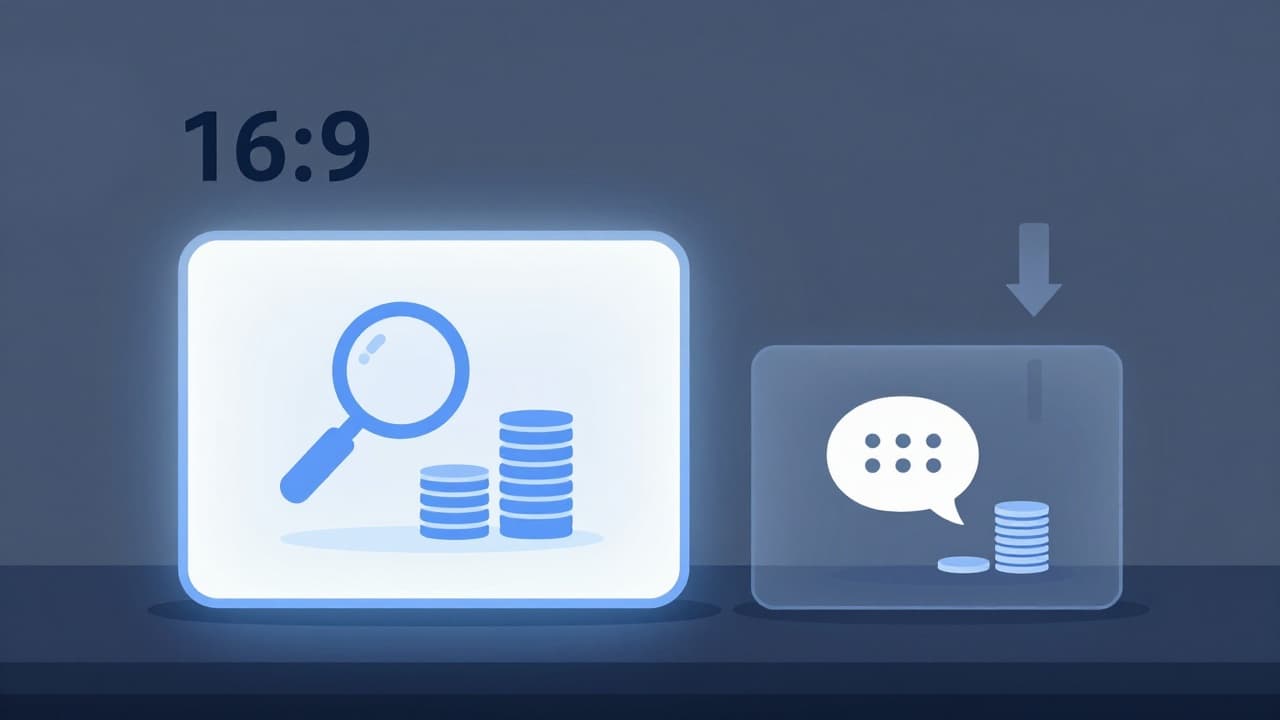
Paid ChatGPT traffic currently achieves the worst results among leading advertising channels, offering less than a sixth of the value for money compared to paid Google Search. A paid visit via ChatGPT generates $0.89, while a paid visit to Google Search brings in $2.45, a shortfall of 64 per cent. Paid visitors from ChatGPT achieve a conversion rate of 0.37 per cent, compared to 1.17 per cent from Google.
Based on the return from paid search, the real value of a paid click on ChatGPT is approximately $0.26. The largest publicly known advertising account paid as much as $1.72 per click, which is more than six times above the parity price with Google.
Advertising models in AI assistants do, however, show that ads do not necessarily devalue the core product. But until ad prices and realised revenues align with the real value for advertisers, this model will not be able to independently finance the costs of free access to artificial intelligence.