Genetic analysis has shown that the first inhabitants of Hawaii arrived from Mangareva, an island in French Polynesia, according to a study published in the journal Science. The research uncovered strong genetic links between the people of Hawaii and Rapa Nui, better known as Easter Island, and a slightly weaker connection to Mangareva, suggesting that Mangareva may have been the point of origin for the ancestors of today’s indigenous inhabitants of these island groups.
Polynesia is a vast area of the Pacific Ocean comprising more than 1,000 islands, and our ancestors began settling this region more than 3,000 years ago. Thousands of years later, they reached Hawaii, one of the most isolated island groups in the world. Hawaii and Rapa Nui are approximately 7,000 kilometres apart from each other, and each of these island groups is more than 3,000 kilometres from the nearest inhabited island. Alexander Ioannidis, a researcher in genetics and biomedical informatics at Stanford University and one of the study’s lead authors, stated: "In this paper, we discover where the indigenous people of Hawaii come from." He added that "Hawaii is the only Polynesian island in the Northern Hemisphere, so it is very far from everything."
Because there are no written records of these ancient voyages, scientists have attempted to reconstruct the history of Polynesian settlement by analysing the DNA of today’s inhabitants. They used data on the complete genetic material of people from various Pacific islands: they analysed previously published data on the genomes of 1,050 people from French Polynesia, 12 previously unpublished genomes of Rapa Nui inhabitants, and genetic data of indigenous Hawaiians, Samoans and Tongans from the biobank of the US National Institutes of Health (NIH). They employed a machine-learning-based computational tool called Gnomix to isolate segments of DNA of Polynesian origin, as well as a method known as identity by descent (IBD), which allows for the identification of common ancestors based on inherited segments of DNA.
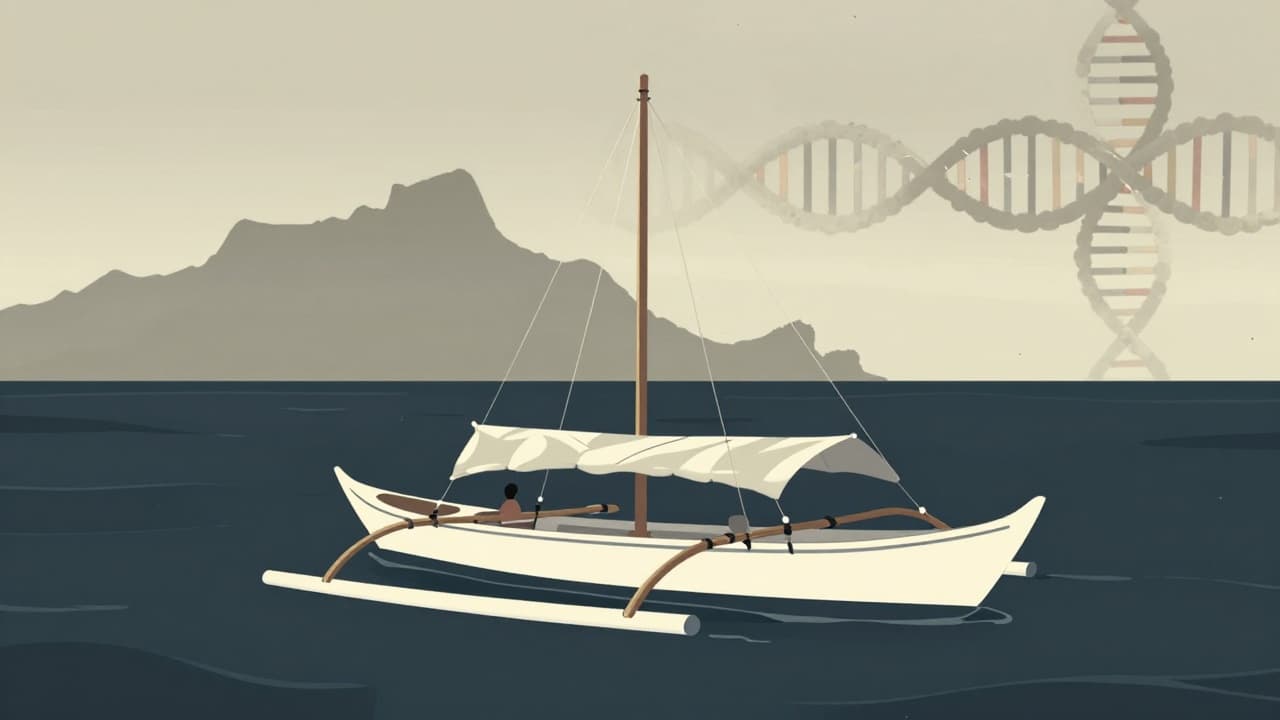
Previous research by the same scientific team had already identified the main directions of Polynesian migration. People spread from Samoa to Fiji and Tonga, then to the Cook Islands and the Society Islands, which include Tahiti, and finally reached Rapa Nui around 1210. New analysis of the genomes of Tahitian inhabitants showed that the island was settled approximately 34 generations ago, or around 1070, by a group of roughly 800 people of reproductive age, a estimate that does not include children or older residents who may have travelled with them. The settlement of remote Pacific islands took place in relatively small groups, and travellers used traditional double-hulled vessels that could carry several dozen people. Each new voyage left a mark on the genetic structure of their descendants.
Travel in small groups led to a phenomenon geneticists call the founder effect. When a new community is established by a small number of people, their descendants inherit only a portion of the genetic diversity of the population from which they originated, and a reduction in genetic diversity can increase the frequency of certain harmful mutations. Some populations, such as the Amish and the Finns, have undergone one or two genetic bottlenecks, and the ancestors of today’s Hawaiian inhabitants may have experienced several genetic bottlenecks during the settlement of the islands.
Scientists identified three genetic variants associated with rare hereditary diseases. These are autosomal recessive conditions, in which a person must inherit two altered copies of a specific gene, one from each parent, for the disease to develop. One of the identified variants is located in the ADAMTSL4 gene, which is involved in the construction and maintenance of body tissues, and two faulty copies of this gene can cause lens dislocation, a condition that can seriously affect vision. A second variant is linked to the PDE6B gene, which is important for normal visual function, and changes in this gene can cause a gradual weakening of sight. Mutations in the FAN1 gene, which is involved in repairing damaged DNA, can lead to kidney failure. All three identified variants are very rare in other populations, and the FAN1 gene variant was not found in any of the more than 800,000 individuals whose genetic data are included in the international gnomAD database.
Scientists believe the results could help in better understanding health risks in populations with different genetic origins. Such insights are important for developing guidelines for genetic testing and the timely detection of rare hereditary diseases, and the research could be particularly useful for indigenous Hawaiian communities, whose genetic characteristics have been insufficiently studied until now. A better understanding of these variants could help doctors recognise certain health risks. However, Ioannidis stated: "We do not have recommendations for genetic testing, and insurance does not cover the costs because these are conditions we do not know about at all." He also warned about the lack of data on rare hereditary diseases in this population and emphasised that the scientific community must pay more attention to the genetic diversity of Hawaii’s inhabitants.