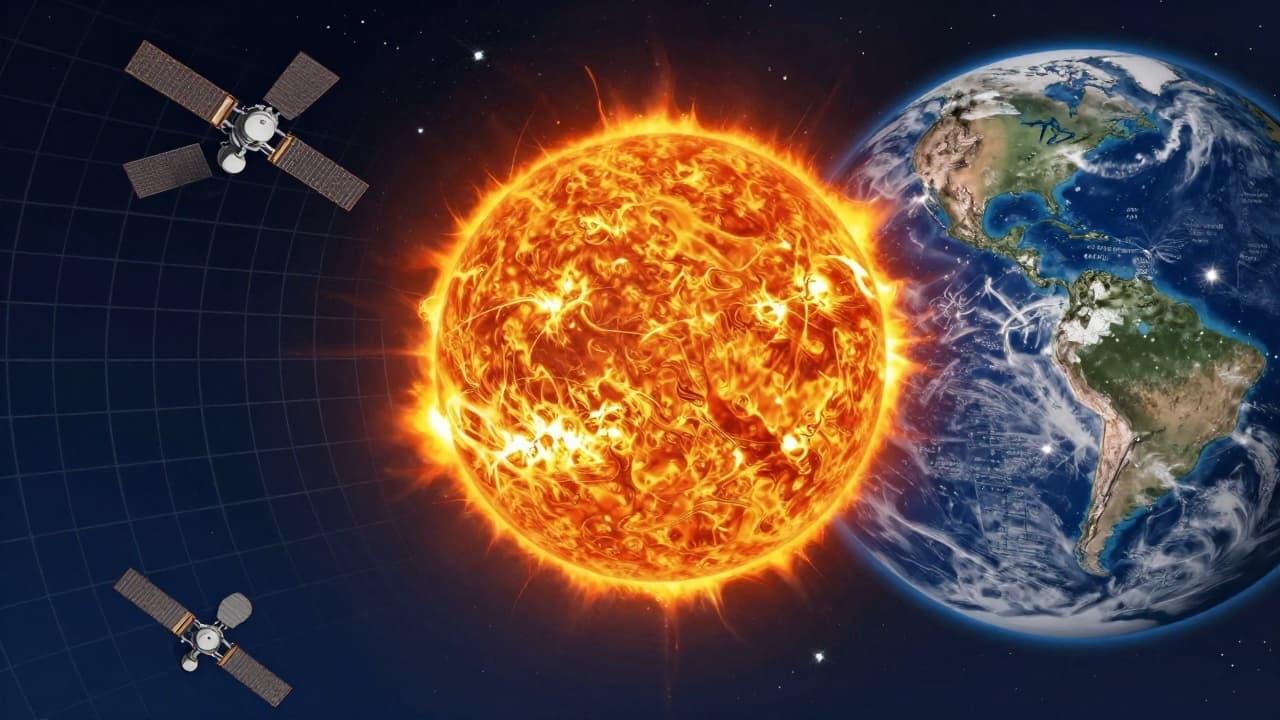
The Sun has the potential for catastrophic superflares, a new study published in the Philosophical Transactions of the Royal Society A warns. A superflare directed at Earth could lead to the collapse of entire power grids, the destruction of satellites, global disruption of radio communications, and a chain reaction of infrastructure failure.
Compared to other stars of similar size, temperature, and variability, the Sun is unusually quiet. Research indicates that stars similar to the Sun produce superflares approximately once a century. Superflares are extreme solar flares, more powerful than a trillion hydrogen bombs. Scientists have not yet recorded superflares on the Sun, but traces of powerful bursts of high-energy particles from Earth's past have been found, such as elevated levels of radioactive isotopes in tree rings, ice cores, and meteorites. It is not clear if these particle bursts were indeed caused by superflares. A superflare directed at Earth could cause damage worth a trillion dollars.
In a new study, researchers applied a different approach. They analysed data from NASA's Solar Dynamics Observatory to estimate the maximum power of a solar flare. They reviewed observations collected between 2010 and 2016, isolating the 300 most powerful flares recorded in that period. The team compared the energy released by each flare with the size of the active region from which it originated. Active regions are parts of the Sun's surface associated with sunspots, where the magnetic field is particularly strong and structurally complex. When the magnetic field tangles, it snaps like a rubber band, releasing a burst of energy known as a solar flare.
They identified a statistical correlation between the energy released and the size of the active region, which should hold true for more powerful events. They analysed the largest sunspots ever recorded on the Sun's surface. Based on their size, they estimated the size of the corresponding active regions, and then the maximum power of the flare that could occur in those regions. The analysis showed that the largest historically recorded sunspot groups could have produced superflares.
Humanity has been studying the Sun for only a tiny fraction of its lifespan. Previous research suggests that stars similar to the Sun produce superflares approximately once every 100 years. This is a statistical average derived from data on thousands of stars, not a fixed schedule. It is possible that the Sun has produced superflares in the past, but this happened so long ago that all evidence has either disappeared or cannot be confidently linked to a superflare.
The largest flare ever documented by modern instruments occurred in the period from late October to early November 2003. This flare did not reach the level of a superflare. The resulting solar storms affected more than half of all spacecraft in Earth orbit. The solar storms forced several missions in deep space to switch to safe mode. The storms forced astronauts on the International Space Station to seek shelter from radiation.