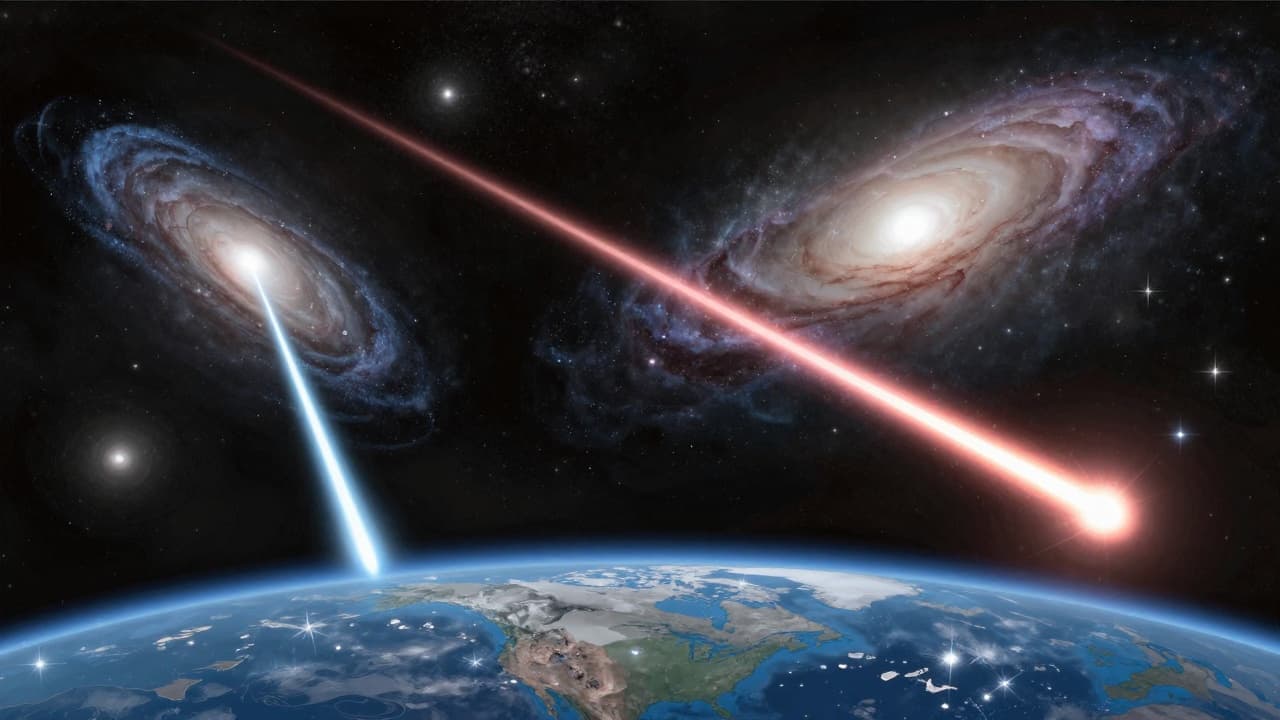
Astronomers have recorded two completely distinct gamma-ray bursts from the same region of space, separated by only four minutes. This unique event, designated GRB 160425A, exhibits characteristics of both short and long bursts.
Gamma-ray bursts, known by the acronym GRB, are classified as either short or long. Short bursts last less than two seconds and are typically produced by the merger of neutron stars or other extremely dense celestial bodies, such as black holes. Long bursts last more than two seconds and most commonly occur when the core of a massive star collapses at the end of its life.
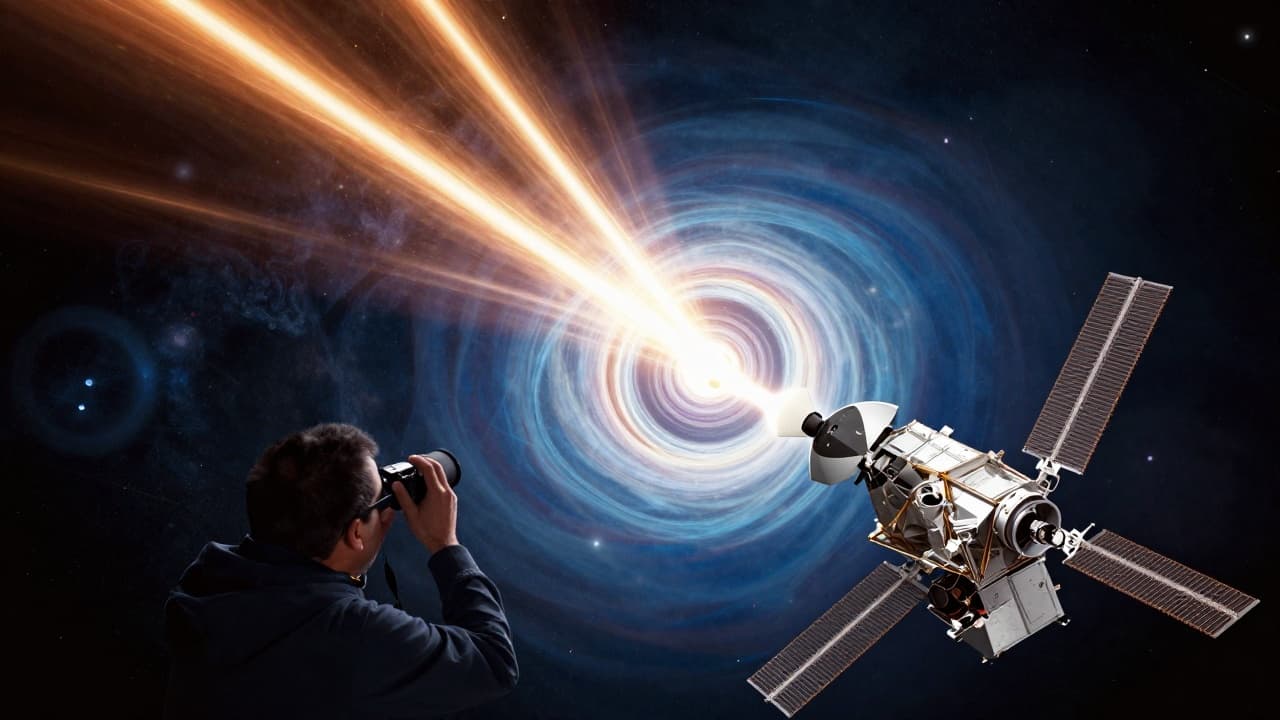
The unusual signal was detected on 25 April 2016 by the Neil Gehrels Swift space observatory. Scientists determined that it consisted of two distinct gamma-ray bursts, separated by a period without such radiation. The first burst, designated G1, lasted only 1.7 seconds, and its properties correspond to short bursts associated with the merger of extremely dense celestial bodies. Approximately four minutes later, a second burst, G2, occurred, lasting 51.2 seconds and exhibiting characteristics of long bursts, which are linked to the collapse of massive stars and their explosions.
The source is located in a very distant galaxy, and the light took approximately 5.5 billion years to reach Earth. The event occurred almost a billion years before the formation of the Solar System, with the radiation only reaching instruments in 2016. Scientists consider it extremely unlikely that two completely unrelated explosions would coincidentally produce signals from almost the same direction in such a short interval, and therefore hypothesise that both bursts share a common origin.
Astrophysicist Bing Zhang from the University of Hong Kong, one of the authors of the research published in the journal Nature Astronomy, stated that this is currently the only recorded event with such an unusual property. According to his explanation, the total energy emitted by the Sun over its entire lifetime is insufficient to explain the power of the second burst if the radiation is assumed to spread equally in all directions. Gamma-ray bursts typically release energy in narrow beams.
The event differs from previously recorded bursts in three key respects: it involves two clearly separated explosions, with a multi-minute pause between them, and each has the properties of a different type of gamma-ray burst. Researchers considered five possible explanations. The first is that they were two unrelated explosions in different galaxies that happened to be directed towards Earth within a few minutes of each other, with the probability of such a coincidence estimated at approximately two in a trillion. The second possibility is that two unrelated explosions occurred in the same galaxy, but at different locations, which scientists estimate to be even less likely.
The third scenario assumes it is a rare type of short burst that produces additional, weaker radiation after the initial explosion, but in this case, the second burst was too powerful, and the gap between the signals was too long. The fourth possibility is that the first, short burst was merely a precursor to the main explosion of a massive star, but scientists believe such an initial flash should have been significantly weaker than what was recorded. The fifth explanation assumes that both bursts originated in the same complex system involving multiple celestial bodies. Researchers currently do not know what kind of system could produce such an event, nor what physical mechanism could link processes otherwise considered separate, and Zhang admitted that they have exhausted the possibilities.