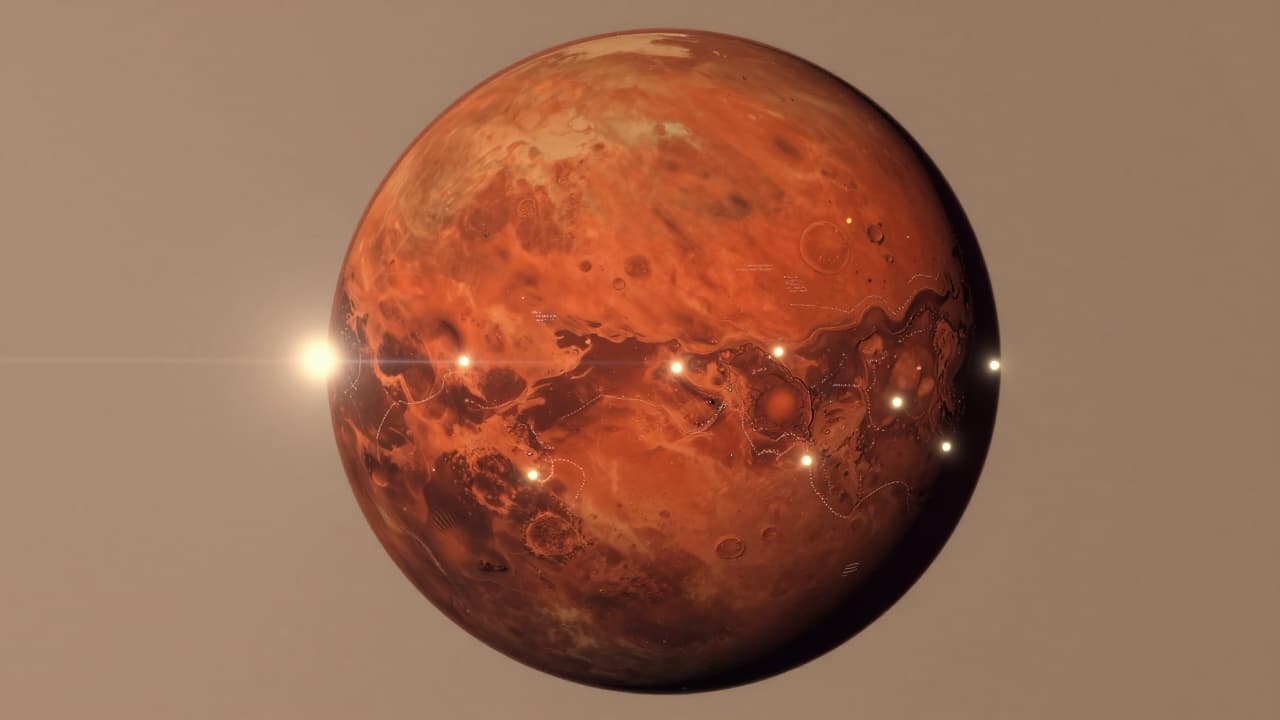
Scientists have produced a global map of Mars identifying 13 locations whose mineral composition and chemical characteristics match those of meteorite Teghaza 001, one of the oldest Martian meteorites ever found on Earth.
Teghaza 001 contains traces linking it to the highlands in the southern hemisphere of Mars. These traces allowed scientists to narrow the area of interest and compare it with a global map of the red planet, on which 13 matching locations were highlighted.
Nevertheless, scientists can never know with certainty exactly where a Martian meteorite originated. Each sample found on Earth is the result of material being randomly ejected from Mars, so the original location can only be inferred based on composition and comparison with orbital data.
A fragment of meteorite Teghaza 001 was used to determine the age of the rock. Analysis of this sample enabled the meteorite to be placed among the oldest known Martian samples on Earth.
In the analysis, scientists were aided by reflected light images, which serve as a sort of roadmap and help them locate minerals of interest for further analysis using various instruments. The image labelled Figure A shows the same shot with additional information.
The results are based on data published by NASA.