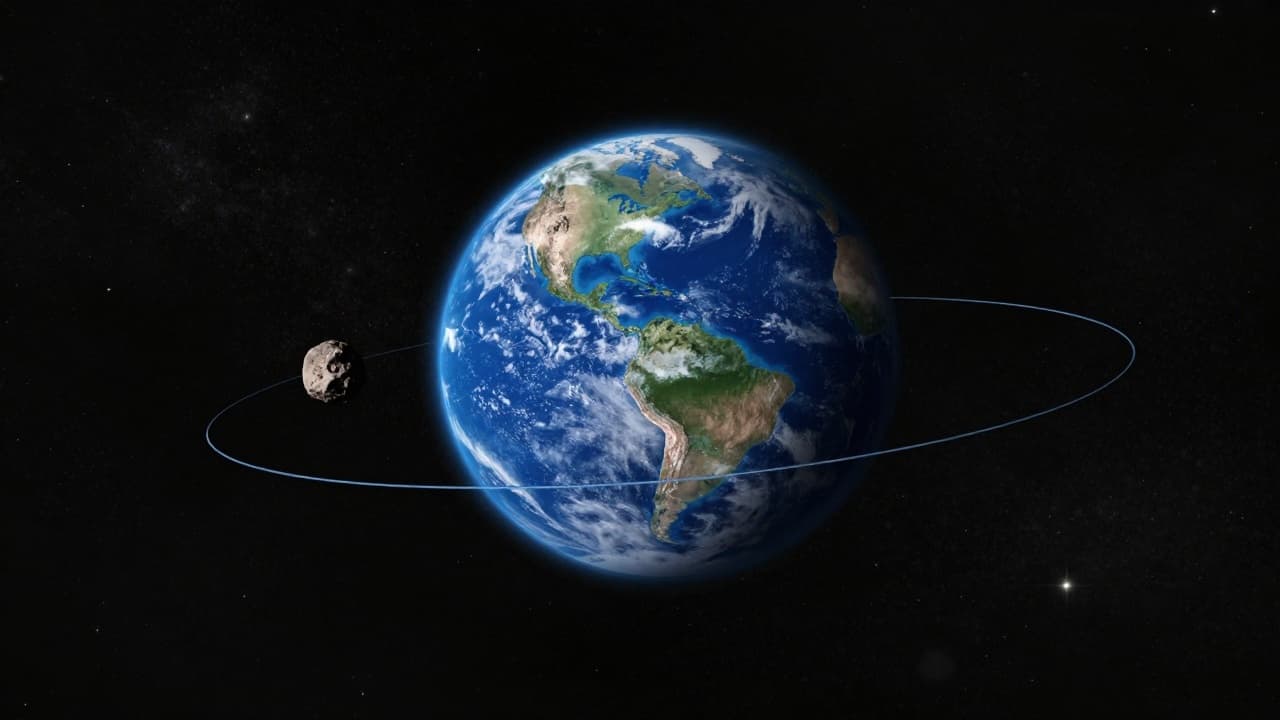
Astronomers have confirmed that the asteroid named 2026 QQ8 has become Earth's temporary "mini-moon". The object, which is just two metres in diameter, was captured by Earth's gravity in April and will remain in orbit until December, after which it will continue its journey around the Sun. The asteroid poses no danger to Earth.
Astronomers first spotted 2026 QQ8 in August, and it took them several weeks to confirm that it was a natural object rather than an old satellite or space debris. The Minor Planet Center of the International Astronomical Union officially assigned the designation 2026 QQ8 at the end of October. The term "mini-moon" is not an official astronomical term — scientists use it for small natural objects temporarily captured by Earth's gravity.
Such objects are not rare. Asteroid 2006 RH120 spent approximately a year in Earth's orbit, while object 2020 CD3 orbited Earth for nearly three years before returning to interplanetary space. "On average, there is probably always one in our vicinity," said Matthew Payne, director of the Minor Planet Center. "They stay for a few weeks or months. Sometimes there are none, and sometimes there are several at once."
Most mini-moons are only a few metres or less in diameter, reflect very little sunlight and are often located at great distances from Earth. "Most of them are truly tiny. They are often too far away, and from our perspective they move very quickly, making them difficult to record with current observation systems," Payne explained.
Nevertheless, 2026 QQ8 does not pose a threat. Its trajectory is known, and there are currently no signs that it could hit Earth. Payne explains that an object about two metres in diameter would most likely break apart during its passage through the atmosphere. "At best, we would see a bright meteor in the sky and perhaps hear a mild crack," he said.
The asteroid was discovered in August by Hungarian astronomer Krisztián Sárneczky, who works at the Konkoly Observatory and coordinates research at that institution. The object was initially given the temporary designation Sar2901. "I was looking for asteroids near Earth, which I do every clear night since 2020," Sárneczky wrote. "At the moment of discovery, it looked like almost 400 other asteroids I had found. Its peculiarity only became clear later, after precise orbital calculations."
After the discovery, scientists were unsure whether it was a natural rock or an object left in space by humans. For weeks, they monitored how solar radiation affected its movement and concluded based on that data that it was a natural object, not a remnant of a satellite or rocket. Observations involved scientists using the Lowell Discovery Telescope in Arizona and the University of Hawaii telescope on Mauna Kea.
The exact origin of asteroid 2026 QQ8 is not yet known. Payne explains that many small asteroids originate from the asteroid belt between Mars and Jupiter. "If one of those objects approaches Earth at a speed that is not too high, a gentle encounter can occur," he said. "The object moves alongside Earth, slowly approaches it, and then increasingly feels its gravity, as well as the Moon's gravity. This can slightly deflect it from its path and put it into orbit around Earth."
Astronomers have so far identified approximately 40,000 near-Earth objects, while a total of approximately 1.5 million small bodies in the Solar System are known. The Vera C. Rubin Observatory in Chile, equipped with the largest digital camera in the world, is expected to play a particularly important role in future discoveries. During its ten-year sky survey, LSST will systematically search for asteroids, comets and other space objects. "When LSST begins operating at full capacity, we expect a huge number of new discoveries," Payne said.