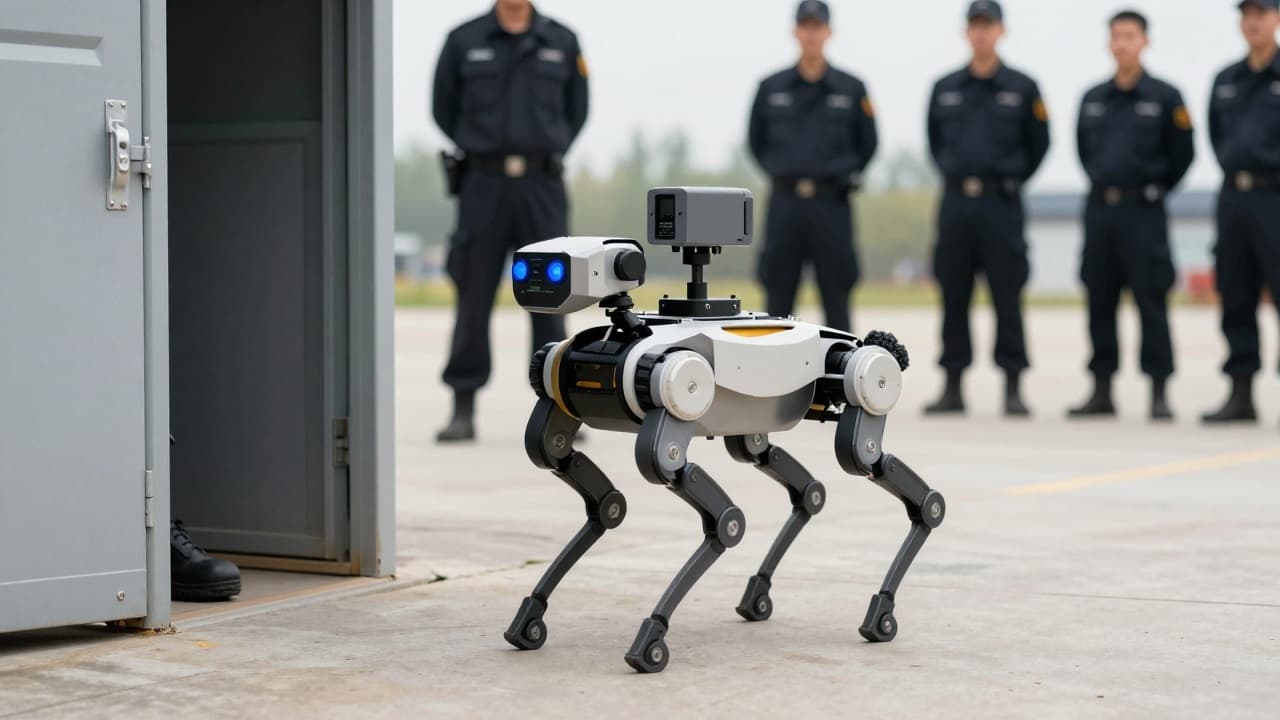
The Serbian military displayed armed quadruped robots on a large scale, which resemble the D1 Max Pro model, an industrial robot by the company AgiBot. AgiBot is a partner in the factory in Šabac, but it is not known whether the robots displayed at the exercise were assembled in Serbia. The Serbian military did not respond to the request from Radio Slobodna Europa regarding the place of production of the robotic dogs.
The 'Viktor 2026' exercise was held in south-west Serbia, with quadrupeds armed with 'Osa' anti-tank missiles of Yugoslav design, automatic rifles and 40-millimetre grenade launchers. The footage shows robots firing automatic weapons and entering a mock-up building, with soldiers following. The factory in Šabac plans an annual production of 3,000 humanoid and quadruped robots.
The footage from the military exercise has raised concerns about the development of 'robot killer' armies in the Balkans, but analysts consider such a scenario unlikely in the near future. The Ukrainian military released footage in August 2024 of soldiers using robotic dogs, but in the two years since, these robots have rarely been seen on the battlefield. In the same period, units on the front line have increasingly adopted wheeled ground drones.
A representative of the Ukrainian initiative Brave1 told RSE that wheeled drones 'are a better choice for certain missions due to their payload, durability and ability to be used in long-range operations'. Brave1 did not directly answer the question of whether quadruped robots were being withdrawn from use in Ukraine, but noted that 'platforms with legs can have advantages in difficult terrain or when overcoming obstacles in operations'. The Ukrainian ground drone 'Spider' on wheels weighs 50 kilograms, but can carry a load of 100 kilograms, while a quadruped robot of the same weight can carry only 10 kilograms. Belgrade claims that its 'robotic dog' has a maximum payload of 50 kilograms.
Serbia has presented the technology of armed quadrupeds at a time when Belgrade is increasingly incorporating advanced systems into its military arsenal, including missile systems and drones. Almost 60 per cent of Serbia's arms imports in the period from 2020 to 2024 came from China. The use of robots on 13 September followed the promise by President Aleksandar Vučić on 29 August that armed robots of Chinese design would appear in the military 'within 15 days' of the opening of the factory in Šabac.
Jared Keller, a military technology expert, told RSE that Serbia 'is likely to face the same problems as other militaries that have begun to question the introduction of robotic dogs'. He added that quadruped robots, compared to other unmanned platforms, still require significant development to address issues of reliability and range. Each quadruped requires about 12 separate motors and a range of sensors, and advanced models cost tens of thousands of dollars and would be easy targets for cheap FPV drones.
The European Union and the United States have signalled their unease at the 'iron friendship' between Beijing and Belgrade. A spokesperson for the US State Department told the Balkan service of RSE that Serbia's 'future economic opportunities will largely depend on the investments, political decisions and partnerships it chooses today'. He called on Belgrade to choose 'reliable sources and suppliers of artificial intelligence technology' and 'partners in trust such as the United States'.
Keller believes that the public display of armed quadrupeds by Serbia is more a matter of geopolitical image than actual combat strategy. 'Leaders of mid-sized powers often showcase advanced weapons to send a message of technological strength, even when these systems are not supported by a clear tactical doctrine that would form the basis for real operations,' he concluded.